Sakariba (Amusement Districts) and Shopping Areas around Railway Stations as Japanese-style Public Spaces
Journal title STORIA URBANA
Author/s Hidenobu Jinnai
Publishing Year 2026 Issue 2025/181
Language English Pages 29 P. 156-184 File size 2967 KB
DOI 10.3280/SU2025-181009
DOI is like a bar code for intellectual property: to have more infomation
click here
Below, you can see the article first page
If you want to buy this article in PDF format, you can do it, following the instructions to buy download credits
FrancoAngeli is member of Publishers International Linking Association, Inc (PILA), a not-for-profit association which run the CrossRef service enabling links to and from online scholarly content.
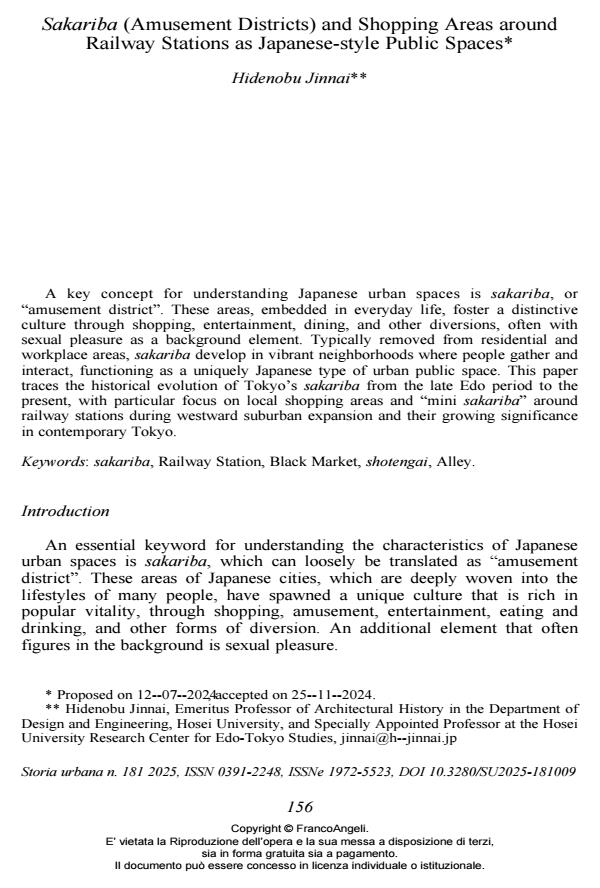
A key concept for understanding Japanese urban spaces is sakariba, or “amusement district”. These areas, embedded in everyday life, foster a distinctive culture through shopping, entertainment, dining, and other diversions, often with sexual pleasure as a background element. Typically removed from residential and workplace areas, sakariba develop in vibrant neighborhoods where people gather and interact, functioning as a uniquely Japanese type of urban public space. This paper traces the historical evolution of Tokyo’s sakariba from the late Edo period to the present, with particular focus on local shopping areas and “mini sakariba” around railway stations during westward suburban expansion and their growing significance in contemporary Tokyo.
Keywords: sakariba, Railway Station, Black Market, shotengai, Alley.
Hidenobu Jinnai, Sakariba (Amusement Districts) and Shopping Areas around Railway Stations as Japanese-style Public Spaces in "STORIA URBANA " 181/2025, pp 156-184, DOI: 10.3280/SU2025-181009