Persecution of foreigners and economic nationalism. The confiscation of enemy property in Western Europe after the First World War
Journal title SOCIETÀ E STORIA
Author/s Cristiano La Lumia
Publishing Year 2026 Issue 2026/191
Language Italian Pages 28 P. 94-121 File size 241 KB
DOI 10.3280/SS2026-191006
DOI is like a bar code for intellectual property: to have more infomation
click here
Below, you can see the article first page
If you want to buy this article in PDF format, you can do it, following the instructions to buy download credits
FrancoAngeli is member of Publishers International Linking Association, Inc (PILA), a not-for-profit association which run the CrossRef service enabling links to and from online scholarly content.
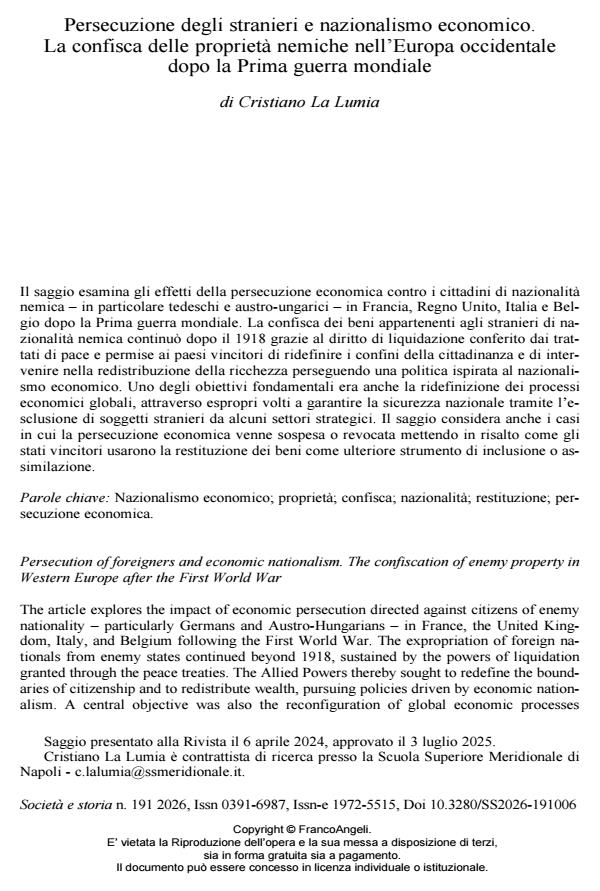
The article explores the impact of economic persecution directed against citizens of enemy nationality – particularly Germans and AustroHungarians – in France, the United Kingdom, Italy, and Belgium following the First World War. The expropriation of foreign nationals from enemy states continued beyond 1918, sustained by the powers of liquidation granted through the peace treaties. The Allied Powers thereby sought to redefine the boundaries of citizenship and to redistribute wealth, pursuing policies driven by economic nationalism. A central objective was also the reconfiguration of global economic processes through confiscations designed to safeguard national security by excluding foreign actors from strategic economic and financial sectors. The essay further examines instances in which economic persecution was suspended or reversed, demonstrating how the victorious states at times used restitution as an instrument of inclusion or assimilation.
Keywords: economic nationalism; property; confiscation; nationality; restitution; economic persecution.
- Aalders G., Wiebes C. (1996), The Art of Cloaking Ownership: The Secret Collaboration and Protection of the German War Industry by the Neutrals: The Case of Sweden, Amsterdam, Amsterdam University Press. Auslandswarte (1922), 3, n. 17, p. 77.
- Baldwin R.E., Martin P. (1999), Two Waves of Globalisation: Superficial Similarities, Fundamental Differences, in «NBER Working Papers», url: https://ideas.repec.org//p/nbr/nberwo/6904.html (visitato il 19 luglio 2023).
- Bariéty J. (1977), Les relations francoallemandes après la PremièreGuerre mondiale: 10 novembre 191810 janvier 1925 : de l’exécution à la négociation, Paris, Pedone.
- Barone G. (1986), Mezzogiorno e modernizzazione. Elettricità, irrigazione e bonifica nell‘Italia contemporanea, Torino, Einaudi.
- Bauerkämper A. (2021), Sicherheit und Humanität im Ersten und Zweiten Weltkrieg: Der Umgang mit zivilen Feindstaatenangehörigen im Ausnahmezustand, Oldenbourg, De Gruyter.
- Bazzi A. (2019), La luce è là, Milano, Mondadori.
- Becker B. (2021), France and Germany in the South China Sea, c. 18401930: Maritime Competition and Imperial Power, Cham, Switzerland, Palgrave Macmillan.
- Beloch J. (1926), Karl Julius Beloch, in Die Geschichtswissenschaft der Gegenwart in Selbstdarstellungen, a cura di S. Steinberg, Leipzig, Meiner, pp. 127.
- Benedetti N. (1923), Alla Commissione speciale per i beni dei cittadini degli Stati già nemici istituita coll’art. 1 del R. Decretolegge 10 maggio 1923, n. 1118 : ricorso dei conti Alfonso, Edgardo ed Alvino Henckel von Donnersmark, rappresentati dall’ing. Waldemaro Schornstein in Cave del Predil (Raibl), rispettivamente dagli avvocati dott. Nicolò Benedetti e dott. Bruno Negri in Trieste, appar mandato in atti contro il decreto del Ministero per l’industria e il commercio, notificato il 7 maggio 1923, s.l.
- Berghahn V.R. (2015), American Big Business in Britain and Germany: A Comparative History of Two «Special Relationships» in the 20th Century, Princeton and Oxford, Princeton University Press.
- Berkes A. (2020), The League of Nations and the Optants’ Dispute in the Hungarian Borderlands. Romania, Yugoslavia, and Czechoslovakia in Remaking Central Europe: The League of Nations and the Former Habsburg Lands, a cura di P. Becker,
- N. Wheatley, Oxford: Oxford University Press, pp. 283314.
- Bitter F.W., Zelle A. (1933), No More War on Foreign Investments. A Kellogg Pact for Private Property, Philadelphia, Dorrance & Co.
- Borrelli A. (2015), Benedetto Croce e la Stazione Zoologica Anton Dohrn Benedetto Croce and the Stazione Zoologica Anton Dohrn, in «History and Philosophy of the Life Sciences», 36, pp. 425439.
- Bresciani M., Richter K. (2023), Trieste and Danzig after the Great War: Imperial Collapse, Narratives of Loss, Reconfigured Globalization, in «The Journal of Modern History», 95, pp. 557595.
- Caglioti D.L. (2021), War and Citizenship: Enemy Aliens and National Belonging from the French Revolution to the First World War, Cambridge, Cambridge University Press.
- Caglioti D.L. (2023), Stranieri nemici. Nazionalismo e politiche di sicurezza in Italia durante la Prima guerra mondiale, Roma, Viella.
- Conrad S. (2010), Globalisation and the nation in imperial Germany, Cambridge, Cambridge University Press.
- Daudet L. (1913), L’avantguerre: études et documents sur l’espionnage juifallemand en France depuis l’affaire Dreyfus, Paris, Nouvelle librairie nationale.
- Daudet L. (18 novembre 1914), La chasse aux maisons allemandes, in «L’Action Française».
- Daudet L. (20 settembre 1917), Le séquestre du nommé de Poorter, in «L’Action Française».
- Dehne P. (2020), After the Great War: Economic Warfare and the Promise of Peace in Paris 1919, London and New York, Bloomsbury Academic.
- Dungy M.L. (2021), Writing Multilateral Trade Rules in the League of Nations, in «Contemporary European History», 30, pp. 6075.
- Dungy M.L. (2023), Order and Rivalry: Rewriting the Rules of International Trade after the First World War, Cambridge, Cambridge University Press.
- Esch A. (1992), Die Lage der Deutschen Wissenschaftlichen Institute in Italien nach dem Ersten Weltkrieg und die Kontroverse über ihre Organisation: Paul Kehrs “römische Mission” 1919/1920, in «Quellen und Forschungen aus italienischen Archiven und Bibliotheken», 72, pp. 314373.
- Fink C. (2006), Defending the Rights of Others: The Great Powers, the Jews, and International Minority Protection, 18781938, Cambridge, Cambridge University Press.
- Fischer C. (2005), Scoundrels without a Fatherland? Heavy Industry and Transnationalism in PostFirst World War Germany, in «Contemporary European History», 14, pp. 441464.
- Forcade O. (2011), L’Action française contre l’espionnage allemand: une rhétorique de la trahison devant l’opinion, in «Le Temps des médias», 16, pp. 918.
- Gentile C. (2019), La nazionalizzazione di Palazzo Venezia del 1916: cronaca di un’acquisizione e della reazione della Santa Sede, Roma, Aracne editrice, 2019.
- Gerwarth R. (2016), The Vanquished: Why the First World War Failed to End, London, Allen.
- Gosewinkel D., Meyer S. (2009), Citizenship, property rights and dispossession in postwar Poland (1918 and 1945), in «European Review of History: Revue européenne d’histoire», 16, pp. 575595.
- Gosewinkel D., Rezník M., Holec R. (2018), Eigentumsregime und Eigentumskonflikte im 20. Jahrhundert: Deutschland und die Tschechoslowakei im internationalen Kontext, Essen, Klartext Verlag.
- Hayes P. (1987), Industry and Ideology: I. G. Farben in the Nazi Era, Cambridge, Cambridge University Press.
- Hertner P. (1981), Il capitale straniero in Italia (18831914), in «Studi Storici», 22, pp. 767795.
- Hesse J.O., Poletto E. (2021), L’interconnessione globale dell’economia di Weimar. Deglobalizzazione o mutamento della globalizzazione economica?, in La Repubblica di Weimar: democrazia e modernità, a cura di C. Cornelissen, G. D’Ottavio, Bologna, Il Mulino, pp. 119142.
- Hoffman R.J.S. (1933), Great Britain and the German Trade Rivalry: 18751914, Philadelphia, University of Pennsylvania Press.
- Horne J. (2009), Demobilizing the Mind: France and the Legacy of the Great War, 19191939, in «France History & Civilization», 2, pp. 101119.
- Howell L.D., Chaddick B. (1994), Models of Political Risk for Foreign Investment and Trade: An Assessment of Three Approaches, in «The Columbia Journal of World Business», 29, pp. 7091.
- Kauth J.T. (2018), Fremdenrecht und Völkerbund. Das Scheitern der International Conference on the Treatment of Foreigners 1929, in «Archiv des Völkerrechts», 56, pp. 202228.
- Krüger H., Loewenfeld W., Loewenfeld E., Magnus J., Wolff E., (a cura di) (1930). Die Beschlagnahme, Liquidation und Freigabe deutschen Vermögens im Auslande unter Benutzung amtlichen Materials, Berlin, Heymann.
- Krüger P. (1985), Die Außenpolitik der Republik von Weimar, Darmstadt, Wissenschaftliche Buchgesellschaft.
- La Lumia C. (2021), From protection to liquidation. The case of the Milanese jurists and enemy alien property (1915–1920), in «European Review of History: Revue européenne d’histoire», 28, p. 199219.
- La Lumia C. (2022a), Nemici di guerra in tempo di pace. Le proprietà tedesche nelle nuove province italiane dopo la grande guerra (19181927), in «Studi storici», 63, pp. 643674.
- La Lumia C. (2022b), The Ambiguities of Being Stateless. Property Rights, Statelessness and Enemy Aliens in the UK, France, Belgium and Germany (1914–1930), in «German History», 40, pp. 538562.
- La Stampa, “Il retroscena del preteso documento tedesco”, 3 settembre 1921.
- Lenz F., Schmidt E. (1924), Die deutschen Vergeltungsmaßnahmen im Wirtschaftskrieg nebst einer Gesamtbilanz des Wirtschaftskrieges, 19141918, Bonn Leipzig, K. Schroeder.
- Le Progrès de Sétif, “L’histore de l’hôtel Astoria”, 3 maggio 1924.
- L’Idea Nazionale, “Il piano germanico per la conquista economica dell’Italia”, 28 agosto 1921.
- Lohr E. (2003), Nationalizing the Russian Empire: The Campaign against Enemy Aliens during World War I, Cambridge (MA), Harvard University Press.
- Lubinski C. (2022), Navigating Nationalism in Global Enterprise: A Century of IndoGerman Business Relations, Cambridge, Cambridge University Press.
- Lussana C., Capelli S. (2018), La Grande Guerra dalle carte degli archivi industriali: il caso Dalmine, in “Ora vi dico di io …”. Dalmine e la Grande Guerra, a cura di C. Pesenti, Tipografia dell’Isola, Terno d’Isola.
- Mai G. (2014), Die MarokkoDeutschen 18731918, Göttingen, Vandenhoeck & Ruprecht.
- Maier C.S. (1988), La ricostruzione dell’Europa borghese: Francia, Germania e Italia nel decennio successivo alla Prima guerra mondiale, Bologna, Il Mulino.
- Manz S., Panayi P. (2020), Enemies in the Empire: Civilian Internment in the British Empire during the First World War, Oxford, Oxford University Press.
- Miller M.B. (2012), Europe and the Maritime World: A TwentiethCentury History, Cambridge, Cambridge University Press.
- Moazzin G. (2015), From Globalization to Liquidation: The DeutschAsiatische Bank and the First World War in China, in «CrossCurrents: East Asian History and Culture Review», 16, pp. 5276.
- Mohwinckel T. (1932), 60 Jahre! Deutscher Hilfsverein Mailand. Bericht d. Verwaltungsrats über d. Tätigkeit d. Vereines, mit geschichtl. Notizen über d. Deutsche Kolonie Mailand i. d.J. 18711931. (Nachw.: Th[eodor] Mohwinckel), Mailand.
- Mulder N. (2020a), ‘A Retrograde Tendency’: The Expropriation of German Property in the Versailles Treaty, in «Journal of the History of International Law / Revue d’histoire du droit international», 22, pp. 129.
- Mulder N. (2020b), The Trading with the Enemy Acts in the Age of Expropriation, 191449, in «Journal of Global History», 15, pp. 8199
Cristiano La Lumia, Persecuzione degli stranieri e nazionalismo economico. La confisca delle proprietà nemiche nell’Europa occidentale dopo la Prima guerra mondiale in "SOCIETÀ E STORIA " 191/2026, pp 94-121, DOI: 10.3280/SS2026-191006