A class of productive processes in the theory of the growth of the firm of Edith T. Penrose

Journal title HISTORY OF ECONOMIC THOUGHT AND POLICY
Author/s Gaetano Martino
Online First 5/8/2026 Issue 2026/Online First
Language English Pages 29 P. 1-29 File size 260 KB
DOI 10.3280/hetp2026-22571
DOI is like a bar code for intellectual property: to have more infomation click here

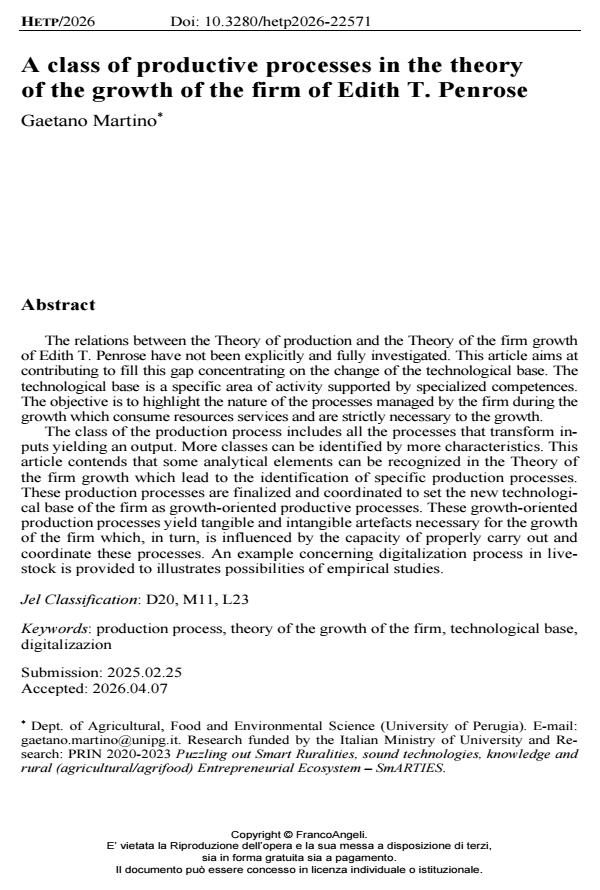
Below, you can see the article first page

If you want to buy this article in PDF format, you can do it, following the instructions to buy download credits
Article preview

FrancoAngeli is member of Publishers International Linking Association, Inc (PILA), a not-for-profit association which run the CrossRef service enabling links to and from online scholarly content.

The relations between the Theory of production and the Theory of the firm growth of Edith T. Penrose have not been explicitly and fully investigated. This article aims at contributing to fill this gap concentrating on the change of the technological base. The technological base is a specific area of activity supported by specialized competences. The objective is to highlight the nature of the processes managed by the firm during the growth which consume resources services and are strictly necessary to the growth. The class of the production process includes all the processes that transform in-puts yielding an output. More classes can be identified by more characteristics. This article contends that some analytical elements can be recognized in the Theory of the firm growth which lead to the identification of specific production processes. These production processes are finalized and coordinated to set the new technologi-cal base of the firm as growth-oriented productive processes. These growth-oriented production processes yield tangible and intangible artefacts necessary for the growth of the firm which, in turn, is influenced by the capacity of properly carry out and coordinate these processes. An example concerning digitalization process in live-stock is provided to illustrates possibilities of empirical studies.

Keywords: production process, theory of the growth of the firm, technological base, digitalizazion

Jel codes: D20, M11, L23

  1. Geels F.W. 2002. Technological transitions as evolutionary reconfiguration pro-cesses. Research Policy, 31(8-9), 1257-1274, DOI: 10.1016/S0048-7333(02)00062-8
  2. Gerring J. 2006. Case Study Research. Cambridge University Press. Gerring J. 2011. Social Science Methodology. Cambridge University Press.
  3. Gupta S., Starr M.K. 2014. Production and Operations Management Systems. CRC Press, Boca Raton.
  4. Halachmi I., Dzidic A., Metz J.H., Speelman L., Dijkhuizen A.A., Kleijnen J.P. 2001. Validation of simulation model for robotic milking barn design. European Journal of Operational Research, 134(3), 677-688, DOI: 10.1016/S0377-2217(00)00261-1
  5. Han N., Tong T.W. 2024. Knowledge resources in Penrose’s theory. Strategic Man-agement Review, 5(1-2), 125-147, DOI: 10.1561/111.00000063
  6. Higgins V., Bryant M., Howell A., Battersby J. 2017. Ordering adoption of precision agriculture technologies. Journal of Rural Studies, 55, 193-202,
  7. Hodgson G.M. 2015. Conceptualizing Capitalism. University of Chicago Press. Hodgson G.M. 2008. The concept of a routine. In Becker M. (ed). Handbook of Organizational Routines. Edward Elgar, 15-29.
  8. Ichijo K., Nonaka I. 2006. Knowledge Creation and Management. Oxford Univer-sity Press.
  9. Kay N. 1999. Hercules and Penrose. Contributions to Political Economy, 18(1), 67-86,
  10. King A. 2017. Technology: The future of agriculture. Nature, 544, S21-S23,
  11. Kor Y.Y., Mahoney J.T., Siemsen E., Tan D. 2016. Penrose’s theory as engaged scholarship. Production and Operations Management, 25(10), 1727-1744,
  12. Kor Y.Y., Mahoney J.T. 2000. Penrose’s resource-based approach. Journal of Man-agement Studies, 37(1), 165-191, DOI: 10.1111/1467-6486.00174
  13. Lockett A., Wiklund J., Davidsson P., Girma S. 2011. Organic and acquisitive growth. Journal of Management Studies, 48(1), 48-74,
  14. Mäkitie T., Hanson J., Damman S., Wardeberg M. 2023. Digital innovation and sus-tainability transitions. Technology in Society, 73, 102255,
  15. Martin T., Gasselin P., Hostiou N., Feron G., Laurens L., Purseigle F., Ollivier G. 2022. Robots and transformations of work in farming. Agronomy for Sustainable Development, 42, 66,
  16. Mehrabi Z., McDowell M.J., Ricciardi V., et al. 2021. The global divide in data-driven farming. Nature Sustainability, 4(2), 154-160,
  17. Ménard C., Martino G. 2025. Unbundling institutions: the case for meso-institutions. Journal of Institutional Economics, 21, e31, DOI: 10.1017/S174413742400010X
  18. Miozzo M., DiVito L. 2020. Productive opportunities and science-based firm emer-gence. Small Business Economics, 54, 539-560, Change, 189, 122270,
  19. Penrose E.T. 1960. The growth of the firm: the Hercules Powder Company. Business History Review, 34(1), 1-23, DOI: 10.2307/3111575
  20. Penrose E.T. 1955. Limits to the growth and size of firms. American Economic Re-view, 45(2), 531-543.
  21. Penrose E.T. 1963. The Theory of the Growth of the Firm. Basil Blackwell, Oxford. Penrose E.T. 2008. Strategy, organization and the metamorphosis of the large firm. Organization Studies, 29(8-9), 1117-1124, DOI: 10.1177/0170840608094777
  22. Rodenburg J. 2017. Robotic milking. Journal of Dairy Science, 100(9), 7729-7738,
  23. Rossing W., Hogewerf P.H., Ipema A.H., Ketelaar-de Lauwere C.C., De Koning
  24. C.J.A.M. 1997. Robotic milking in dairy farming. Netherlands Journal of Agri-cultural Science, 45(1), 15-31,
  25. Shen T.Y. 1970. Economies of scale and the Penrose effect. Journal of Political Economy, 78(4), 702-716, DOI: 10.1086/259667
  26. Spanos Y.E., Prastacos G. 2004. Understanding organizational capabilities. Journal of Knowledge Management, 8(3), 31-43, DOI: 10.1108/13673270410541024
  27. Spring M., Araujo L. 2013. Service innovation in manufacturing supply networks. Industrial Marketing Management, 42(1), 59-70,
  28. Tan D., Mahoney J.T. 2005. Examining the Penrose effect in international business.
  29. Managerial and Decision Economics, 26(2), 113-127,
  30. Abbate S., Centobelli P., Cerchione R. 2023. The digital and sustainable transition of the agri-food sector. Technological Forecasting and Social Change, 187, 122222,
  31. Annosi M.C., Ráez R.M.O., Appio F.P., Del Giudice T. 2022. An integrative review of innovations in the agricultural sector: The roles of agency, structure, and their dynamic interplay. Technological Forecasting and Social Change, 185, 122035,
  32. Aoki M., Yoshikawa H. 2002. Demand saturation-creation and economic growth. Journal of Economic Behavior and Organization, 48(2), 127-154, DOI: 10.1016/S0167-2681(01)00201-4
  33. Araujo L., Spring M. 2006. Services, products, and the institutional structure of pro-duction. Industrial Marketing Management, 35(7), 797-805,
  34. Best M.H., Garnsey E. 1999. Edith T. Penrose, 1914-1996. The Economic Journal, 109, F187-F201, DOI: 10.1111/1468-0297.00439
  35. Bleischwitz R., Nechifor V., Winning M., Huang B., Geng Y. 2018. Extrapolation or saturation – Revisiting growth patterns, development stages and decoupling. Global Environmental Change, 48, 86-96,
  36. Busse M., Schwerdtner W., Siebert R., Doernberg A., Kuntosch A., König B., Bokelmann W. 2015. Analysis of animal monitoring technologies in Germany from an innovation system perspective. Agricultural Systems, 138, 55-65,
  37. Butler D., Holloway L., Bear C. 2012. The impact of technological change in dairy farming: robotic milking systems and the changing role of the stockperson. Jour-nal of the Royal Agricultural Society of England, 173, 1.
  38. Copi I.M., Cohen C. 1999. Introduction to Logic. Prentice Hall International, Hemel Hempstead.
  39. Demir R., Wennberg K., McKelvie A. 2017. The strategic management of high-growth firms: A review and theoretical conceptualization. Long Range Planning, 50(4), 431-456,
  40. Devir S., Hogeveen H., Hogewerf P.H., Ipema A.H., Lauwere C.K. de, Rossing W., Stefanowska J. 1996. Design and implementation of a system for automatic milk-ing and feeding. Canadian Agricultural Engineering, 38(2), 107-114.
  41. Dosi G., Malerba F., Ramello G.B., Silva F. 2006. Information, appropriability, and the generation of innovative knowledge. Industrial and Corporate Change, 15(6), 891-901,
  42. Egidi M. 1992. Organizational learning, problem solving and the division of labour. In Egidi M., Marris R. (eds.). Economics, Bounded Rationality and the Cognitive Revolution. Edward Elgar, Aldershot, 148-173.
  43. Engås K.G., Raja J.Z., Neufang I.F. 2023. Decoding technological frames in agri-culture. Technological Forecasting and Social Change, 190, 122405,
  44. Fazio G., Quèrè M. 1999. Edith T. Penrose ou la 22ième conception d’une théorie de la firme. Économie et Sociétés, Série P.E., 33, 187-205.
  45. Feldman M.S., Pentland B.T. 2003. Reconceptualizing organizational routines as a source of flexibility and change. Administrative Science Quarterly, 48, 94-118, DOI: 10.2307/3556620
  46. Finch J.H. 2000. Is post-Marshallian economics an evolutionary research tradition. European Journal of the History of Economic Thought, 3(7), 377-406, DOI: 10.1080/09672560050192116
  47. Foss N.J. 1999. Edith T. Penrose and Penrosians. Économie et Sociétés, Série P.E., 33, 143-164.
  48. Frisch R. 1964. Theory of Production. Springer, Dordrecht.
  49. Gander J.P. 1991. Managerial intensity, firm size and growth. Managerial and De-cision Economics, 12(3), 261-266,
  50. Garnsey E., Stam E., Heffernan P. 2006. New firm growth. Industry and Innovation, 13(1), 1-20, DOI: 10.1080/13662710500513367

Gaetano Martino, A class of productive processes in the theory of the growth of the firm of Edith T. Penrose in "HISTORY OF ECONOMIC THOUGHT AND POLICY" Online First/2026, pp 1-29, DOI: 10.3280/hetp2026-22571