Childhood out-of-home care in Lombardy Region
Journal title MALTRATTAMENTO E ABUSO ALL’INFANZIA
Author/s Sarah Miragoli, Vittoria Badino, Luca Villa, Laura De Rui, Luca Milani
Publishing Year 2026 Issue 2026/2
Language Italian Pages 17 P. 13-29 File size 101 KB
DOI 10.3280/MAL2026-002002
DOI is like a bar code for intellectual property: to have more infomation
click here
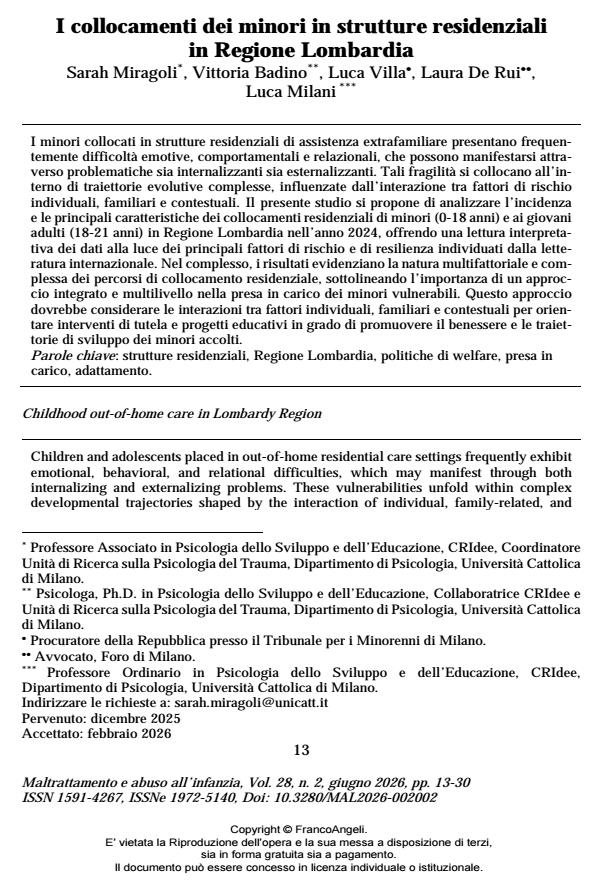
Below, you can see the article first page
If you want to buy this article in PDF format, you can do it, following the instructions to buy download credits
FrancoAngeli is member of Publishers International Linking Association, Inc (PILA), a not-for-profit association which run the CrossRef service enabling links to and from online scholarly content.
Children and adolescents placed in out-of-home residential care settings frequently exhibit emotional, behavioral, and relational difficulties, which may manifest through both internalizing and externalizing problems. These vulnerabilities unfold within complex developmental trajectories shaped by the interaction of individual, family-related, and contextual risk factors. The present study aims to analyze the incidence and main characteristics of residential placements involving minors (0–18 years) and young adults (18–21 years) in the Lombardy Region during the year 2024, providing an interpretative reading of the data in light of the main risk and resilience factors identified in the international literature. Overall, the findings highlight the multifactorial and complex nature of residential placement pathways, underscoring the importance of an integrated and multilevel approach in the care of vulnerable minors. This approach should consider the interactions between individual, familial, and contextual factors in order to guide protective interventions and educational programs capable of promoting well-being and positive developmental trajectories among children and adolescents in residential care.
Keywords: out-of-home care, Lombardy Region, welfare policies, taking charge, risk factors.
- Farmer, E. (2010). What factors relate to good placement outcomes in kinship care? British Journal of Social Work, 40(2), 426-444.
- Badino, V, Miragoli, S., & Milani, L. (2024). Minori nelle Comunità Terapeutiche di Regione Lombardia: una analisi dell'incidenza e delle caratteristiche. Maltrattamento e Abuso all’Infanzia, 26(3), 97-112. DOI: 10.3280/MAL2024-003005
- Bai, R., Collins, C., Fischer, R., Groza, V., & Yang, L. (2022). Exploring the association between housing insecurity and child welfare involvement: A systematic review. Child and Adolescent Social Work Journal, 39(2), 247-260.
- Bailey, C., Klas, A., Cox, R., Bergmeier, H., Avery, J., & Skouteris, H. (2019). Systematic review of organization-wide, trauma-informed care models in out-of-home care (OoHC) settings. Health & Social Care in the Community, 27(3), e10-e22.
- Biehal, N., Sinclair, I., & Wade, J. (2015). Reunifying abused or neglected children: Decision making and outcomes. Child Abuse & Neglect, 49, 107-118.
- Bronfenbrenner, U. (1979). The ecology of human development: Experiments by nature and design. Harvard: Harvard University Press.
- Burns, B. J., Phillips, S. D., Wagner, H. R., Barth, R. P., Kolko, D. J., Campbell, Y., & Landsverk, J. (2004). Mental health need and access to mental health services by youths involved with child welfare: A national survey. Journal of the American Academy of Child & Adolescent Psychiatry, 43(8), 960-970.
- Conn, A. M., Szilagyi, M. A., Jee, S. H., Blumkin, A. K., & Szilagyi, P. G. (2015). Mental health outcomes among child welfare investigated children: In-home versus out-of-home care. Children and Youth Services Review, 57, 106-111.
- Cox, R., Skouteris, H., Fuller-Tyszkiewicz, M., McCabe, M., Watson, B., Fredrickson, J., Jones, A. D., Omerogullari, S., Stanton, K., Bromfield, L., & Hardy, L. L. (2018). A qualitative exploration of coordinators’ and carers’ perceptions of the Healthy Eating, Active Living (HEAL) programme in residential care. Child Abuse Review, 27(2), 122-136.
- Di Blasio, P., Miragoli, S., & De Rui, L. (2023). I tempi del bambino e i tempi della giustizia: analisi dei procedimenti penali per abuso sessuale a danno di minori. Maltrattamento e abuso all’infanzia, 8(3), 37-56. DOI: 10.3280/MAL2023-003-S1004
- Esposito, T., Trocmé, N., Chabot, M., Shlonsky, A., Collin-Vézina, D., & Sinha, V. (2013). Placement of children in out-of-home care in Québec, Canada: When and for whom initial out-of-home placement is most likely to occur. Children and Youth Services Review, 35(12), 2031-2039.
- Ezekwem-Obi, A., Blythe, S., & Grace, R. (2025). “Your culture is in you”: Cultural identity and connection for children from culturally diverse backgrounds in care: A scoping review of child perspectives. Child Protection and Practice, 5, 100134.
- Farmer, E. M., Burns, B. J., Chapman, M. V., Phillips, S. D., Angold, A., & Costello, E. J. (2001). Use of mental health services by youth in contact with social sevices. Social Service Review, 75(4), 605-624. DOI: 10.1086/323165
- Farmer, E., & Wijedasa, D. (2013). The reunification of looked after children with their parents: What contributes to return stability?. British Journal of Social Work, 43(8), 1611-1629.
- Gypen, L., Vanderfaeillie, J., De Maeyer, S., Belenger, L., & Van Holen, F. (2017). Outcomes of children who grew up in foster care: Systematic review. Children and Youth Services Review, 76, 74-83.
- Hussey, D. L. (2008). Gender differences in young residential treatment children. Residential Treatment for Children & Youth, 24(1-2), 19-34. DOI: 10.1080/08865710802146671
- Hussey, D. L., & Guo, S. (2002). Profile characteristics and behavioral change trajectories of young residential children. Journal of child and Family Studies, 11(4), 401-410. DOI: 10.1023/A:1020927223517
- James, S., Roesch, S., & Zhang, J. J. (2012). Characteristics and behavioral outcomes for youth in group care and family-based care: A propensity score matching approach using national data. Journal of Emotional and Behavioral Disorders, 20(3), 144-156. DOI: 10.1177/1063426611409041
- Jones, A., & LaLiberte, T. (2017). Risk and protective factors of foster care reentry: An examination of the literature. Journal of Public Child Welfare, 11(4-5), 516-545. DOI: 10.1080/15548732.2017.1357668
- Karki, S., Ryynanen, O.-P., Salokekkila, P., & Haggman-Laitila, A. (2023). Bayesian analysis of the factors explaining the disruptive behaviour of care leavers: A retrospective document analysis. Children and Youth Services Review, 155, 107174.
- Kimberlin, S. E., Anthony, E. K., & Austin, M. J. (2009). Re-entering foster care: Trends, evidence, and implications. Children and Youth Services Review, 31(4), 471-481.
- Lee, B. R., & Thompson, R. (2009). Examining externalizing behavior trajectories of youth in group homes: Is there evidence for peer contagion?. Journal of Abnormal Child Psychology, 37(1), 31-44.
- Leloux-Opmeer, H., Kuiper, C., Swaab, H., & Scholte, E. (2016). Characteristics of children in foster care, family-style group care, and residential care: A scoping review. Journal of Child and Family Studies, 25(8), 2357-2371.
- Loxterkamp, L. (2009). Contact and truth: The unfolding predicament in adoption and fostering. Clinical Child Psychology and Psychiatry, 14(3), 423-435. DOI: 10.1177/1359104509104050
- Lutman, E., & Farmer, E. (2013). What contributes to outcomes for neglected children who are reunified with their parents? Findings from a five-year follow-up study. British Journal of Social Work, 43(3), 559-578.
- Miller, H., & Alla, K. (2024). Understanding the mental health and wellbeing of children in out-of-home care. (disponibile online: https://emergingminds.com.au/resources/understanding-the-mental-health-and-wellbeing-of-children-in-out-of-home-care/#psychosocial- outcomes-of-children-in-out-of-home-care).
- Miragoli, S., Cascone C., Sgrò, F., Badino, V., & Milani, L. (2023). Incidenza e caratteristiche dei minori accolti in Strutture Residenziali in Regione Lombardia. Maltrattamento e Abuso all’Infanzia, 24(3), 67-83. DOI: 10.3280/MAL2023-003005
- Moyers, S., Farmer, E., & Lipscombe, J. (2006). Contact with family members and its impact on adolescents and their foster placements. British Journal of Social Work, 36(4), 541-559.
- Opoku, R., Judd, N., Cresswell, K., Parker, M., James, M., Scourfield, J., Hughes, K., Noyes, J., Bristow, D., Kontopantelis, E., Brophy, S., & Kennedy, N. (2025). Factors associated with childhood out-of-home care entry and re-entry in high income countries: A systematic review of reviews. Children and Youth Services Review, 10, 108467.
- Riebschleger, J., Day, A., & Damashek, A. (2015). Foster care youth share stories of trauma before, during, and after placement: Youth voices for building trauma-informed systems of care. Journal of Aggression, Maltreatment & Trauma, 24(4), 339-360. DOI: 10.1080/10926771.2015.1009603
- Sen, R., & Broadhurst, K. (2011). Contact between children in out-of-home placements and their family and friends networks: A research review. Child & Family Social Work, 16(3), 298-309.
- Shaw, T. V. (2006). Reentry into the foster care system after reunification. Children and Youth Services Review, 28(11), 1375-1390.
- Stanborough, M. A., Stanborough, M., Berger, E., Warren, J., Allen, K. A., & Leif, E. (2025). A scoping review of the program components, practice components, and outcomes of behaviour support programs delivered to children and young people in out-of-home care. Children and Youth Services Review, 173, 108321.
- Strijker, J., & Knorth, E. J. (2009). Factors associated with the adjustment of foster children in the Netherlands. American Journal of Orthopsychiatry, 79(3), 421-429.
- Tarren-Sweeney, M. (2008). Retrospective and concurrent predictors of the mental health of children in care. Children and Youth Services Review, 30(1), 1-25.
- Tarren-Sweeney, M., & Hazell, P. (2006). Mental health of children in foster and kinship care in New South Wales, Australia. Journal of Paediatrics and Child Health, 42(3), 89-97.
- Yampolskaya, S., Sharrock, P., Armstrong, M. I., Strozier, A., & Swanke, J. (2014). Profile of children placed in out-of-home care: Association with permanency outcomes. Children and Youth Services Review, 36, 195-200.
Sarah Miragoli, Vittoria Badino, Luca Villa, Laura De Rui, Luca Milani, I collocamenti dei minori in strutture residenziali in Regione Lombardia in "MALTRATTAMENTO E ABUSO ALL’INFANZIA" 2/2026, pp 13-29, DOI: 10.3280/MAL2026-002002