Paura della firma, fatica dell’amministrare, riforma della Corte dei conti e soppressione della responsabilità amministrativa: ab maximis ad minima?
Journal title CITTADINANZA EUROPEA (LA)
Author/s Quirino Lorelli
Publishing Year 2026 Issue 2026/1
Language Italian Pages 54 P. 123-176 File size 297 KB
DOI 10.3280/CEU2026-001003
DOI is like a bar code for intellectual property: to have more infomation
click here
Below, you can see the article first page
If you want to buy this article in PDF format, you can do it, following the instructions to buy download credits
FrancoAngeli is member of Publishers International Linking Association, Inc (PILA), a not-for-profit association which run the CrossRef service enabling links to and from online scholarly content.
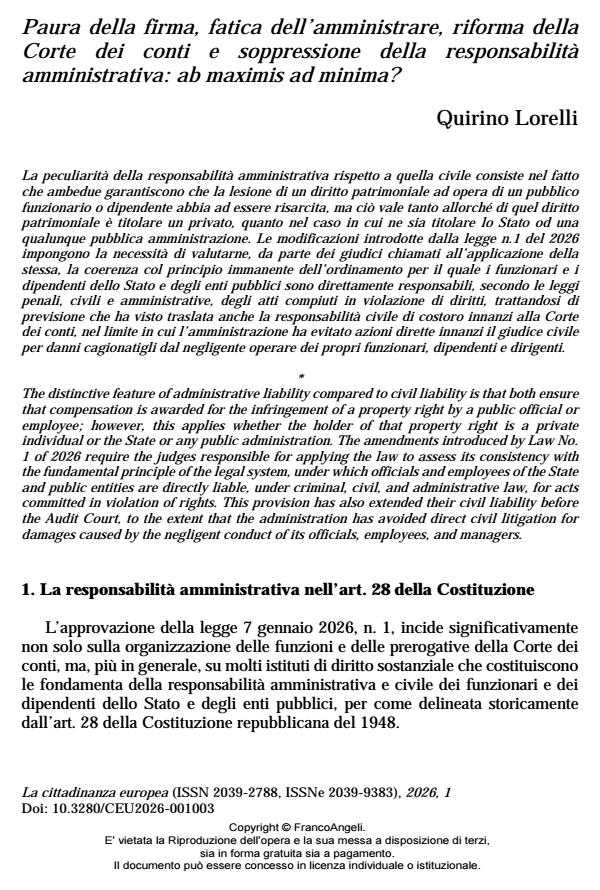
The distinctive feature of administrative liability compared to civil liability is that both ensure that compensation is awarded for the infringement of a property right by a public official or employee; however, this applies whether the holder of that property right is a private individual or the State or any public administration. The amendments introduced by Law No. 1 of 2026 require the judges responsible for applying the law to assess its consistency with the fundamental principle of the legal system, under which officials and employees of the State and public entities are directly liable, under criminal, civil, and administrative law, for acts committed in violation of rights. This provision has also extended their civil liability before the Audit Court, to the extent that the administration has avoided direct civil litigation for damages caused by the negligent conduct of its officials, employees, and managers.
Quirino Lorelli, Paura della firma, fatica dell’amministrare, riforma della Corte dei conti e soppressione della responsabilità amministrativa: ab maximis ad minima? in "CITTADINANZA EUROPEA (LA)" 1/2026, pp 123-176, DOI: 10.3280/CEU2026-001003