Identities, Otherness, and Mental Health: from Discrimination to Social Resilience
Journal title RIVISTA SPERIMENTALE DI FRENIATRIA
Author/s Antonio Ventriglio, Fabiana Ricci, Daniela Giallanella, Julio Torales, João Maurício Castaldelli-Maia, Tomás Caycho-Rodríguez, Antonello Bellomo
Publishing Year 2026 Issue 2026/2
Language English Pages 16 P. 55-70 File size 264 KB
DOI 10.3280/RSF2026-002004
DOI is like a bar code for intellectual property: to have more infomation
click here
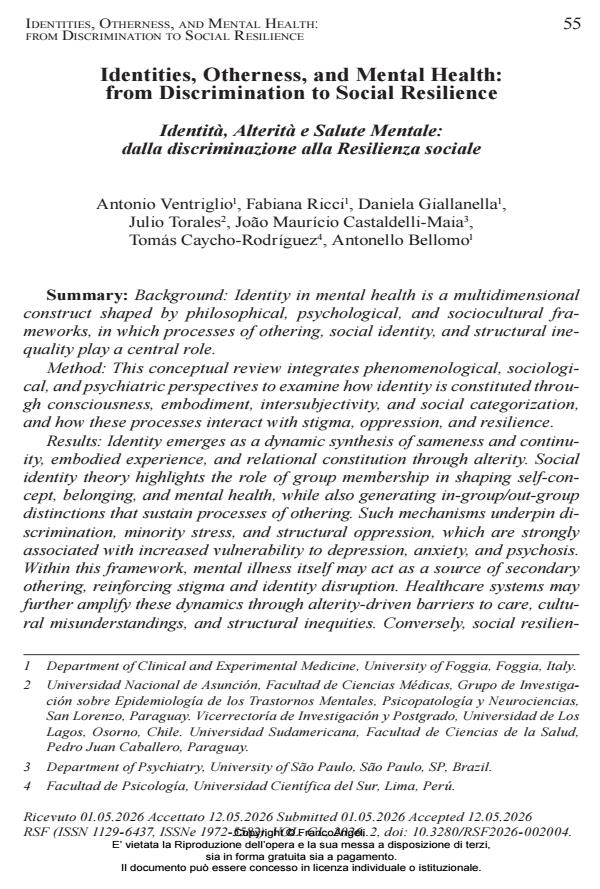
Below, you can see the article first page
If you want to buy this article in PDF format, you can do it, following the instructions to buy download credits
FrancoAngeli is member of Publishers International Linking Association, Inc (PILA), a not-for-profit association which run the CrossRef service enabling links to and from online scholarly content.
Background: Identity in mental health is a multidimensional construct shaped by philosophical, psychological, and sociocultural frameworks, in which processes of othering, social identity, and structural inequality play a central role. Method: This conceptual review integrates phenomenological, sociological, and psychiatric perspectives to examine how identity is constituted through consciousness, embodiment, intersubjectivity, and social categorization, and how these processes interact with stigma, oppression, and resilience. Results: Identity emerges as a dynamic synthesis of sameness and continuity, embodied experience, and relational constitution through alterity. Social identity theory highlights the role of group membership in shaping selfconcept, belonging, and mental health, while also generating ingroup/outgroup distinctions that sustain processes of othering. Such mechanisms underpin discrimination, minority stress, and structural oppression, which are strongly associated with increased vulnerability to depression, anxiety, and psychosis. Within this framework, mental illness itself may act as a source of secondary othering, reinforcing stigma and identity disruption. Healthcare systems may further amplify these dynamics through alteritydriven barriers to care, cultural misunderstandings, and structural inequities. Conversely, social resilience plays as a protective and complementary process that reinforces individual identity by fostering belonging, cohesion, and shared identity reconstruction. Conclusions: Identity is a socially embedded, relational, and dynamic construct continuously shaped by otherness, structural inequality, and resilience processes. Strengthening social resilience and inclusive systems is essential to contrast stigma, inequities, and promote both personal and collective identity integration.
Keywords: Identity, Othering, Social Identity, Discrimination, Social Resilience.
Antonio Ventriglio, Fabiana Ricci, Daniela Giallanella, Julio Torales, João Maurício Castaldelli-Maia, Tomás Caycho-Rodríguez, Antonello Bellomo, Identities, Otherness, and Mental Health: from Discrimination to Social Resilience in "RIVISTA SPERIMENTALE DI FRENIATRIA" 2/2026, pp 55-70, DOI: 10.3280/RSF2026-002004