Neurodivergence and Alterity: Denaturalising the Norm
Journal title RIVISTA SPERIMENTALE DI FRENIATRIA
Author/s Alice Sodi, Roberto Mastropasqua
Publishing Year 2026 Issue 2026/2
Language English Pages 14 P. 71-84 File size 243 KB
DOI 10.3280/RSF2026-002005
DOI is like a bar code for intellectual property: to have more infomation
click here
Below, you can see the article first page
If you want to buy this article in PDF format, you can do it, following the instructions to buy download credits
FrancoAngeli is member of Publishers International Linking Association, Inc (PILA), a not-for-profit association which run the CrossRef service enabling links to and from online scholarly content.
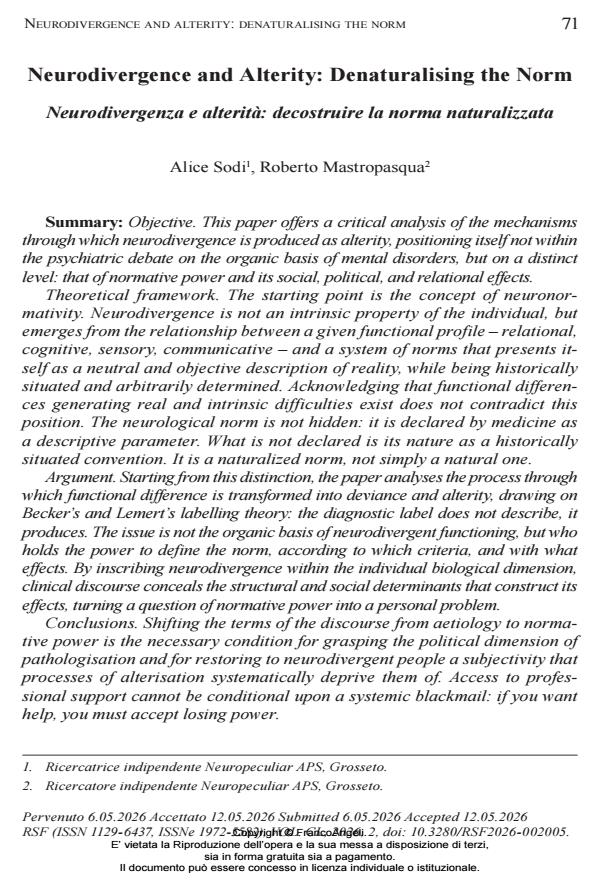
Objective. This paper offers a critical analysis of the mechanisms through which neurodivergence is produced as alterity, positioning itself not within the psychiatric debate on the organic basis of mental disorders, but on a distinct level: that of normative power and its social, political, and relational effects. Theoretical framework. The starting point is the concept of neuronormativity. Neurodivergence is not an intrinsic property of the individual, but emerges from the relationship between a given functional profile – relational, cognitive, sensory, communicative – and a system of norms that presents itself as a neutral and objective description of reality, while being historically situated and arbitrarily determined. Acknowledging that functional differences generating real and intrinsic difficulties exist does not contradict this position. The neurological norm is not hidden: it is declared by medicine as a descriptive parameter. What is not declared is its nature as a historically situated convention. It is a naturalized norm, not simply a natural one. Argument. Starting from this distinction, the paper analyses the process through which functional difference is transformed into deviance and alterity, drawing on Becker’s and Lemert’s labelling theory: the diagnostic label does not describe, it produces. The issue is not the organic basis of neurodivergent functioning, but who holds the power to define the norm, according to which criteria, and with what effects. By inscribing neurodivergence within the individual biological dimension, clinical discourse conceals the structural and social determinants that construct its effects, turning a question of normative power into a personal problem. Conclusions. Shifting the terms of the discourse from aetiology to normative power is the necessary condition for grasping the political dimension of pathologisation and for restoring to neurodivergent people a subjectivity that processes of alterisation systematically deprive them of. Access to professional support cannot be conditional upon a systemic blackmail: if you want help, you must accept losing power.
Keywords: Neurodivergence, Neuronormativity, Alterity, Pathologisation, Labelling, Normative Power.
Alice Sodi, Roberto Mastropasqua, Neurodivergence and Alterity: Denaturalising the Norm in "RIVISTA SPERIMENTALE DI FRENIATRIA" 2/2026, pp 71-84, DOI: 10.3280/RSF2026-002005