Governance and data for sustainable tourism flows
Journal title ECONOMIA E SOCIETÀ REGIONALE
Author/s Paola Bagatella, Stefan Marchioro
Publishing Year 2026 Issue 2026/2
Language Italian Pages 14 P. 15-28 File size 318 KB
DOI 10.3280/ES2026-002002
DOI is like a bar code for intellectual property: to have more infomation
click here
Below, you can see the article first page
If you want to buy this article in PDF format, you can do it, following the instructions to buy download credits
FrancoAngeli is member of Publishers International Linking Association, Inc (PILA), a not-for-profit association which run the CrossRef service enabling links to and from online scholarly content.
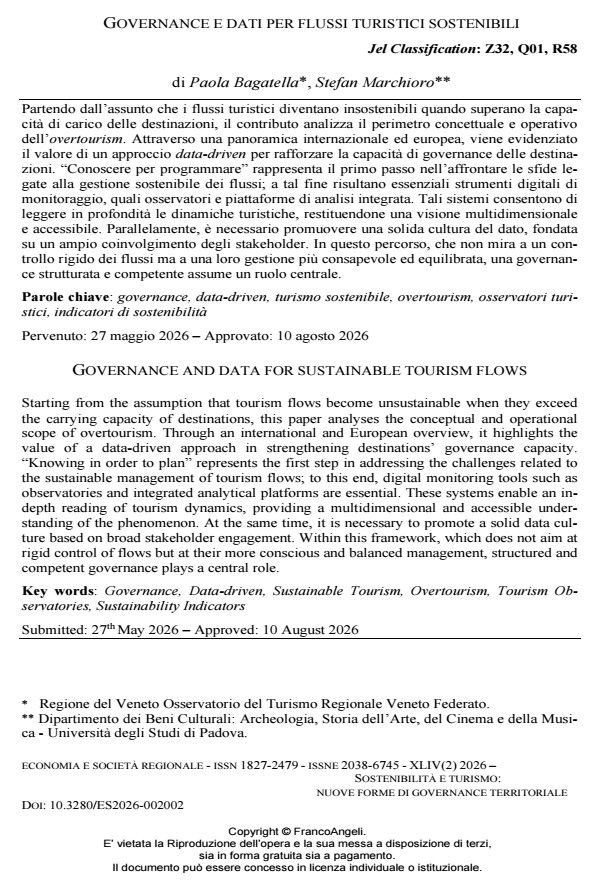
Starting from the assumption that tourism flows become unsustainable when they exceed the carrying capacity of destinations, this paper analyses the conceptual and operational scope of overtourism. Through an international and European overview, it highlights the value of a datadriven approach in strengthening destinations’ governance capacity. “Knowing in order to plan” represents the first step in addressing the challenges related to the sustainable management of tourism flows; to this end, digital monitoring tools such as observatories and integrated analytical platforms are essential. These systems enable an indepth reading of tourism dynamics, providing a multidimensional and accessible understanding of the phenomenon. At the same time, it is necessary to promote a solid data culture based on broad stakeholder engagement. Within this framework, which does not aim at rigid control of flows but at their more conscious and balanced management, structured and competent governance plays a central role.
Keywords: Governance, Datadriven, Sustainable Tourism, Overtourism, Tourism Observatories, Sustainability Indicators
Jel codes: Z32, Q01, R58
- UN Tourism (s.d.). Datadriven decisions and technical cooperation initiatives <https://www.untourism.int/technicalcooperation/datadrivendecisions>.
- Butler R.W. (1980). The concept of a tourist area cycle of evolution: implications for management of resources. Canadian Geographer, 24(1): 512.
- Commissione Europea (2022). The transition of EU tourism Bruxelles: European Commission <https://transport.ec.europa.eu/tourism/transitioneutourism_en>.
- Gretzel U., Sigala M., Xiang Z., Koo C. (2015). Smart tourism: foundations and developments. Electronic Markets, 25(3): 179188.
- Istat (2025). Annuario Statistico Italiano 2025. Capitolo 19 – Turismo. Roma: Istat.
- Lalli M. (2025). DMO: cambiare o sparire nell’era dell’intelligenza artificiale. Officina Turistica <https://www.officinaturistica.com>.
- Nazioni Unite (2015). Transforming our world: the 2030 Agenda for Sustainable Development. New York: United Nations.
- Peeters P., Gössling S., Klijs J., Milano C., Novelli M., Dijkmans C., Eijgelaar E., Hartman S., Heslinga J., Isaac R., Mitas O., Moretti S., Nawijn J., Papp B., Postma A. (2018). Overtourism: impact and possible policy responses, Study for the Committee on Transport and Tourism (Tran). Brussels: European Parliament.
- UN Tourism (2004). Indicators of Sustainable Development for Tourism Destinations: A Guidebook. Madrid: World Tourism Organization.
Paola Bagatella, Stefan Marchioro, Governance e dati per flussi turistici sostenibili in "ECONOMIA E SOCIETÀ REGIONALE " 2/2026, pp 15-28, DOI: 10.3280/ES2026-002002