Inter-organizational coordination in sustainable tourism: sector specificities and governance design options
Journal title ECONOMIA E SOCIETÀ REGIONALE
Author/s Elena Bonel
Publishing Year 2026 Issue 2026/2
Language Italian Pages 16 P. 29-44 File size 265 KB
DOI 10.3280/ES2026-002003
DOI is like a bar code for intellectual property: to have more infomation
click here
Below, you can see the article first page
If you want to buy this article in PDF format, you can do it, following the instructions to buy download credits
FrancoAngeli is member of Publishers International Linking Association, Inc (PILA), a not-for-profit association which run the CrossRef service enabling links to and from online scholarly content.
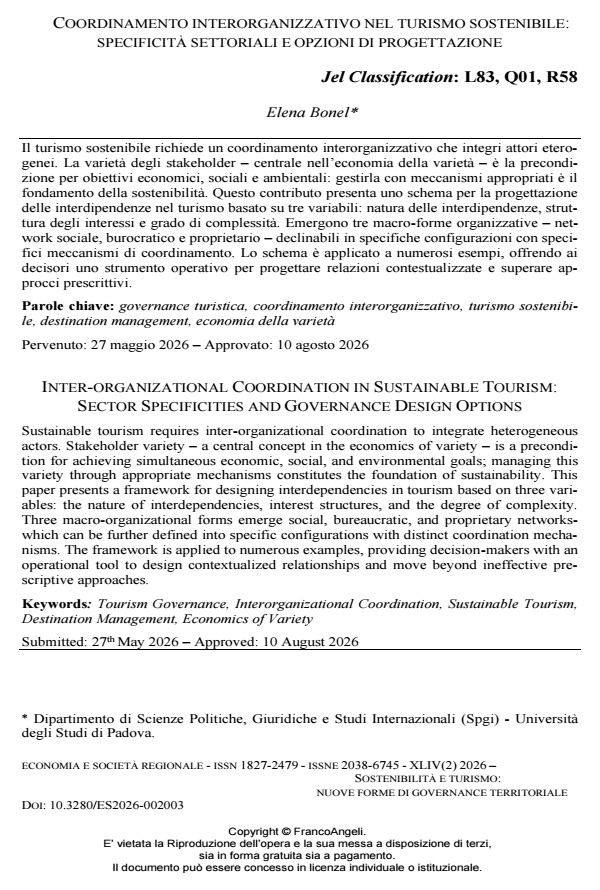
Sustainable tourism requires interorganizational coordination to integrate heterogeneous actors. Stakeholder variety – a central concept in the economics of variety – is a precondition for achieving simultaneous economic, social, and environmental goals; managing this variety through appropriate mechanisms constitutes the foundation of sustainability. This paper presents a framework for designing interdependencies in tourism based on three variables: the nature of interdependencies, interest structures, and the degree of complexity. Three macroorganizational forms emerge social, bureaucratic, and proprietary networkswhich can be further defined into specific configurations with distinct coordination mechanisms. The framework is applied to numerous examples, providing decisionmakers with an operational tool to design contextualized relationships and move beyond ineffective prescriptive approaches.
Keywords: Tourism Governance, Interorganizational Coordination, Sustainable Tourism, Destination Management, Economics of Variety
Jel codes: L83, Q01, R58
- Beritelli P., Laesser C. (2011). Power dimensions and influence reputation in tourist destinations: Empirical evidence from a network of actors and stakeholders. Tourism Management, 32(6): 12991309.
- Burini F. (2023). Il ruolo strategico della governance territoriale per il turismo enogastronomico. In: Garibaldi R., a cura di. Rapporto sul turismo enogastronomico italiano. Tendenze & Scenari. Bergamo: Associazione Italiana Turismo Enogastronomico.
- Bramwell B., Lane B. (2011). Critical research on the governance of tourism and sustainability. Journal of Sustainable Tourism, 19(45): 411421. DOI: 10.1080/09669582.2011.580586
- Della Corte V. (2000). La gestione dei sistemi locali di offerta turistica. Padova: Cedam.
- Frenken K., Van Oort F., Verburg T. (2007). Related variety, unrelated variety and regional economic growth. Regional Studies, 41(5): 685697. DOI: 10.1080/00343400601120296
- Grandori A. (1999). Il coordinamento organizzativo fra imprese. Sviluppo & Organizzazione, 171: 7591.
- Grandori A., Soda G. (1995). Interfirm Networks: Antecedents, Mechanisms and Forms. Organization Studies, 16(2): 183214. DOI: 10.1177/017084069501600201
- Hall C.M. (2011). A typology of governance and its implications for tourism policy analysis. Journal of Sustainable Tourism, 19(45): 437457. DOI: 10.1080/09669582.2011.570346
- Marschak J. (1965). Economics of Language. Behavioral Science, 10: 135 140.
- Nooteboom B. (2000). Learning and innovation in organizations and economies. Oxford: Oxford University Press.
- Pencarelli T., Forlani F. (2002). Il marketing dei distretti turistici – sistemi vitali nell’economia delle esperienze. Sinergie, 58: 231277.
- Presenza A., Del Chiappa G., Sheehan L. (2013). Residents’ engagement and local tourism governance in maturing beach destinations. Evidence from an Italian case study. Journal of Destination Marketing & Management, 2(1): 2230.
- Rispoli M., Tamma M. (1995). Risposte strategiche alla complessità: le forme di offerta dei prodotti alberghieri. Torino: Giappichelli.
- Saviotti P.P., Metcalfe J.S. (1991). Present development and trends in evolutionary economics. In: Saviotti P.P., Metcalfe J.S., a cura di. Evolutionary theories of economic and technological change: present status and future prospects. London: Routledge.
- Storper M., Venables A.J. (2004). Buzz: facetoface contact and the urban economy. Journal of Economic Geography, 4(4): 351370.
- Thompson J.D. (1967). Organizations in action: Social science bases of administrative theory. New York: McGrawHill.
Elena Bonel, Coordinamento interorganizzativo nel turismo sostenibile: specificità settoriali e opzioni di progettazione in "ECONOMIA E SOCIETÀ REGIONALE " 2/2026, pp 29-44, DOI: 10.3280/ES2026-002003