Unesco world heritage sites as living laboratories for sustainable tourism: opportunities, risks, and management approaches
Journal title ECONOMIA E SOCIETÀ REGIONALE
Author/s Alice Andreos, Giorgio Andrian
Publishing Year 2026 Issue 2026/2
Language Italian Pages 20 P. 45-64 File size 419 KB
DOI 10.3280/ES2026-002004
DOI is like a bar code for intellectual property: to have more infomation
click here
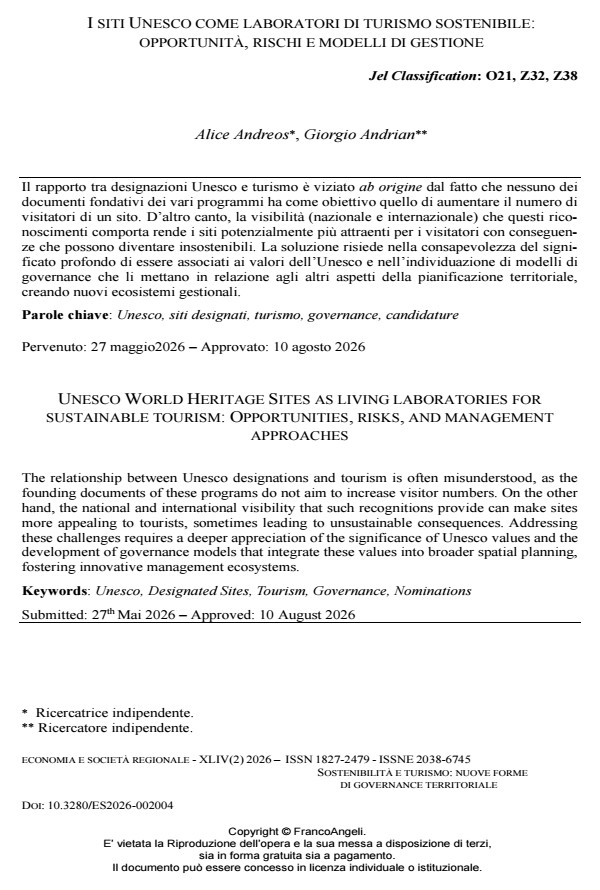
Below, you can see the article first page
If you want to buy this article in PDF format, you can do it, following the instructions to buy download credits
FrancoAngeli is member of Publishers International Linking Association, Inc (PILA), a not-for-profit association which run the CrossRef service enabling links to and from online scholarly content.
The relationship between Unesco designations and tourism is often misunderstood, as the founding documents of these programs do not aim to increase visitor numbers. On the other hand, the national and international visibility that such recognitions provide can make sites more appealing to tourists, sometimes leading to unsustainable consequences. Addressing these challenges requires a deeper appreciation of the significance of Unesco values and the development of governance models that integrate these values into broader spatial planning, fostering innovative management ecosystems.
Keywords: Unesco, Designated Sites, Tourism, Governance, Nominations
Jel codes: O21, Z32, Z38
- Harvey D.C. (2001). Heritage Pasts and Heritage Presents: temporality, meaning and the scope of heritage studies. International Journal of Heritage Studies, 7(4): 319338. DOI: 10.1080/13581650120105534
- Hugo N.C. (2020). Overtourism at Heritage and Cultural Sites. In: Séraphin H., Gladkikh T., Vo Thanh T., Eds. Overtourism. Cham: Palgrave Macmillan. DOI: 10.1007/9783030424589_10
- Immobiliare Unesco (2006, 25 novembre). D di Repubblica.
- Kohl J., Eubanks T. (2008). A SystemsBased Interpretive Planning Model that Links Culturally Constructed Place Meanings and Conservation. Journal of Interpretation Research, 13(2): 5974. DOI: 10.1177/109258720801300205
- Living treasure. Unesco is better at naming enemies than finding friends. (2012, 14 luglio). The Economist <https://www.economist.com/booksandarts/2012/07/14/livingtreasure>.
- L’Unesco “benedice” Firenze, Dante e… la tramvia (2020, 24 gennaio). Nove da Firenze <https://www.nove.firenze.it/lunescobenedicefirenzedanteelatramvia.htm>.
- Mammadova A., May S.M., Tomita Y., Harada S. (2025). Synergies and Conflicts in DualDesignated UNESCO Sites: Managing Governance, Conservation, Tourism, and Community Engagement at Mount Hakusan Global Geopark and Biosphere Reserve, Japan. Land, 14(3): 488.
- Mariani M.M., Guizzardi A. (2020). Does Designation as a Unesco World Heritage Site Influence Tourist Evaluation of a Local Destination? Journal of Travel Research, 59(1): 2236. DOI: 10.1177/0047287518821737
- Matteucci X., Nawijn J., von Zumbusch J. (2021). A new materialist governance paradigm for tourism destinations. Journal of Sustainable Tourism, 30(1): 169184. DOI: 10.1080/09669582.2021.1924180
- Meskell L. (2018). A Future in Ruins: UNESCO, World Heritage, and the Dream of Peace. Oxford: Oxford University Press.
- Michelson A., Paadam K. (2016). Destination branding and reconstructing symbolic capital of urban heritage: A spatially informed observational analysis in medieval towns, Journal of Destination Marketing & Management, 5(2): 141153.
- Nye J.S. (2005). Soft Power: The Means to Success in World Politics. PublicAffairs.
- Santos N., Moreira C.O., Ferreira C.C., Silveira L.A. (2025). Tourism management of World Heritage Sites. Perspectives on 10 years of integration of the University of Coimbra, Alta and Sofia in the Unesco list. Cadernos de Geografia, 52: 197214. DOI: 10.14195/08711623_52_10
- Smith L. (2006). Uses of Heritage. London: Routledge. DOI: 10.4324/9780203602263
- Unesco (1972). Convention Concerning the Protection of the World Cultural and Natural Heritage.
- Unesco (2015). Operational Guidelines for Unesco Global Geoparks.
- Unesco (2022). Technical guidelines for Biosphere Reserves.
- Unesco (2025). Unesco Creative Cities Network Call for Application 2025. Application Guidelines.
- D’Angella F., Go F.M. (2009). Tale of two cities’ collaborative tourism marketing: Towards a theory of destination stakeholder assessment, Tourism Management, 30(3): 429440.
- D’Eramo Marco (2015, 2 febbraio). La maledizione dell’Unesco sulle città. Il Foglio.
- Farsani N.T., Coelho C.O.A., Costa C.M.M. (2014). Analysis of Network Activities in Geoparks as Geotourism Destinations. International Journal of Tourism Research, 16(1): 110.
- Harrison R. (2012). Heritage: Critical Approaches. London: Routledge. DOI: 10.4324/9780203108857
- Amer M., Ginzarly M., Renzi M.F. (2023). Civita di Bagnoregio, Italy: towards a peoplecentred heritage branding approach. Journal of Heritage Tourism, 18(4): 483503. DOI: 10.1080/1743873X.2023.2188450
- Barraclough A.D., Reed M.G., Coetzer K., Price M.F., Schultz L., MoreiraMunoz A., Måren I. (2023). Global knowledgeaction networks at the frontlines of sustainability: Insights from five decades of science for action in UNESCO’s World Network of biosphere reserves. People and Nature, 5(5): 14301444.
- Bertacchini E., Liuzza C., Meskell L., Saccone D. (2016). The politicization of UNESCO World Heritage decision making. Public Choice, 167: 95129.
- Commissione Nazionale per l’Unesco (2011). Il valore del Brand Unesco.
- Costa P., Van der Borg J. (1988). Un modello lineare per la programmazione del turismo. Sulla capacità massima di accoglienza turistica del Centro Storico di Venezia. COSES informazioni, 32/33: 2126.
Alice Andreos, Giorgio Andrian, I siti unesco come laboratori di turismo sostenibile: opportunità, rischi e modelli di gestione in "ECONOMIA E SOCIETÀ REGIONALE " 2/2026, pp 45-64, DOI: 10.3280/ES2026-002004