Snow at any cost? Artificial snowmaking reservoirs, climate change and development models in the Veneto Dolomites
Journal title ECONOMIA E SOCIETÀ REGIONALE
Author/s Alberto Lanzavecchia, Alice Ravanelli
Publishing Year 2026 Issue 2026/2
Language Italian Pages 28 P. 73-100 File size 853 KB
DOI 10.3280/ES2026-002006
DOI is like a bar code for intellectual property: to have more infomation
click here
Below, you can see the article first page
If you want to buy this article in PDF format, you can do it, following the instructions to buy download credits
FrancoAngeli is member of Publishers International Linking Association, Inc (PILA), a not-for-profit association which run the CrossRef service enabling links to and from online scholarly content.
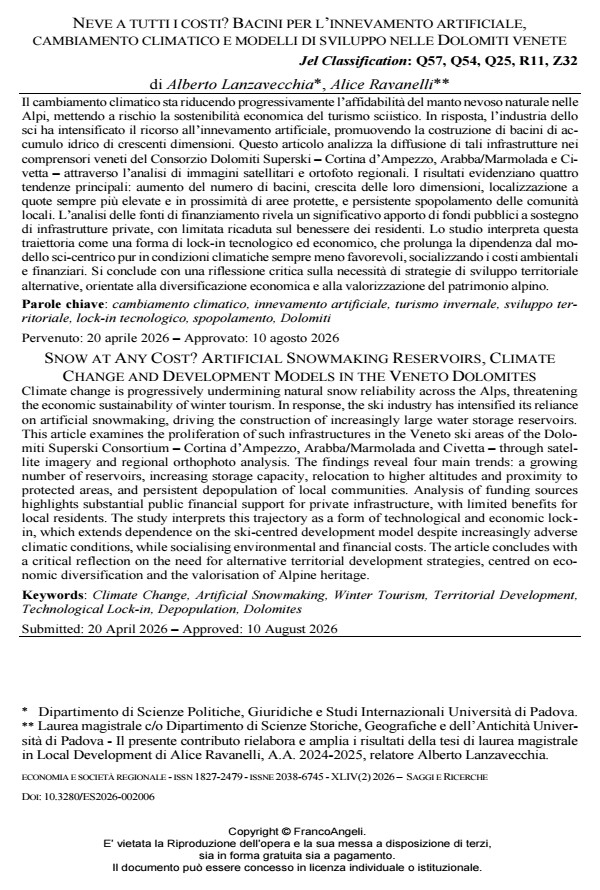
Climate change is progressively undermining natural snow reliability across the Alps, threatening the economic sustainability of winter tourism. In response, the ski industry has intensified its reliance on artificial snowmaking, driving the construction of increasingly large water storage reservoirs. This article examines the proliferation of such infrastructures in the Veneto ski areas of the Dolomiti Superski Consortium – Cortina d’Ampezzo, Arabba/Marmolada and Civetta – through satellite imagery and regional orthophoto analysis. The findings reveal four main trends: a growing number of reservoirs, increasing storage capacity, relocation to higher altitudes and proximity to protected areas, and persistent depopulation of local communities. Analysis of funding sources highlights substantial public financial support for private infrastructure, with limited benefits for local residents. The study interprets this trajectory as a form of technological and economic lockin, which extends dependence on the skicentred development model despite increasingly adverse climatic conditions, while socialising environmental and financial costs. The article concludes with a critical reflection on the need for alternative territorial development strategies, centred on economic diversification and the valorisation of Alpine heritage.
Keywords: Climate Change, Artificial Snowmaking, Winter Tourism, Territorial Development, Technological Lockin, Depopulation, Dolomites
Jel codes: Q57, Q54, Q25, R11, Z32
- Adler C., Wester P., Bhatt I., Huggel C., Insarov G.E., Morecroft M.D., Muccione V., Prakash A. (2022). CrossChapter Paper 5: Mountains. In: Pörtner H.O., Roberts D.C., Tignor M., Poloczanska E.S., Mintenbeck K., Alegría A., Craig M., Langsdorf S., Löschke S., Möller V., Okem A., Rama B., a cura di. Climate Change 2022: Impacts, Adaptation and Vulnerability. Contribution of Working Group II to the Sixth Assessment Report of the Intergovernmental Panel on Climate Change. Cambridge (UK): Cambridge University Press: 22732318. DOI: 10.1017/9781009325844.022
- Beltran O., Vaccaro I. (2024). La ecología política del esquí en el Pirineo catalán: entre la iniciativa privada y el rescate público. Pasos Revista de Turismo y Patrimonio Cultural, 22(1): 2941.
- Beniston M., Farinotti D., Stoffel M. et al. (2018). The European Mountain cryosphere: a review of its current state, trends, and future challenges. The Cryosphere, 12(2): 759794.
- Bridda D., Savaris I., Crepaz M. (2018). Emigrazione e spopolamento in montagna., Anno LIII n. 13. Belluno: Bellunesi nel Mondo Edizioni.
- Campolo S. (2025). Dallo spopolamento alla resilienza: il ruolo del Bellunese nella nuova geografia delle Alpi. Dolomind <https://dolomind.eu/dallospopolamentoallaresilienzailruolodelbellunesenellanuovageografiadellealpi>.
- Casanova L. (2021). Funivie con soldi pubblici, la farsa della mobilità alternativa. Mountain Wilderness <https://www.mountainwilderness.it/editoriale/funivieconsoldipubblicilafarsadellamobilitaalternativa/>.
- Casanova L., Facchini D. (2024). Oro colato: l’eredità per pochi delle Olimpiadi di Milano Cortina 2026. Milano: Altreconomia.
- Castiglioni B., Varotto M., a cura di (2012). Di chi sono le Alpi? Appartenenze politiche, economiche e culturali nel mondo alpino contemporaneo. Padova: Padova University Press.
- Corrado F., Dematteis G., a cura di (2016). Riabitare la montagna. Scienze del Territorio. Rivista di Studi Territorialisti, 4. Firenze: Firenze University Press. Costanza R., Alperovitz G., Daly H., Farley J., Franco C., Jackson T., Kubiszewski I., Schor J., Victor P. (2013). Building a Sustainable and Desirable Economy inSocietyinNature. Canberra (Aus): Anu Press <http://www.jstor.org/stable/j.ctt5hgz53>.
- Daly H.E. (1996). Beyond Growth: The Economics of Sustainable Development. Boston: Beacon Press.
- Dematteis M., Nardelli M. (2022). Inverno liquido: la crisi climatica, le terre alte e la fine della stagione dello sci di massa. Roma: DeriveApprodi.
- Ferrari M.A. (2023). Assalto alle Alpi. Torino: Giulio Einaudi Editore.
- Fontanive C. (2023). Agordo. Sei nuovi impianti di risalita e un lago più grande per creare la neve artificiale. Il Gazzettino <https://www.ilgazzettino.it/nordest/belluno/agordo_olimpiadi_cortina_zoldo_impianti_risalita_neve_artificiale7415670.html>.
- Gobiet A., Kotlarski S., Beniston M. et al. (2014). 21st century climate change in the European Alps – a review. Science of the Total Environment, 493: 11381151.
- Ipsos (2022). Percezioni e opinioni degli italiani sulle aree montane del Paese, Dicembre 2022. Roma: Unione Nazionale Comuni Comunità Enti Montani < chromeextension://efaidnbmnnnibpcajpcglclefindmkaj/https://uncem.it/wpcontent/uploads/2022/12/IPSOSperUNCEMPercezioneeopinionisulleareemontane_PRESENTAZIONE13122022.pdf>.
- Kiashemshaki H., Abdi E., Torbidoni E.I.F. (2026). Ski area sustainability across economic, social, and environmental dimensions: a systematic review. Journal of Outdoor Recreation and Tourism, 54, 101020.
- Knight J. (2022). Scientists’ warning of the impacts of climate change on mountains. PeerJ, 10, e14253.
- Langer A. (1994). La conversione ecologica potrà affermarsi soltanto se apparirà socialmente desiderabile. In: Langer A. Il viaggiatore leggero: scritti 19611995. Palermo: Sellerio.
- Legambiente (2023). Report Nevediversa 2023: il turismo invernale nell’era della crisi climatica. Roma: Legambiente <https://www.legambiente.it/attivitascientifiche/nevediversa>.
- Legambiente (2025). Report Nevediversa 2025: una nuova montagna è possibile. Roma: Legambiente <https://www.legambiente.it/attivitascientifiche/nevediversa>.
- Matiu M. (2021). Neve. Come sta cambiando in Alto Adige e nelle Alpi. Bolzano: Eurac Research.
- Michelini L. (2023). Una ricerca indaga il tramonto di Cortina. Alla vigilia delle Olimpiadi. Altreconomia <https://altreconomia.it/unaricercaindagailtramontodicortinaallavigliadelleolimpiadi/>.
- Ministero delle Infrastrutture e dei Trasporti (2020, 21 luglio). Decreto del Commissario numero C20210000346P: approvazione dell’intervento L1N6 – Bacino idrico “Potor” per l’innevamento artificiale in località Cinque Torri <https://www.mit.gov.it/normativa/decretodelcommissarionumeroc20210000346pdel21072020>.
- Moore J.W. (2027). Wasting the world: Class, capital & cheap toxification in the capitalist worldecology. In: Armiero M., Gabbriellini F., Lanzidei C.M., & Vettori F., Eds. Resisting the Wasteocene: Fighting the global dump. Bloomsbury Academic. (Advance version retrieved from ResearchGate, August 2025) <https://www.researchgate.net/publication/394425386_Wasting_the_World_Class_Capital_Cheap_Toxification_in_the_Capitalist_WorldEcology>.
- Mountain Wilderness Italia (2024). I fallimenti delle tutele Unesco sulle Dolomiti, una responsabilità solo politica. Mountain Wilderness <https://www.mountainwilderness.it/eticaecultura/ifallimentidelletuteleunescosulledolomitiunaresponsabilitasolopolitica/>.
- Oecd (2007). Climate Change in the European Alps: Adapting Winter Tourism and Natural Hazards Management. Paris: Oecd Publishing.
- Öncü M.A., Somuncu M., Güney I., Perlik M. (2023). Rural and alpine gentrification impact on lifestyle mobilities during Covid19: the Yayla experience at the Taurus Mountains in Turkey. European Countryside, 15(2): 259280.
- Pellizzoni L. (2025). Zone di sacrificio: Un'esplorazione concettuale. In: Perocco F. Pirina G., a cura di. Le disuguaglianze territoriali in Italia: Cause, forme, conseguenze: 379398. Edizioni Ca’ Foscari. DOI: 10.30687/9788869699917/016
- Peroni F., Codato D., Buscemi L. et al. (2023). Rethinking urban riparian ecosystems as a frontline strategy to counter climate change: mapping 60 years of carbon sequestration evolution in Padua, Italy. Frontiers in Climate, 5.
- Provincia di Belluno (2017, 9 novembre). Determinazione dirigenziale n. 1844: verifica di assoggettabilità Via per progetto innevamento Plan Boè. Bollettino Ufficiale Regione Veneto, n. 114, 24 novembre 2017.
- Regione Veneto (2015, 28 agosto). Decreto n. 205 del 19 giugno 2015. Bollettino Ufficiale della Regione del Veneto, n. 83 Supplemento.
- Rixen C., Rolando A., a cura di (2013). The Impacts of Skiing and Related Winter Recreational Activities on Mountain Environments. Sharjah: Bentham Science Publishers. DOI: 10.2174/97816080548861130101
- Rouch L., George E. (2024). Tourism diversification paths in ski midmountain territories: any transformations? Current Issues in Tourism, 27(24), 44304445. DOI: 10.1080/13683500.2023.2276788
- Segafreddo A. (2017). Via libera ai lavori per il lago artificiale sulle Cinque Torri. Corriere delle Alpi. <https://www.corrierealpi.it/cronaca/vialiberaailavoriperillagoartificialesullecinquetorrirtzuzdy1>.
- Società Infrastrutture Milano Cortina 20202026 S.p.A. (2025, 2 maggio). Decreto dell’Amministratore Delegato n. B06.0: Nuovo bacino in Po’ Drusciè 2 – integrazione dell’opera “Upgrade delle strutture e delle dotazioni per aggiornamento alle nuove tecnologie e adeguamento alle competizioni paralimpiche” – Cup C44J22000290002 <https://www.simico.it/decretodellamministratoredelegato12/>.
- Soratroi L. (2020). Un nuovo bacino al Passo Pordoi. Funivie.org. <https://www.funivie.org/web/unnuovobacinoalpassopordoi/>.
- Tessore L. (2025). Bacini idrici per la neve programmata. La Rivista della Natura.<https://rivistanatura.com/baciniidriciperlaneveprogrammata/>.
- Unruh G.C. (2000). Understanding carbon lockin. Energy Policy, 28(12): 817830. DOI: 10.1016/S03014215(00)000707
- Valt M. (2019). Standardized Snow Pack Index SSPI nelle Alpi Orientali. Neve e Valanghe, 87: 1423.
- Varotto M. (2017). Montagne del Novecento. Il volto della modernità nelle Alpi e Prealpi venete. Verona: Cierre Edizioni.
- Varotto M. (2020). Montagne di mezzo. Una nuova geografia. Torino: Einaudi. Zinzani A. (2023). Geografie della crisi ecoclimatica in montagna: produzione sociale dell’ambiente e futuri contesi nelle Dolomiti. Rivista Geografica Italiana, 3: 7189.
- Matiu M., Bertoldi G., Notarnicola C., Zebisch M. (2021). Snow: Developments and Effects in South Tyrol and the Alps. Bolzano: Eurac Research.
- Tzatzadaki O. (2025). Turismo rurale e innovazione sociale nelle Dolomiti bellunesi Unesco. economia e società regionale, LXIII(2): 125147.
Alberto Lanzavecchia, Alice Ravanelli, Neve a tutti i costi? Bacini per l’innevamento artificiale, cambiamento climatico e modelli di sviluppo nelle Dolomiti Venete in "ECONOMIA E SOCIETÀ REGIONALE " 2/2026, pp 73-100, DOI: 10.3280/ES2026-002006