The problematic growth of the ict sector in southern italy
Journal title ECONOMIA E SOCIETÀ REGIONALE
Author/s Roberto Errico
Publishing Year 2026 Issue 2026/2
Language Italian Pages 11 P. 101-111 File size 290 KB
DOI 10.3280/ES2026-002007
DOI is like a bar code for intellectual property: to have more infomation
click here
Below, you can see the article first page
If you want to buy this article in PDF format, you can do it, following the instructions to buy download credits
FrancoAngeli is member of Publishers International Linking Association, Inc (PILA), a not-for-profit association which run the CrossRef service enabling links to and from online scholarly content.
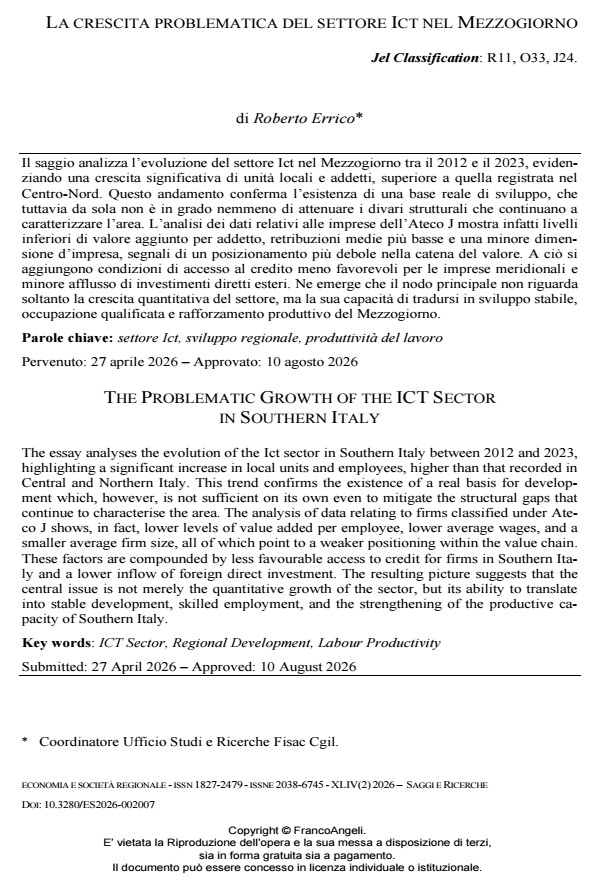
The essay analyses the evolution of the Ict sector in Southern Italy between 2012 and 2023, highlighting a significant increase in local units and employees, higher than that recorded in Central and Northern Italy. This trend confirms the existence of a real basis for development which, however, is not sufficient on its own even to mitigate the structural gaps that continue to characterise the area. The analysis of data relating to firms classified under Ateco J shows, in fact, lower levels of value added per employee, lower average wages, and a smaller average firm size, all of which point to a weaker positioning within the value chain. These factors are compounded by less favourable access to credit for firms in Southern Italy and a lower inflow of foreign direct investment. The resulting picture suggests that the central issue is not merely the quantitative growth of the sector, but its ability to translate into stable development, skilled employment, and the strengthening of the productive capacity of Southern Italy.
Keywords: ICT Sector, Regional Development, Labour Productivity
Jel codes: R11, O33, J24.
- Banca d’Italia (2024). La domanda e l’offerta di credito a livello territoriale. Collana Economie regionali, 21 <https://www.bancaditalia.it/pubblicazioni/economieregionali/2024/20240021/index.html>.
- Banca d’Italia (2025). La domanda e l’offerta di credito a livello territoriale. Collana Economie regionali, 43 <https://www.bancaditalia.it/pubblicazioni/economieregionali/2025/20250043/index.html>.
- Bellucci A., Favaretto I., Giombini G. (2014). Credit availability and propensity to innovate of small and medium enterprises. Economia e Politica Industriale, 41(4): 2750. DOI: 10.3280/POLI2014004003
- Cnel (2025). Rapporto annuale sulla produttività 2025. Roma: Consiglio Nazionale dell’Economia e del Lavoro <chromeextension://efaidnbmnnnibpcajpcglclefindmkaj/https://www.cnel.it/media/ docs/defaultsource/importedresources/rapportoannualeproduttivitaweb.pdf?sfvrsn=dec4b087_0>.
- Cortinovis N., Crescenzi R., Van Oort F. (2020). Multinationals, industrial relatedness and employment in European Regions. Journal of Economic Geography, 20(5), 11651205.
- Eurostat (2023). NACE Rev. 2.1 classification is now official. European Commission <https://ec.europa.eu/eurostat/web/productseurostatnews/w/wdn202302101>.
- Eurostat (2025). NACE Rev. 2.1: Statistical classification of economic activities in the European Union (2025 edition). Publications Office of the European Union <https://ec.europa.eu/eurostat/web/productsmanualsandguide lines/w/ksgq24007>.
- Eurostat (2026). ICT sector value added, employment and R&D. Statistics Explained. European Commission <https://ec.europa.eu/eurostat/statisticsexplained/index.php?title=ICT_sector__value_added,_employment_and_ R%26D>.
- Grimes A., Ren C., Stevens P. (2012). The need for speed: Impacts of internet connectivity on firm productivity. Journal of Productivity Analysis, 37(2): 187201.
- Ilo (2024). World employment and social outlook: Trends 2024. Geneva: International Labour Organization. DOI: 10.54394/HQAE1085
- Ilo (2025a). Digital transformation in employment policies. Geneva: International Labour Organization. DOI: 10.54394/OUSX6485
- Ilo (2025b). World employment and social outlook: Trends 2025. Geneva: International Labour Organization. DOI: 10.54394/IZLN1673
- Istat (2019). Struttura e competitività delle imprese multinazionali Anno 2017. Roma: Istituto Nazionale di Statistica <chromeextension://efaidnb mnnnibpcajpcglclefindmkaj/https://www.istat.it/wpcontent/uploads/2019/11/Re port_Multinazionali_Anno_2017.pdf>.
- Istat (2025). Capitolo 14 Imprese. Annuario statistico italiano 2025. Roma: Istituto Nazionale di Statistica <chromeextension://efaidnbmnnnibpcaj pcglclefindmkaj/https://www.istat.it/storage/ASI/2025/notemetodologiche/ N14.pdf>.
- Istat (2026). Struttura e competitività delle imprese multinazionali Anno 2023. Roma: Istituto Nazionale di Statistica <chromeextension://efai dnbmnnnibpcajpcglclefindmkaj/https://www.istat.it/wpcontent/uploads/2025/11/Re port_Impresemultinazionali_Anno2023.pdf>.
- Javorcik B.S. (2004). Does Foreign Direct Investment Increase the Productivity of Domestic Firms? In Search of Spillovers through Backward Linkages. The American Economic Review, 94(3): 605627. <http://www.jstor.org/stable/3592945>.
- Jorgenson D.W., Stiroh K.J. (1999). Information technology and growth. American Economic Review, 89(2): 109115.
- KersanSkabic I., Barisic A. (2023). Foreign direct investments and participation in global value chains: New evidence from advanced manufacturing industries in Central and Eastern Europe. E&M Economics and Management, 26(4): 416.
- Nguyen T.P., Dinh T.T.H., Tran N.T., Thi Thuy T.D. (2022). Ushaped impacts of institutional quality and ICT penetration on economic growth: Evidence from selected emerging countries. Cogent Economics & Finance, 10: Article 2139887. DOI: 10.1080/23322039.2022.2139887
- Oecd (2011). Oecd Guide to Measuring the Information Society 2011. Paris: Oecd Publishing.
Roberto Errico, La crescita problematica del settore ict nel mezzogiorno in "ECONOMIA E SOCIETÀ REGIONALE " 2/2026, pp 101-111, DOI: 10.3280/ES2026-002007