Female voices from the Alps: three reading suggestions /
Journal title SOCIETÀ E STORIA
Author/s Stefano Levati, Alessandro Pastore, Elisa Marazzi, Blyte Alice Raviola
Publishing Year 2026 Issue 2026/193
Language Italian Pages 20 P. 543-562 File size 311 KB
DOI 10.3280/SS2026-193006
DOI is like a bar code for intellectual property: to have more infomation
click here
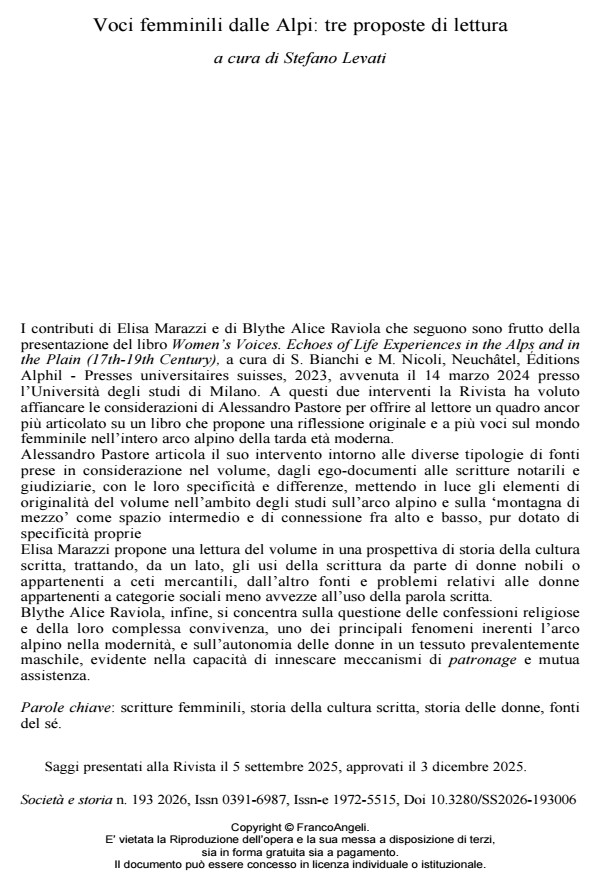
Below, you can see the article first page
If you want to buy this article in PDF format, you can do it, following the instructions to buy download credits
FrancoAngeli is member of Publishers International Linking Association, Inc (PILA), a not-for-profit association which run the CrossRef service enabling links to and from online scholarly content.
The following contributions by Elisa Marazzi and Blythe Alice Raviola are based on the presentation of the book Women’s Voices. Echoes of Life Experiences in the Alps and in the Plain (17th19th Century), edited by S. Bianchi and M. Nicoli, Neuchâtel, Éditions Alphil Presses Universitaires Suisses, 2023, which took place on 14 March 2024 at the University of Milan. This journal has chosen to assort these contributions with the views of Alessandro Pastore in order to offer readers an even more detailed overview of a book that presents an original and multivoiced reflection on the world of women throughout the Alps in the late modern age. Alessandro Pastore structures his contribution around the different types of sources considered in the volume, from egodocuments to notarial and judicial records, with their specificities and differences, highlighting the original elements of the volume in the field of studies on the Alpine world and on the “middle mountain” as an intermediate space connecting high and low, albeit with its own specificities. Elisa Marazzi offers a reading of the volume from the perspective of the history of written culture, dealing, on the one hand, with the uses of writing by noble women or those belonging to the merchant classes and, on the other, with sources and issues relating to women belonging to social categories less accustomed to the use of the written word. Finally, Blythe Alice Raviola focuses on the issue of religious beliefs and their complex coexistence, one of the main phenomena present in the Alpine arc in modern times, and on the autonomy of women in a predominantly maledominated world, evident in their ability to trigger mechanisms of patronage and mutual assistance.
Keywords: women writings, history of written culture, women’s history, egodocuments
- Betri M.L. (2015), Donne dell’Ottocento. Amori, politica e utopia, Milano, FrancoAngeli.
- Bianchi S. (2018), Uomini che partono. Scorci di storia della Svizzera italiana tra migrazione e vita quotidiana (secoli XVIXIX), Bellinzona, Casagrande.
- Evangelisti C. (2009), Roffeno. Ricerche su una comunità montana di fine Cinquecento, Verona, QuiEdit.
- Evangelisti C. (2018), Parlare, scrivere, vivere nell’Italia di fine Cinquecento. Quattro saggi, Roma, Carocci.
- Mathieu J. (2000), Storia delle Alpi, 15001900. Ambiente, sviluppo e società, Bellinzona, Casagrande.
- Rosenwein B.H. (2016), Generazioni di sentimenti. Una storia delle emozioni, 6001700, Roma, Viella.
- Varotto M. (2020), Montagne di mezzo. Una nuova geografia, Torino, Einaudi.
- Betri M.L. e Brambilla E. (a cura di) (2004), Salotti e ruolo femminile in Italia. Tra fine del Seicento e primo Novecento, Venezia, Marsilio.
- Caffiero M. e Venzo M.I. (2014), La collana La memoria restituita: fonti, interpretazioni, scritture del sé, in Storia di genere in Italia in età moderna: un confronto tra storiche nordamericane e italiane, a cura di E. Brambilla e A. Jacobson Schutte, Roma, Viella, pp. 247279.
- Castillo Gómez A. (2013), Leggere nella Spagna moderna. Erudizione, religiosità e svago, Bologna, Pàtron.
- Cavallo S. (2020), The Domestic Culture of Health, in The Routledge History of the Domestic Sphere in Europe 16th to 19th centuries, a cura di J. Eibach e M. Lanzinger, London, Routledge, pp. 455474.
- Cesana R. (a cura di) (2014), Donne in editoria, in «Bibliologia», nn. 9 e 10.
- De Pasquale A. (2019), Le carte del tipografo: libri e manoscritti dall’archivio di Giambattista Bodoni e della vedova, in «Ticontre. Teoria, testo, traduzione», 11, pp. 203233.
- Leong E. (2018), Recipes and Everyday Knowledge: Medicine, Science and the Household in Early Modern England, Chicago, University of Chicago Press.
- Minuzzi S. (2016), Sul filo dei segreti. Farmacopea, libri e pratiche terapeutiche a Venezia in età moderna, Milano, Unicopli.
- Mouysset S. (2007), Papiers de famille. Introduction à l’étude des livres de raison (France, XVeXIXe siècle), Rennes, Presses universitaires de Rennes.
- Niccoli O. (2015), Cultura popolare: un relitto abbandonato?, in «Studi storici», 56, 4, pp. 9971010.
- Plebani T. (2019), Le scritture delle donne in Europa. Pratiche quotidiane e ambizioni letterarie (secoli XIIIXX), Roma, Carocci.
- Testa E. (2014), L’italiano nascosto. Una storia linguistica e culturale, Torino, Einaudi.
- Von Tippelskirch X. (2011), Sotto controllo. Letture femminili in Italia nella prima età moderna, Roma, Viella.
- Zarri G. (a cura di) (1999), Per lettera. La scrittura epistolare femminile tra archivio e tipografia (secoli XVXVII), Roma, Viella.
- Andina T. E Sacco G. (2023), Documentare la transgenerazionalità. Cosa possono insegnarci i lasciti testamentari sui rapporti tra generazioni? in La vita in atto. Donazioni, lasciti, testamenti tra Torino e Italia settentrionale (secoli XVIXVIII), a cura di A. Cantaluppi e B.A. Raviola, Firenze, Olschki, pp. 283302.
- Bettassa M. (2023), La Compagnia di San Paolo e la lotta all’eresia. Lasciti pii e strategie testamentarie nel Piemonte sabaudo (XVIIXVIII secolo), in La vita in atto. Donazioni, lasciti, testamenti tra Torino e Italia settentrionale (secoli XVIXVIII), a cura di A. Cantaluppi e B.A. Raviola, Firenze, Olschki, pp. 131150.
- Bonoldi A., HeadKönig A.L., Lorenzetti L. (a cura di) (2016), Transits/ Transit, numero monografico di «Histoire des Alpes/ Storia delle Alpi/ Geschichte der Alpen», n. 21.
- Cavallera M. (a cura di) (2007), Lungo le antiche strade. Vie d’acqua e di terra tra Stati, giurisdizioni e confini nella cartografia dell’età moderna. Genova, Stati Sabaudi, Feudi Imperiali, Stati Farnesiani, Monferrato, Stato di Milano, Busto Arsizio, Nomos Edizioni.
- Cavallera M. (2017), Società delle ville e cultura del lavoro: il territorio varesino nel XVIII secolo, Busto Arsizio, Nomos Edizioni.
- Foucault M. (1978), La volontà di sapere, Milano, Feltrinelli.
- BarthScalmani G., Kupper P. e König A.L. (a cura di) (2018), Frontiéres/ Grenzen, numero monografico di «Histoire des Alpes/ Storia delle Alpi/ Geschichte der Alpen», n. 23.
- Guzzi Hebb S. (2022), Sexe, impôt et parenté. Une histoire sociale à l’époque moderne (14501850), Paris, Éditions du CNRS.
- Le Bras G. (19551956), Études de sociologie religieuse, 2 voll., Paris, PUF, «Bibliothèque de Sociologie contemporaine».
- Levati S. e Lorenzetti L. (a cura di) (2008), Dalla Sila alle Alpi: l’itinerario storiografico di Raul Merzario. Milano, FrancoAngeli.
- Lorenzetti L. e Merzario R. (2005), Il fuoco acceso. Famiglie e migrazioni alpine nell’Italia dell’età moderna, Roma, Donzelli.
- Merzario R. (2000), Adamocrazia: famiglie di emigranti in una regione alpina. Svizzera italiana, XVIII secolo, Bologna, il Mulino.
- Peyronel S. (a cura di) (2024), Diventare riformati, vol. 2 della Storia dei valdesi, a cura di S. Peyronel Rambaldi, G. P. Romagnani, Torino, Claudiana.
- Viazzo P.P. (1990), Comunità alpine. Ambiente, popolazione, struttura sociale nelle Alpi dal XVI secolo a oggi, Meti edizioni, Torino.
- Zemon D.N. (2001), Donne ai margini. Tre vite del XVII secolo, RomaBari, Laterza (I ed. or. Women on the Margins: Three SeventeenthCentury Lives, Harvard University Press, 1997).
Stefano Levati, Alessandro Pastore, Elisa Marazzi, Blyte Alice Raviola, Voci femminili dalle Alpi: tre proposte di lettura / Voci delle donne: fonti e problemi / Voci di donne nella storia della cultura scritta. Riflessioni intorno a Women’s Voices / Donne ai margini? Per una lettura del volume Women’s Voices in "SOCIETÀ E STORIA " 193/2026, pp 543-562, DOI: 10.3280/SS2026-193006