Institutional problems of psychoanalytic education
Journal title PSICOTERAPIA E SCIENZE UMANE
Author/s Otto F. Kernberg
Publishing Year 2026 Issue 2026/3
Language Italian Pages 28 P. 457-484 File size 377 KB
DOI 10.3280/PU2026-003008
DOI is like a bar code for intellectual property: to have more infomation
click here
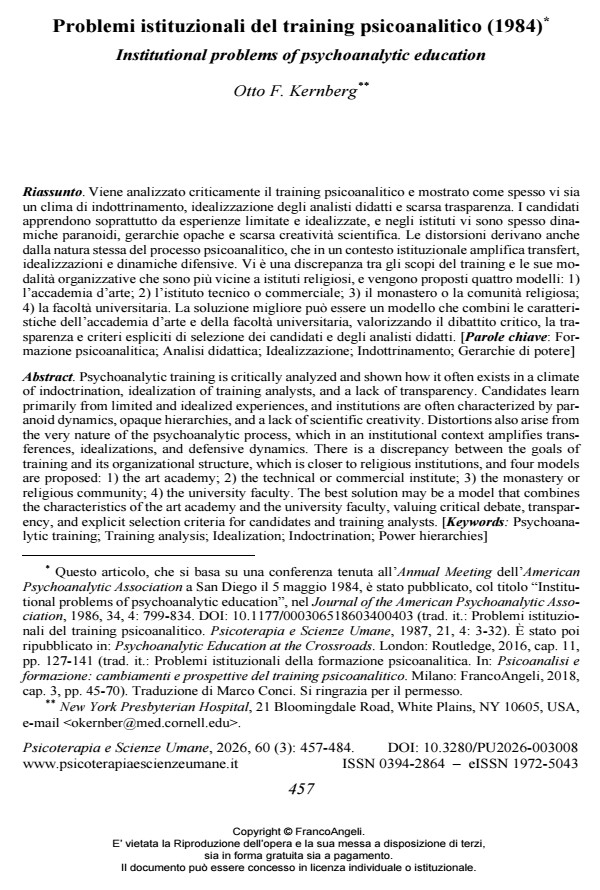
Below, you can see the article first page
If you want to buy this article in PDF format, you can do it, following the instructions to buy download credits
FrancoAngeli is member of Publishers International Linking Association, Inc (PILA), a not-for-profit association which run the CrossRef service enabling links to and from online scholarly content.
Psychoanalytic training is critically analyzed and shown how it often exists in a climate of indoctrination, idealization of training analysts, and a lack of transparency. Candidates learn primarily from limited and idealized experiences, and institutions are often characterized by paranoid dynamics, opaque hierarchies, and a lack of scientific creativity. Distortions also arise from the very nature of the psychoanalytic process, which in an institutional context amplifies transferences, idealizations, and defensive dynamics. There is a discrepancy between the goals of training and its organizational structure, which is closer to religious institutions, and four models are proposed: 1) the art academy; 2) the technical or commercial institute; 3) the monastery or religious community; 4) the university faculty. The best solution may be a model that combines the characteristics of the art academy and the university faculty, valuing critical debate, transparency, and explicit selection criteria for candidates and training analysts.
Keywords: Psychoanalytic training; Training analysis; Idealization; Indoctrination; Power hierarchies
- Arlow J.A. (1972). Some dilemmas in psychoanalytic education. Journal of the American Psychoanalytic Association, 20, 3: 556566. DOI: 10.1177/000306517202000310
- Bion W.R. (1961). Experiences in Groups. London: Tavistock (trad. it.: Esperienze nei gruppi e altri saggi. Roma: Armando, 1971).
- Dulchin J. & Segal A.J. (1982a). The ambiguity of confidentiality in a psychoanalytic institute. Psychiatry, 45, 1: 1325.
- Dulchin J. & Segal A.J. (1982b). Third party confidences: The uses of information in a psychoanalytic institute. Psychiatry, 45, 1: 2737.
- Franzen S. (1982). Editorial. Council for the Advancement of Psychoanalysis – Education Bulletin, 2, 2: 2.
- Freud S. (1922 [1923]). Due voci di enciclopedia: “Psicoanalisi” e “Teoria della libido”. Opere, 9: 439462. Torino: Boringhieri, 1977.
- Greenacre P. (1959). Problems of the training analysis. In: Minutes of Training Analysts’ Seminar. Chicago, IL: Chicago Institute for Psychoanalysis, November 21.
- Jaques E. (1976). A General Theory of Bureaucracy. New York: Halsted (trad. it.: Teoria generale della burocrazia. Milano: Mondadori, 1979). Di Elliott Jaques si vedano anche gli articoli “L’apprendimento dell’incertezza” e “Tesi sul lavoro e la creatività” (tratti dal libro del 1970 Lavoro creatività e giustizia sociale. Torino: Boringhieri, 1978) pubblicati nel n. 3/4 del 1972 di Psicoterapia e Scienze Umane.
- Keiser S. (1969). Report of the outgoing Chairman of the Committee on Institutes to the Board on Professional Standards. In: Annual Meeting, May, 1969. Bulletin of the American Psychoanalytic Association, 25, 2: 11681169 (Journal of the American Psychoanalytic Association, 1969, 17).
- Kernberg O.F. (1980). Internal World and External Reality: Object Relations Theory Applied.
- New York: Aronson (trad. it.: Mondo interno e realtà esterna. Torino: Boringhieri, 1985). Kernberg O.F. (1984). The couch at sea: Psychoanalytic studies of group and organizational leadership. International Journal of Group Psychotherapy, 34, 1: 523. DOI: 10.1080/00207284.1984.11491359
- Lifschutz J.E. (1976). A critique of reporting and assessment in the training analysis. Journal of the American Psychoanalytic Association, 24, 1: 4359. DOI: 10.1177/000306517602400103
- Mahony P.J. (1979). The budding international association of psychoanalysis and its discontents. Psychoanalysis and Contemporary Thought, 2, 4: 551593.
- Roustang F. (1982). Dire Mastery: Discipleship from Freud to Lacan. Baltimore, MD: John Hopkins University Press.
Otto F. Kernberg, Problemi istituzionali del training psicoanalitico (1984) in "PSICOTERAPIA E SCIENZE UMANE" 3/2026, pp 457-484, DOI: 10.3280/PU2026-003008