Training analysis and power. The transformation of a method of training and learning into an instrument of power in institutionalized psychoanalysis
Journal title PSICOTERAPIA E SCIENZE UMANE
Author/s Johannes Cremerius
Publishing Year 2026 Issue 2026/3
Language Italian Pages 26 P. 517-542 File size 382 KB
DOI 10.3280/PU2026-003011
DOI is like a bar code for intellectual property: to have more infomation
click here
Below, you can see the article first page
If you want to buy this article in PDF format, you can do it, following the instructions to buy download credits
FrancoAngeli is member of Publishers International Linking Association, Inc (PILA), a not-for-profit association which run the CrossRef service enabling links to and from online scholarly content.
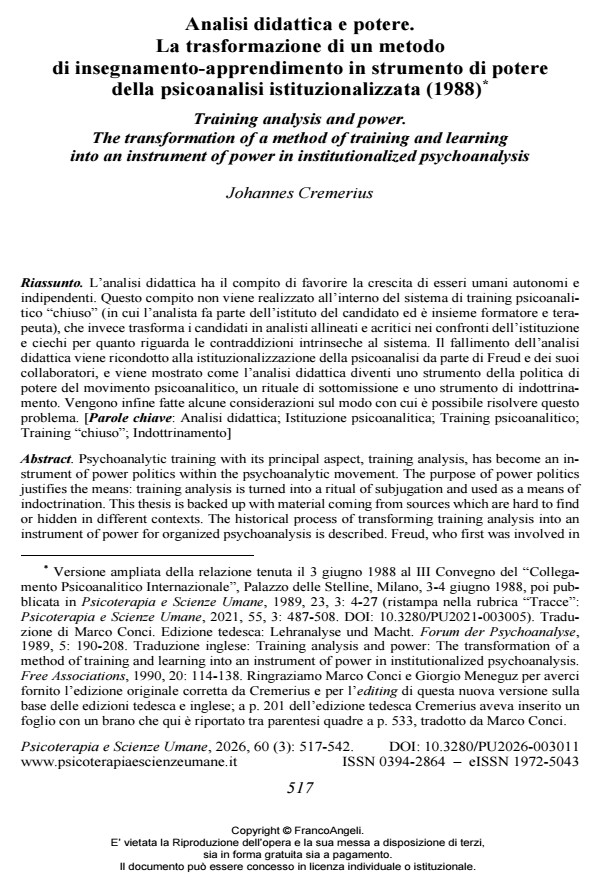
Psychoanalytic training with its principal aspect, training analysis, has become an instrument of power politics within the psychoanalytic movement. The purpose of power politics justifies the means: training analysis is turned into a ritual of subjugation and used as a means of indoctrination. This thesis is backed up with material coming from sources which are hard to find or hidden in different contexts. The historical process of transforming training analysis into an instrument of power for organized psychoanalysis is described. Freud, who first was involved in this development, later shared his criticism of training analysis with his daughter Anna, who wrote about this problem in 1938. Too late, however, to be able to influence the antipsychoanalytic aspects of training analysis. After the description of the present situation, criticisms of training analysis based on many years of experience as a training analyst within the psychoanalytic institution are suggested. The task of promoting independent candidates which is assigned to training analysis is not performed; on the contrary, it brings forth proselytes, devoted analysts and members who are uncritical of the institution. Finally, some suggestions on how we can solve this problem are presented.
Keywords: Training analysis; Psychoanalytic institution; Psychoanalytic training; “Closed” training system; Indoctrination
- Alexander F. (1930). Der therapeutische Lehrgang. In: Zehn Jahre Berliner Institut. Wien: Internationaler Psychoanalytischer Verlag, 1930, pp. 5458.
- Appy G. (1986). “Selbstentfremdung der Psychoanalyse in der Gesundheitspolitik”. Relazione tenuta il 20 novembre 1986 a un convegno della DPV a Wiesbaden.
- Balint M. (1947). On the psychoanalytic training system. International Journal of Psychoanalysis, 1948, 29, 2: 163173 (trad. it.: Il sistema didattico in psicoanalisi. In: Balint, 1974, pp.
- 1747. Anche in: Psicoterapia e Scienze Umane, 2026, 60, 3: 373392. DOI: 10.3280/PU2026003003)
- Balint M. (1953). Analytic training and training analysis. International Journal of Psychoanalysis, 1954, 35, 2: 157162 (trad. it.: Formazione analitica e analisi didattica. In: Balint, 1974, pp. 4964. Anche in: Psicoterapia e Scienze Umane, 2026, 60, 3: 417428. DOI: 10.3280/PU2026003005)
- Balint M. (1974). L’analisi didattica. Chi psicoanalizzerà gli psicoanalisti? Rimini: Guaraldi (vedi anche: L’amore primario. Rimini: Guaraldi, 1973; Milano: Raffaello Cortina, 1991).
- Benedek Th. (1965). Training analysis: Past, present and future. International Journal of Psychoanalysis, 1969, 50: 437445.
- Bernfeld S. (1952). On psychoanalytic training. Psychoanalytic Quarterly, 1962, 31, 4: 453482
- (trad. it.: Sul training psicoanalitico. Psicoterapia e Scienze Umane, 2026, 60, 3: 393416. DOI: 10.3280/PU2026003004)
- Bird B. (1968). On candidate selection and its relation to analysis. International Journal of Psychoanalysis, 49: 513526.
- BlayaPerez M. (1985). Die Beendigung der Lehranalyse. ProzessErwartungenWas erreicht wurde. In: Cooper A.M., editor, Die Beendigung der Lehranalyse: Prozeß, Erwartungen, Was erreicht wurde. Schriftenreihe der IPV, 1985, vol. 5.
- Brecht K., Friedrich V., Hermanns L.M., Juelich D. & Kaminer I.J., editors (1985). “Hier geht das Leben auf eine sehr merkwürdige Weise weiter...”: Zur Geschichte der Psychoanalyse in Deutschland. Hamburg: Kellner.
- Bruzzone M., Casaula E., Jimenez J.P. & Jordan J.F. (1985). Regression and persecution in analytic training. Reflections on experience. International Review of Psychoanalysis, 12: 411415.
- Clark R. (1980). Freud, the Man and the Cause. London: Cape (trad. it.: Freud: vita e opere del padre della psicoanalisi. Milano: Rizzoli, 1983).
- Cremerius J. (1969). Einleitung zu: Karl Abraham, Psychoanalytische Studien. Frankfurt a.M.: Fischer, 196971 (trad. it.: Introduzione. In: Karl Abraham, Opere. Torino: Boringhieri, 1975, pp. 933).
- Cremerius J., editor (1971). Neurose und Genialität. Psychoanalytische Biographien. Frankfurt a.M.: Fischer (trad. it.: Nevrosi e genialità. Torino: Boringhieri, 1975).
- Cremerius J. (1981). Freud bei der Arbeit über die Schulter geschaut. Seine Technik im Spiegel von Schülern und Patienten. Jahrbuch der Psychoanalyse, 6 (Suppl.): 123158 (trad. it.: Freud al lavoro: uno sguardo al di sopra delle sue spalle. La sua tecnica nel resoconto di allievi e pazienti. In: Il mestiere dell’analista. Torino: Boringhieri, 1985, pp. 184215).
- Cremerius J. (1982). Die Bedeutung des Dissidenten für die Psychoanalyse. Psyche, 36, 6: 481514 (trad. it.: L’importanza dei dissidenti per la psicoanalisi. Psicoterapia e Scienze Umane, 1983, 17, 3: 337).
- Ferenczi S. (1920). “Rundbriefe” und das “Geheime Komitee”, 2091920. In: Otto Rank Archive. New York: Columbia University Library (cit. in: Wittenberger, 1987).
- Cremerius, J. (1985). Krankheitswandel oder Verlagerung und Umschichtung der Neurosen im medizinischen Versorgungsbereich? [Modifica della malattia oppure viraggio della nevrosi nell’area medica?]. Praxis der Psychotherapie und Psychosomatik, 30, 2: 6071.
- Cremerius J. (1986). Spurensicherung. Die “Psychoanalytische Bewegung” und das Elend der psychoanalytischen Institution. Psyche, 40, 12: 10361091 (relazione al primo convegno dell’Internationale Psychoanalytische Vernetzung, dal titolo “Istituzionalizzazione/Deistituzionalizzazione. Passato e presente della Sinistra psicoanalitica” [Institutionalisierung/Deinstitutionalisierung], Zurigo, 30 maggio1 giugno 1986) (trad. it.: Alla ricerca di tracce perdute. Il “Movimento psicoanalitico” e la miseria dell’istituzione psicoanalitica. Psicoterapia e Scienze Umane, 1987, 21, 3: 324).
- Cremerius J. (1987a). Unterdrückung von Wahrheit, persönlicher Freiheit und wissenschaftlichem Denken in der psychoanalytischen Bewegung (relazione al secondo convegno dell’Internationale Psychoanalytische Vernetzung, dal titolo “Astinenza? Elementi di una psicoanalisi critica” [Abstinenz? Elemente einer kritischen Psychoanalyse], Zurigo, 2628 giugno 1987. Vedi Werkblatt, 1988, 16/17). In: Psychoanalytisches Seminar Zürich (PSZ), editor, Between the Devil and the Deep Blue Sea. Psychoanalyse im Netz. Freiburg i.B.: Kore Verlag, 1987, pp. 1534.
- Cremerius J. (1987b). Wenn wir als Psychoanalytiker die psychoanalytische Ausbildung organisieren, müssen wir sie psychoanalytisch organisieren! Psyche, 41, 12: 10671096 (trad. it.: Quando noi, psicoanalisti, organizziamo il training psicoanalitico, dobbiamo farlo in maniera psicoanalitica! Quaderni. Associazione di Studi Psicoanalitici, 1991, II, 3: 523 [I e II parte], 4: 2435 [III parte]. Anche in: Psicoterapia e Scienze Umane, 2026, 60, 3: 485514. DOI: 10.3280/PU2026003009)
- Cremerius J. (1988). Analisi didattica e potere. La trasformazione di un metodo di insegnamentoapprendimento in strumento di potere della psicoanalisi istituzionalizzata. Psicoterapia e Scienze Umane, 1989, 23, 3: 327. Ristampe: 2021, 55, 3: 487508.003005; 2026, 60, 3: 517542. DOI: 10.3280/PU202
- Cremerius J. (1989). Kritische Überlegungen zum psychoanalytischen Ausbildungssystem. Psychoanalyse im Widerspruch, 1: 3950 (relazione al quarto convegno dell’Internationale Psychoanalytische Vernetzung, dal titolo “Ricordare, dimenticare, essere responsabili” [Erinnern, vergessen, verantworten], Francoforte, 24 giugno 1989. Vedi Werkblatt, 1989, 20/21).
- Dräger K. (1971). Bemerkungen zu den Zeitumständen und zum Schicksal der Psychoanalyse und der Psychotherapie in Deutschland zwischen 1933 und 1949. Psyche, 25, 4: 255268.
- Eissler K.R. (1965). Medical Orthodoxy and the Future of Psychoanalysis. New York: International Universities Press (trad. it.: Ortodossia medica e futuro della psicoanalisi. Roma: Armando, 1979).
- Eitingon M. (1925). Korrespondenzblatt der internationalen psychoanalytischen Vereinigung. Internationale Zeitschrift für Psychoanalyse, 11, 4: 501528.
- Federn E. (1972). A cooperation through life. In: Federn E., Urbach A., Meng H. & Weiss E., editors, Thirtyfive years with Freud in honour of the hundredth anniversary of Paul Federn,
- M.D. Journal of the History of the Behavioral Sciences, 1972, 8, S1 (Suppl.): 1833. Ferenczi S. (191011). Zur Organisation der psychoanalytischen Bewegung. In: Balint M., editor,
- Schriften zur Pscychoanalyse. Frankfurt a.M.: Fischer, 1970 (trad. it.: A proposito della storia del movimento psicoanalitico. In: Opere, 19081912, vol. I. Milano: Raffaello Cortina, 1989, pp. 144153).
- Forel A. (1910). Kulturbestrebungen der Gegenwart. München: Reinhardt.
- France A. (1914). La révolte des anges. Paris: Calmann Levy (trad. it.: La ribellione degli angeli.
- Sesto San Giovanni [MI]: Barion, 1928; La rivolta degli angeli. Firenze: Sansoni, 1966).
- Freud A. (1938). Probleme der Lehranalyse. In: Max Eitingon in Memoriam. Jerusalem: Israel Psychoanalytic Society, 1950, pp. 8094 (trad. it.: Problemi dell’analisi didattica. In: Opere di Anna Freud. Vol. 1. Torino: Boringhieri, 1978, pp. 269280. Anche in: Psicoterapia e Scienze Umane, 2026, 60, 3: 363372. DOI: 10.3280/PU2026003002).
- Freud A. (1976). Bemerkungen über Probleme der psychoanalytischen Ausbildung. In: Die Schriften der Anna Freud. Munich: Kindler, 1980, vol. X, pp. 28052810.
- Freud A. (1978). Inaugural Lecture for the Sigmund Freud Chair at the Hebrew University, Jerusalem. International Journal of Psychoanalysis, 59, 2: 145148.
- Freud S. (1904 [1905]). Psicoterapia. Opere, 4: 429439. Torino: Boringhieri, 1970.
- Freud S. (1912). Tecnica della psicoanalisi. Consigli al medico nel trattamento psicoanalitico. Opere, 6: 532541. Torino: Boringhieri, 1974.
- Freud S. (1914). Per la storia del movimento psicoanalitico. Opere, 7: 377438. Torino: Boringhieri, 1975.
- Freud S. (191517 [191617]). Introduzione alla psicoanalisi. Opere, 8: 191611. Torino: Borin ghieri, 1976.
- Freud S. (1918 [1919]). Vie della terapia psicoanalitica. Opere, 9: 1928. Torino: Boringhieri, 1977.
- Freud S. (1922 [1923]). Due voci di enciclopedia: “Psicoanalisi” e “Teoria della libido”. 1. Psicoanalisi. Opere, 9: 439457. Torino: Boringhieri, 1977.
- Freud S. (1926). Il problema dell’analisi condotta da non medici. Conversazione con un interlocutore imparziale. Opere, 10: 347415. Torino: Boringhieri, 1978.
- Freud S. (1927). Poscritto del 1927 [a “Il problema dell’analisi condotta da non medici. Conversazione con un interlocutore imparziale” (1926). Opere, 10: 347415]. Opere, 10: 416423. Torino: Boringhieri, 1978.
- Freud S. (1937). Analisi terminabile e interminabile. Opere, 11: 497535. Torino: Boringhieri, 1979.
- Freud S. & Andreas Salomé L. (1966). Briefwechsel. A cura di E. Pfeiffer. Frankfurt a.M.: Fischer (trad. it.: Eros e conoscenza. Lettere 19121936. Torino: Boringhieri, 1983).
- Freud S. & Jung C.G. (190623 [1974]). Briefwechsel. A cura di W.Mc Guire & W. Sauerlaender. Frankfurt a.M.: Fischer, 1974 (trad. it.: Lettere tra Freud e Jung. Torino: Boringhieri, 1974). Gaddini E. (1984). Changes in psychoanalytic patients up to the present day. In: Wallerstein R.S., editor, Changes in Analysts and in Their Training (IPA Monograph 4). London: IPA, 1984,
- pp. 619 (trad. it.: Se e come sono cambiati i nostri pazienti fino ai nostri giorni. Rivista di Psicoanalisi, 1984, 30, 4: 560580. Anche in: Scritti 19531985. Milano: Raffaello Cortina, 1989, pp. 644662).
- Gillespie W. (1987). Geschichte der IPV im Spiegel ihrer Kongresse. In: Opuscolo informativo dell’IPA, 1987, pp. 2529.
- Gitelson M. (1954). Therapeutic problems in the analysis of the “normal” candidate. International Journal of Psychoanalysis, 35, 2: 174183. Anche in: Psychoanalysis: Science and Profession. New York: International Universities Press, 1973 (trad. it.: Problemi terapeutici nell’analisi del candidato “normale”. In: Psicoanalisi: scienza e professione. Torino: Boringhieri, 1980, cap. 11, pp. 171190).
- Heimann P. (1954). Problems of the training analysis. International Journal of Psychoanalysis, 35, 2: 163168.
- Holder A. (1984). Psychotherapie und staatliche Gesundheitswesen in England. In: Bach et al., editors, Psychoanalyse, Psychotherapie und Öffentlichkeit. Göttingen: Vandenhoock und Ruprecht, 1984, pp. 133137.
- IPA (International Psychoanalytic Association) (1985). Minimalerfordernisse für Erwerb und Aufrechterhaltung der Lehranalytikerfunktion. IPA Newsletter, XIII, 3 (edizione tedesca).
- Jones E. (195357). The Life and Work of Sigmund Freud (3 volumes). New York: Basic Books, 1953 (vol. I), 1955 (vol. II), 1957 (vol. III) (trad. it.: Vita e opere di Freud. Milano: Il Saggiatore, 1962; Milano: Garzanti, 1977).
- Joseph E. (1979). Konferenzbeitrag (Haslemere Symposium, 1823 febbraio 1976, non pubblicato). Cit. in: Klauber J., The identity of the psychoanalyst. Sigmund Freud House Bulletin, 3: 59.
- Kairys D. (1964). The training analysis. A critical review of the literature and a controversial proposal. Psychoanalytic Quarterly, 33, 4: 485512. DOI: 10.1080/21674086.1964.11926324
- Knight R.P. (1953). The present status of organized psychoanalysis in the United States. Journal of the American Psychoanalytic Association, 1, 2: 197221.
- Kuhn T.S. (1962). The Structure of Scientific Revolution (2nd Edition: 1970). Chicago, IL: University of Chicago Press (trad. it.: La struttura delle rivoluzioni scientifiche. Torino: Einaudi, 1969).
- McLaughlin F. (1967). Addendum to a controversial proposal: Some observations on the training analysis. Psychoanalytic Quarterly, 36, 2: 230247. DOI: 10.1080/21674086.1967.11926423
- McLaughlin F. (1973). The nonreporting training analyst, the analysis and the institute. Journal of the American Psychoanalytic Association, 21, 4: 697712.
- Meerwein F. (1978). Die Identität des Psychoanalytikers. Zeitschrift für Psychosomatische Medizin und Psychotherapie, 8: 2944.
- Nacht S. (1953). Difficulté de la psychanalyse didactique par rapport à la psychanalyse thérapeutique. Revue Française de Psychanalyse, 17, 3: 320327 (trad. inglese: The difficulties of didactic psychoanalysis in relation to therapeutic psychoanalysis. International Journal of Psychoanalysis, 1954, 35, 2: 250253).
- Nacht S., Lebovici S. & Diaktine R. (1960). L’enseignement de la psychanalyse. Revue Française de Psychanalyse, 24, 10: 225240.
- Nunberg H. & Federn E., editors (197681). Minutes of the Vienna Psychoanalytic Society, 4 volumi. New York: International Universities Press (trad. it. del solo volume 1, Dibattiti della Società psicoanalitica di Vienna, 19061908. Torino: Boringhieri, 1973).
- Perlman F.T. (2021). Cronache psicoanalitiche: il dibattito sull’analisi didattica all’interno dell’American Psychoanalytic Association. Psicoterapia e Scienze Umane, 55, 3: 363424. DOI: 10.3280/PU2021003001
- Pulver S., reporter (1978). Survey of psychoanalytic practice 1976. Some trends and implications. Journal of the American Psychoanalytic Association, 26, 3: 615631.
- Sachs H. (1930). Die Lehranalyse. In: Zehn Jahre Berliner Psychoanalytisches Institut. Wien: Internationaler Psychoanalytischer Verlag, 1930, pp. 5354.
- Simenauer E. (1983). Some aspects of training analysis. International Review of Psychoanalysis, 10, 2: 145157 (trad. ted.: Aktuelle Probleme der Lehranalyse. Psyche, 1984, 38, 4: 289306). Speier S. (1983). Gedanken zur Ausbildung oder Wie man Analytiker wird. In: Lohmann H.M., editor, Das Unbehagen in der Psychoanalyse. Eine Streitschrift. Frankfurt a.M.: Gumran, 1983, pp. 104110.
- Thomä H. & Kächele H. (1985). Lehrbuch der psychoanalytischen Therapie. 1: Grundlagen. Berlin: Springer (trad. it.: Trattato di terapia psicoanalitica. 1: Fondamenti teorici. Torino: Bollati Boringhieri, 1990).
- Wallerstein R.S. (1981). The psychoanalyst’s life: Expectations, vicissitudes, and reflections. International Review of Psychoanalysis, 8, 3: 28598.
- Wallerstein R.S. (1985). Die Beendigung der Lehranalyse, die Sicht des Institutes. In: Cooper A.M., editor, Die Beendigung der Lehranalyse: Prozeß, Erwartungen, Was erreicht wurde. Schriftenreihe der IPA, 1985, vol. 5.
- Wallerstein R.S. (1988). One psychoanalysis or many? International Journal of Psychoanalysis, 69, 1: 521 (trad. it.: “Una o molte psicoanalisi? Gli Argonauti, 1989, XI, 43: 253276).
- Widlöcher D. (1977). The professional career of the psychoanalyst and problems of training. European Psychoanalytical Federation Bulletin, 11: 26.
- Wittenberger G. (1987). Von der Selbstregulation zum “PrüfungKolloquium”. In: Haesler L. & Maas G., editor, Psychoanalytischer Prozeß und Institution. Hofheim (Wiesbaden): Atti (pubblicati in proprio) del Congresso della DPV, Essen, 69 maggio 1987.
Johannes Cremerius, Analisi didattica e potere. La trasformazione di un metodo di insegnamento-apprendimento in strumento di potere della psicoanalisi istituzionalizzata (1988) in "PSICOTERAPIA E SCIENZE UMANE" 3/2026, pp 517-542, DOI: 10.3280/PU2026-003011