Rethinking Labour Exploitation through Constraints and Agency: a Power Resource perspective
Journal title MONDI MIGRANTI
Author/s Nicola Quondamatteo
Publishing Year 2026 Issue 2026/2
Language English Pages 18 P. 23-40 File size 182 KB
DOI 10.3280/MM2026-002002
DOI is like a bar code for intellectual property: to have more infomation
click here
Below, you can see the article first page
If you want to buy this article in PDF format, you can do it, following the instructions to buy download credits
FrancoAngeli is member of Publishers International Linking Association, Inc (PILA), a not-for-profit association which run the CrossRef service enabling links to and from online scholarly content.
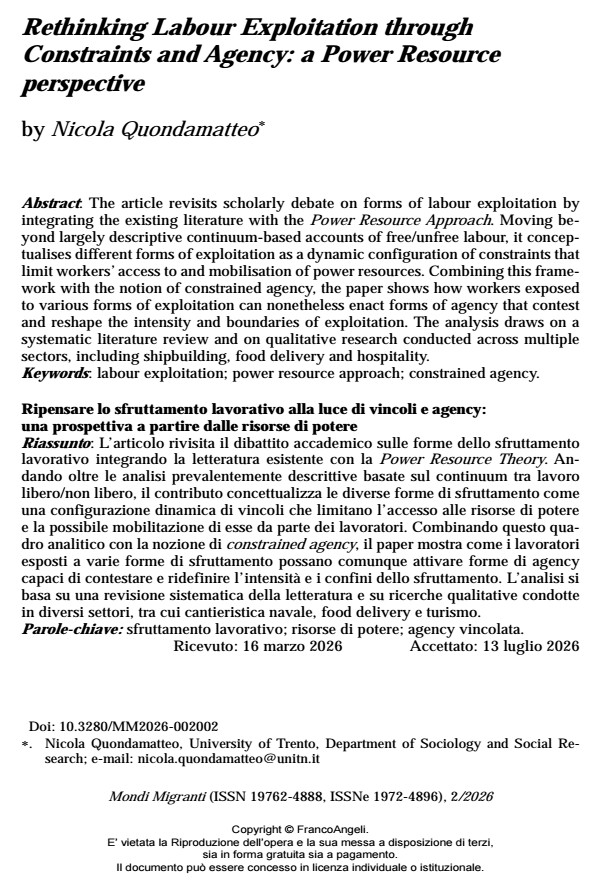
The article revisits scholarly debate on forms of labour exploitation by integrating the existing literature with the Power Resource Approach. Moving beyond largely descriptive continuum-based accounts of free/unfree labour, it conceptualises different forms of exploitation as a dynamic configuration of constraints that limit workers’ access to and mobilisation of power resources. Combining this framework with the notion of constrained agency, the paper shows how workers exposed to various forms of exploitation can nonetheless enact forms of agency that contest and reshape the intensity and boundaries of exploitation. The analysis draws on a systematic literature review and on qualitative research conducted across multiple sectors, including shipbuilding, food delivery and hospitality.
Keywords: labour exploitation; power resource approach; constrained agency.
- Adams Z. (2023). Legal mobilisations, trade unions and radical social change: a case study of the IWGB. Industrial Law Journal, 52, 3: 560-594;
- Alberti G. and Però D. (2018). Migrating industrial relations: migrant workers’ initiative within and outside trade unions. British Journal of Industrial Relations, 56, 4: 693-715;
- Ambrosini M. (2013). Immigration in Italy: between economic acceptance and political rejection. Journal of International Migration and Integration, 14: 175-194;
- Anderson B. (2010). Migration, immigration controls and the fashioning of precarious workers. Work, Employment and Society, 24, 2: 300-317; DOI: 10.1177/0950017010362141/
- Andrijasevic R. and Novitz T. (2020). Supply chains and unfree labor: regulatory failure in the case of Samsung Eletronics in Slovakia. Journal of Human Trafficking, 6, 2: 195-208; DOI: 10.1080/23322705.2020.1691817/
- Andrijasevic R. and Sacchetto D. (2016). From labour migration to labour mobility? The return of the multinational worker in Europe. Transfer: European Review of Labour and Research, 22, 2: 219-231; DOI: 10.1177/1024258916635975/
- Appay B. (1998). Economic concentration and the externalization of labour. Economic and Industrial Democracy, 19, 1: 161-184; DOI: 10.1177/0143831X98191008/
- Baccaro L. and Howell C. (2017). Trajectories of neoliberal transformation. European industrial relations since the 1970s. Cambridge: Cambridge University Press.
- Baglioni E. (2018). Labour control and the labour question in global production networks: exploitation and disciplining in Senegalese export horticulture. Journal of Economic Geography, 18, 1: 111-137; https://www.jstor.org/stable/26396361/.
- Ban C. et al. (2022). A perfect storm: COVID-19 and the reorganisation of the German meat industry. Transfer: European Review of Labour and Research, 28, 1: 101-118; DOI: 10.1177/10242589221081943/
- Bernards N. (2017). The global politics of forced labour. Globalizations, 14, 6: 944-957; DOI: 10.1080/14747731.2017.1287470/
- Berntsen L. and Marino S. (2023). Guest editorial: State policies and regulations towards migrant work in times of, and beyond, the Covid-19 pandemic. International Journal of Sociology and Social Policy, 43, 3-4: 293-305; DOI: 10.1108/IJSSP-04-2023-547/
- Brass T. (2011). Unfree Labour as Primitive Accumulation. Capital & Class, 35, 1: 23-38; DOI: 10.1177/0309816810392969/
- Brass T. and Van der Linden M., eds. (1997). Free and Unfree Labour: The Debate Continues. Berlin: Peter Lang.
- Burawoy M. (1976). The functions and reproduction of migrant labor: comparative material from Southern African and the United States. American Journal of Sociology, 81, 5: 1050-1087; https://www.jstor.org/stable/2777555/.
- Burawoy M. (1979). Manufacturing consent. Changes in the labor process under monopoly capitalism. Chicago: Chicago University Press.
- Carroll M. et al. (2005). The strategic management of contracting in the private sector. In: Marchington M. et al., eds., Fragmenting work: blurring organizational boundaries and disordering hierarchies. Oxford: Oxford University Press.
- Caspersz D. et al. (2022). Modern slavery in global value chains: a global factory and governance perspective. Journal of Industrial Relations, 64, 2: 177-199; DOI: 10.1177/00221856211054586/
- Ceccagno A. (2017). City Making and Global Labor Regimes. Chinese Immigrants and Italy’s Fast Fashion Industry. London: Palgrave McMillan.
- Centenera M. (2023). Argentina’s Milei threatens to cut off social welfare for protesters who block streets. El País, 19/12, viewed on 28/02/24.
- Chun J.J. (2009). Organizing at the margins. The symbolic politics of labor in South Korea and the United States. Ithaca: ILR Press.
- Cini L. (2023) How algorithms are reshaping the exploitation of labour-power: insights into the process of labour invisibilization in the platform economy. Theory and Society, 52: 885-911;
- Cini L. and Goldman B. (2021). The worker capabilities approach: insights from worker mobilizations in Italian logistics and food delivery. Work, Employment and Society, 35, 5: 948-967; DOI: 10.1177/0950017020952670/
- Coe N.M. and Jordhus-Lier D.C. (2010). Constrained agency? Re-evaluating the geographies of labour. Progress in Human Geography, 35, 2: 211-233; DOI: 10.1177/0309132510366746/
- Davies J. (2019). From severe to routine labour exploitation: the case of migrant workers in the UK food industry. Criminology & Criminal Justice, 19, 3: 294-310; DOI: 10.1177/1748895818762264/
- De Genova N.P. (2002). Migrant “illegality” and deportability in everyday life. Annual Review of Anthropology, 31: 419-447; https://www.jstor.org/ stable/4132887/.
- Fernandez B. (2021). Racialised institutional humiliation through the Kafala. Journal of Ethnic and Migration Studies, 47, 19: 4344-4361; DOI: 10.1080/1369183X.2021.1876555/
- Fudge J. (2018). Modern slavery, unfree labour and the labour market: the social dynamics of legal characterization. Social & Legal Studies, 27, 4: 414-434; DOI: 10.1177/0964663917746736/
- Fudge J. (2019). (Re)conceptualising Unfree Labour: local labour control regimes and constraints on workers’ freedom. Global Labour Journal, 10, 2: 108-122;
- Gheorghiev O. (2025). At the Foot of the Mountain: Temporalities of Production and Social Reproduction of Ukrainian Refugee Women in the Czech Republic. International Migration & Integration;
- Gordon T. (2019). Capitalism, neoliberalism, and unfree labour. Critical Sociology, 45, 6: 921-939; DOI: 10.1177/0896920518763936/
- Greer I. (2024). The structural power of workers under capitalism: a marketisation approach. In: Arnholtz J. and Refslund B., eds., Workers, power and society. Power Resource Theory in contemporary capitalism. NY: Routledge.
- Ibsen C.L. (2024). Associational power resources. In: Arnholtz J. and Refslund B., eds., Workers, power and society. Power Resource Theory in contemporary capitalism. NY: Routledge.
- Ince A. et al. (2015). British jobs for British workers? Contesting work, nation and globalisation through the Lindsey Oil Refinery disputes. Antipode: A radical journal of geography, 47, 1: 139-157;
- Kaminer M. (2024). Capitalist Colonial. Thai migrant workers in Israeli agriculture. Stanford: Stanford University Press.
- Lerche J. (2007). A global alliance against forced labour? Unfree labour, neoliberal globalization and the International Labour Organisation. Journal of Agrarian Change, 7, 4: 425-452;
- Lewis H. et al. (2015). Hyper-precarious lives: migrants, work and forced labour in the Global North. Progress in Human Geography, 39, 5: 580-600; DOI: 10.1177/0309132514548303/
- Marino S. and Martinez Lucio M. (2024). Power resource theories and the case of trade unions and migrant labour in increasingly fragmented labour markets. In: Arnholtz J. and Refslund B., eds., Workers, power and society. Power Resource Theory in contemporary capitalism. NY: Routledge.
- Marx K. (1976). Capital. A Critique of Political Economy. Volume 1. NY: Penguin.
- Meardi G. (2018). Economic integration and State responses: change in European Industrial Relations since Maastricht. British Journal of Industrial Relations, 56, 3: 631-655;
- Meardi G. (2024). Migrant segregation and labour standards. In: Meardi G., ed., Research Handbook on Migration and Employment. Cheltenham, UK: Edward Elgar.
- Mezzadri A. (2016). The sweatshop regime. Labouring bodies, exploitation, and garments made in India. Cambridge: Cambridge University Press.
- O’Brady S. (2024). Institutional power resources. A critical analysis. In: Arnholtz J. and Refslund B., eds., Workers, power and society. Power Resource Theory in contemporary capitalism. NY: Routledge.
- Orth B. (2024). Stratified pathways into platform work: migration trajectories and skills in Berlin’s gig economy. Environment and Planning A: Economy and Space, 56, 2: 476-490; DOI: 10.1177/0308518X231191933/
- Palumbo L. (2024). Taking Vulnerabilities to Labour Exploitation Seriously: A Critical Analysis of Legal and Policy Approaches and Instruments in Europe. Cham: Springer.
- Penninx R. and Roosbald J., eds. (2000). Trade Unions, Immigration, and Immigrants in Europe, 1960-1993: A Comparative study of the attitudes and actions of trade unions in seven West European Countries. NY-Oxford: Berghahn Books.
- Pepino L. (2025). Blocco stradale. In: Osservatorio Repressione, Volere La Luna, eds., Questo libro è illegale. Contiene parole che insidiano la “sicurezza”. Milano: Altreconomia.
- Piore M.J. (1979). Birds of passage. Migrant labor and industrial societies. Cambridge: Cambridge University Press.
- Portes Virginio F. et al. (2023). Unpacking super-exploitation in the 21st century: the struggles of Haitian workers in Brazil. Work, Employment and Society, 37, 4: 897-915; DOI: 10.1177/09500170211060748/
- Quondamatteo N. (2025). The world in a shipyard. Subcontracting, migrant labour and union strategies in a globalised workplace. PhD Thesis. Florence: SNS.
- Quondamatteo N. (2023). Un salario per vivere, come minimo. Jacobin Italia, 05/07, viewed on 05/07/23; https://jacobinitalia.it/un-salario-per-vivere-come-minimo/
- Quondamatteo N. (2019). Non per noi ma per tutti. La lotta dei riders e il futuro del mondo del lavoro. Trieste: Asterios.
- Quondamatteo N. and Vianello F.A. (2025). Tides of labour and practices of individual resistance in seasonal tourism industry. Cambio. Rivista Sulle Trasformazioni Sociali, 14, 28;
- Ram M. et al. (2020). The roots of informal responses to regulatory change: non-compliant small firms and the National Living Wage. British Journal of Management, 31: 856-871; DOI: 10.1111/1467-8551.12363/
- Refslund B. and Arnholtz J. (2022). Power resource theory revisited: the perils and promises for understanding contemporary labour politics. Economic and Industrial Democracy, 43, 4: 1958-1979; DOI: 10.1177/0143831X211053379/
- Schierup C.U. and Ålund A. (2011). The end of Swedish exceptionalism? Citizenship, neoliberalism and the politics of exclusion. Race & Class, 53, 1: 45-64; DOI: 10.1177/0306396811406780/
- Schmalz S. et al. (2018). The power resources approach: developments and challenges. Global Labour Journal, 9, 2: 113-134;
- Selwyn B. (2020). Super-exploitation in the Global North and the Imperial Mode of Living: Some Thoughts, viewed on 12/03/23. https://soc21.nl/wp-content/uploads/2020/09/Ben-Selwyn-Super-Exploitaiton-in-the-Global-North-and-the-Imperial-Mode-of-Living-Some-Thoughts-V2.pdf /.
- Silver B. (2003). Forces of Labor. Workers’ movements and globalization since 1870. Cambridge: Cambridge University Press.
- Smith C. (2006). The double indeterminacy of labour power: labour effort and labour mobility. Work, Employment and Society, 20, 2: 389-402; DOI: 10.1177/0950017006065109/
- Tassinari A. and Maccarrone V. (2020). Riders on the storm: workplace solidarity among gig economy couriers in Italy and the UK. Work, Employment and Society, 34, 1: 35-54; DOI: 10.1177/0950017019862954/
- Tattersall A. (2010). Power in coalition: strategies for strong unions and social change. Ithaca: Cornell University Press.
- Webster E., Lambert R. and Bezuidenhout A. (2008). Grounding globalisation: labour in the age of insecurity. Oxford: Blackwell.
- Wright E.O. (2000). Working-class power, capitalist class-interests, and class compromise. American Journal of Sociology, 105, 4: 957-1002; https://www.jstor.org/stable/3003886/.
Nicola Quondamatteo, Rethinking Labour Exploitation through Constraints and Agency: a Power Resource perspective in "MONDI MIGRANTI" 2/2026, pp 23-40, DOI: 10.3280/MM2026-002002