Corpo a corpo. Simulazione incarnata e naturalizzazione dell’esperienza filmica

Titolo Rivista PSICOBIETTIVO
Autori/Curatori Vittorio Gallese, Michele Guerra
Anno di pubblicazione 2014 Fascicolo 2014/1
Lingua Italiano Numero pagine 22 P. 156-177 Dimensione file 1173 KB
DOI 10.3280/PSOB2014-001012
Il DOI è il codice a barre della proprietà intellettuale: per saperne di più clicca qui

Qui sotto puoi vedere in anteprima la prima pagina di questo articolo.

Se questo articolo ti interessa, lo puoi acquistare (e scaricare in formato pdf) seguendo le facili indicazioni per acquistare il download credit. Acquista Download Credits per scaricare questo Articolo in formato PDF
Anteprima articolo

FrancoAngeli è membro della Publishers International Linking Association, Inc (PILA)associazione indipendente e non profit per facilitare (attraverso i servizi tecnologici implementati da CrossRef.org) l’accesso degli studiosi ai contenuti digitali nelle pubblicazioni professionali e scientifiche

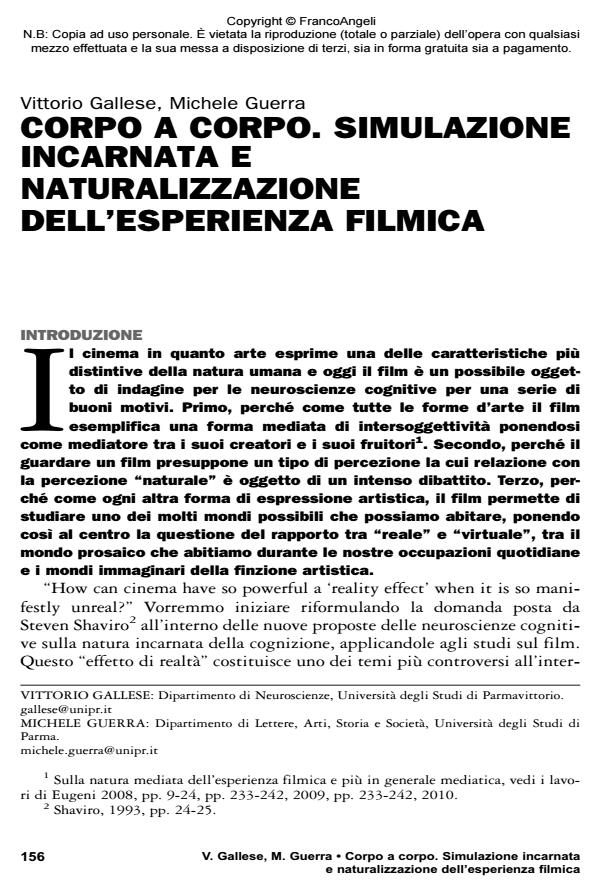
Recenti scoperte neuroscientifiche, tra cui quella dei neuroni specchio, hanno fortemente influenzato il dibattito sulla cognizione spaziale, l’azione, le emozioni e l’empatia, tutti aspetti recentemente riconsiderati dagli studi sul film. Questo articolo si concentra sul ruolo che la teoria della simulazione incarnata - elaborata a partire dalla scoperta dei neuroni specchio - svolge nell’esperienza filmica. È stato proposto che la simulazione incarnata costituisca un meccanismo funzionale di base del cervello umano. Grazie ad un formato rappresentazionale corporeo condiviso, mappiamo le azioni altrui sulle nostre rappresentazioni motorie. Ci chiediamo quanto questo meccanismo sia rilevante per l’esperienza filmica, riconsiderando sia le teorie classiche che quelle più recenti sul film che in qualche modo hanno anticipato la simulazione incarnata. Vaglieremo la nostra ipotesi attraverso l’analisi stilistica di due sequenze tratte da Notorius di Alfred Hitchcock e Il grido di Michelangelo Antonioni.

Parole chiave:Antonioni; Hitchcock; neuroni specchio; simulazione incarnata; stile cinematografico

  1. Eugeni R. (2008) “Soggetto, senso, emozioni: lavorare sul film”, in G. Carluccio, F. Villa (a cura di), Dentro l’analisi. Soggetto, senso, emozioni, Kaplan, Torino, pp. 9-24
  2. Eugeni R. (2009) “Neuroestetica ed esperienza mediale”, in F. Parisi, M. Primo (a cura di), Natura, comunicazione, neurofilosofie, Corisco, Roma-Messina
  3. Eugeni R. (2010) Semiotica dei media. Le forme dell’esperienza, Carocci, Roma
  4. Gallese V. (2003) “The Manifold Nature of Interpersonal Relations: The Quest for a Common Mechanism”, Philosophical Transactions of the Royal Society of London B, 358: 517-528
  5. Gallese V. (2005) “Embodied Simulation: From Neurons to Phenomenal Experience”, Phenomenology and the Cognitive Sciences, 4: 23-48
  6. Gallese V. (2009) “Mirror Neurons, Embodied Simulation and the Neural Basis of Social Identification”, Psychoanalytic Dialogues, 19: 519-536
  7. Gallese V. (2011) “Neuroscience and Phenomenology”, Phenomenology & Mind, 1: 33-48
  8. Gallese V., Guerra M. (2012) “Embodying Movies: Embodied Simulation and Film Studies”, Cinema: Journal of Philosophy and the Moving Image, 3: 183-210
  9. Gallese V., Sinigagllia C. (2011) “What Is So Special About Embodied Simulation?”, Trends in Cognitive Sciences, 15: 512-519
  10. Ghazanfar A.A., Shepherd S.V. (2011) “Monkeys at the Movies: What Evolutionary Cinematics Tells Us about Film”, Projections, 1: 1-25
  11. Grodal T. (1997) Moving Pictures: a New Theory of Film, Genres, Feelings, and Cognition, Oxford University Press, New York
  12. Grodal T. (2009) Embodied Visions: Evolution, Emotion, Culture, and Film, Oxford University Press, New York
  13. Guerra M. (2013a) “Film-Physiology”, pH, 2 (in press)
  14. Guerra M. (2013b) “Film and Cognitive Neuroscience: Toward a Naturalization of Film Experience?”, in J. Luzzi (ed.), The Total Art, Continuum (in press), New York
  15. Guerra M. (2013c) “Lo sguardo smarrito: riflessioni intorno a ‘Il grido di Michelangelo Antonioni’”, Ricerche di S/Confine (in press)
  16. Hansen M. (2011) Cinema and Experience: Siegfried Kracauer, Walter Benjamin, and Theodor W. Adorno, University of California Press, Berkeley and Los Angeles Heidegger M. (2006) Essere e tempo, Mondadori, Milano (I ed. 1927)
  17. Holland N.N. (2007) “The Neuroscience of Metafilm”, Projections, 1: 59-74
  18. Keysers C., Gazzola V. (2009) “Expanding the mirror: vicarious activity for actions, emotions, and sensations”, Current Opinion in Neurobiology, 19: 666-671
  19. Kracauer S. (1962) Film: ritorno alla realtà fisica, Il Saggiatore, Milano
  20. Krohn B. (2000) Hitchcock al lavoro, Rizzoli, Milano
  21. Lakoff G., Johnson M. (1999) Philosophy in the Flesh: the Embodied Mind and Its Challenge to Western Thought, Basic Books, New York
  22. MacDougall D. (2006) The Corporeal Image: Film, Ethnography, and the Senses, Princeton University Press, Princeton
  23. Magliano J., Zacks J.M. (2011) “The Impact of Continuity Editing in Narrative Film on Event Segmentation”, Cognitive Science, 1: 1-27
  24. Merleau-Ponty M. (2003) Fenomenologia della percezione, Bompiani, Milano (I ed. 1945)
  25. Merleau-Ponty M. (2009) Senso e non senso, Il Saggiatore, Milano (I ed. 1948)
  26. Merleau-Ponty M. (2011) Le monde sensible et le monde de l’expression. Cours au Collège de France. Notes 1953, MetisPresses, Genève
  27. Michotte van den Berck A. (1953) “La participation émotionelle du spectateur à l’action représentée à l’écran. Essai d’une théorie”, Revue Internationale de Filmologie, 13: 87-96
  28. Molenberghs P., Cunnington R., Mattingley J.B. (2012) “Brain regions with mirror properties: a meta-analysis of 125 human fMRI studies”, Neuroscience and Biobehavioral Reviews, 36: 341-349
  29. Ortoleva P. (2010) Una specie di transfert. Spettacolo e spettatore, da un antico dibattito all’esperienza filmica e televisiva, relazione al convegno “Etica e spettacolarità”, Almo Collegio Borromeo, Pavia, 21-22 settembre
  30. Pisters P. (2006) “The Spiritual Dimension of the Brain as Screen. Zigzagging from Cosmos to Earth (and Back)”, in R. Pepperell, M. Punt (eds.), Screen Consciousness: Cinema, Mind, and World, Rodopi, Amsterdam, pp. 123-137
  31. Risko E.F., Laidlaw K.E.W., Freeth,M., Foulsham T., Kingstone A. (2012) “Social Attention with Real Versus Reel Stimuli: Toward an Empirical Approach to Concerns About Ecological Validity”, Frontiers in Human Neuroscience, 6: 1-11
  32. Rizzolatti G., Fadiga L., Fogassi L., Gallese V. (1997) “The space around us”, Science, 277: 190-191
  33. Rizzolatti G., Sinigaglia C. (2010) “The functional role of the parieto-frontal mirror circuit: interpretations and misinterpretations”, Nature Review Neuroscience, 11: 264-274
  34. Sabbadini A. (2011) “Cameras, Mirrors, and the Bridge Space: a Winnicottian Lens on Cinema”, Projections, 1: 17-30
  35. Schefer J.L. (2006) L’uomo qualunque del cinema, Quodlibet, Macerata Shaviro S. (1993) The Cinematic Body, Minnesota University Press, Minneapolis
  36. Shaviro S. (2008) “The Cinematic Body Redux”, Parallax, 1: 48-54
  37. Shaviro S. (2009) Post-Cinematic Affect, Zero Books, Winchester Smith M. (2009) “Consciousness”, in P. Livingstone, C. Plantinga (eds.), The Routledge Companion to Philosophy and Film, New York, Routledge
  38. Smith T.J. (2012) “The Attentional Theory of Cinematic Continuity”, Projections, 1: 1-27
  39. Smith T.J., Levin D., Cutting J.E. (2012) “A Window on Reality: Perceiving Edited Moving Images”, Current Directions in Psychological Science, 21: 107-113
  40. Sobchack V. (1992) The Address of the Eye: a Phenomenology of Film Experience, Princeton University Press, Princeton
  41. Sobchack V. (2004) Carnal Thoughts: Embodiment and Moving Image Culture, University of California Press, Berkeley and Los Angeles
  42. Truffaut F. (1996) Il cinema secondo Hitchcock, Pratiche, Parma
  43. Wojciehowski H.C., Gallese V. (2011) “How Stories Make Us Feel: Toward an Embodied Narratology”, California Italian Studies, 2: s.i.p.
  44. Zacks J.M., Magliano J. (2011) “Film, Narrative, and Cognitive Neuroscience”, in F. Bacci, D. Melcher (eds.), Art and the Senses, Oxford University Press, New York
  45. Zernik C. (2010) Perception-cinéma. Les enjeux stylistiques d’un dispositive, Vrin, Paris
  46. Anderson J.D. (1996) The Reality of Illusion: an Ecological Approach to Cognitive Film Theory, Southern Illinois University Press, Carbondale and Edwardsville
  47. Antonioni M. (1964) Sei film, Einaudi, Torino
  48. Antunes L.R. (2012) “The Vestibular in Film: Orientation and Balance in Gus Van Sant’s Cinema of Walking”, Essays in Philosophy, 2, 522-549
  49. Barker J. (2009) The Tactile Eye: Touch and the Cinematic Experience, University of California Press, Berkeley and Los Angeles
  50. Barratt D. (2007) “Assessing the Reality Status of Film: Fiction or Non-Fiction, Live Action or CGI?”, in J.D. Anderson, B. Fischer Anderson (eds.), Narration and Spectatorship in Moving Images, Cambridge Scholar Publishing, Newcastle
  51. Bellour R. (2009) Le corps du cinéma. Hypnoses, émotions, animalité, POL, Paris
  52. Bordwell D., Thompson K. (2011) Minding Movies: Observations on the Art, Craft, and Business of Filmmaking, The Chicago University Press, Chicago
  53. Boyd B. (2009) On the Origin of Stories: Evolution, Cognition, and Fiction, The Belknap Press of Harvard University Press, Cambridge
  54. Brown W. (2011) “Film-Philosophy Conference”, Cinema: Journal of Philosophy and the Moving Image, 2: 218-229
  55. Carbone M. (2011) La chair des images: Merleau-Ponty entre peinture et cinema, Vrin, Paris
  56. Carroll N. (2008) The Philosophy of Motion Pictures, Blackwell, Oxford Chatman S. (1985) Antonioni, or the Surface of the World, University of California Press, Berkeley and Los Angeles
  57. Currie G. (1995) Image and Mind: Film, Philosophy, and Cognitive Science, Cambridge University Press, New York
  58. Cutting J.E. (2005) “Perceiving Scenes in Film and in the World”, in J.D. Anderson, B. Fischer Anderson (eds.), Moving Image Theory: Ecological Considerations, Southern Illinois University Press, Carbondale, pp. 9-27
  59. Damasio A. (2008) “Cinéma, esprit et emotion: la perspective du cerveau”, Trafic, 67: 94-101
  60. Deleuze G. (1984) L’immagine-movimento, Ubulibri, Milano
  61. Elliott P. (2011) Hitchcock and the Cinema of Sensations: Embodied Film Theory and Cinematic Reception, I.B. Tauris, London

  • The Palgrave Handbook of the Philosophy of Film and Motion Pictures Daniel Jerónimo Tobón, pp.865 (ISBN:978-3-030-19600-4)

Vittorio Gallese, Michele Guerra, Corpo a corpo. Simulazione incarnata e naturalizzazione dell’esperienza filmica in "PSICOBIETTIVO" 1/2014, pp 156-177, DOI: 10.3280/PSOB2014-001012