Cycles of (Im)mobility: Waithood and Severely Exploited Labour among Young African Male Migrants in Italy
Titolo Rivista MONDI MIGRANTI
Autori/Curatori Chukwudi Matthew Anuforo
Anno di pubblicazione 2026 Fascicolo 2026/2
Lingua Inglese Numero pagine 18 P. 76-93 Dimensione file 205 KB
DOI 10.3280/MM2026-002005
Il DOI è il codice a barre della proprietà intellettuale: per saperne di più
clicca qui
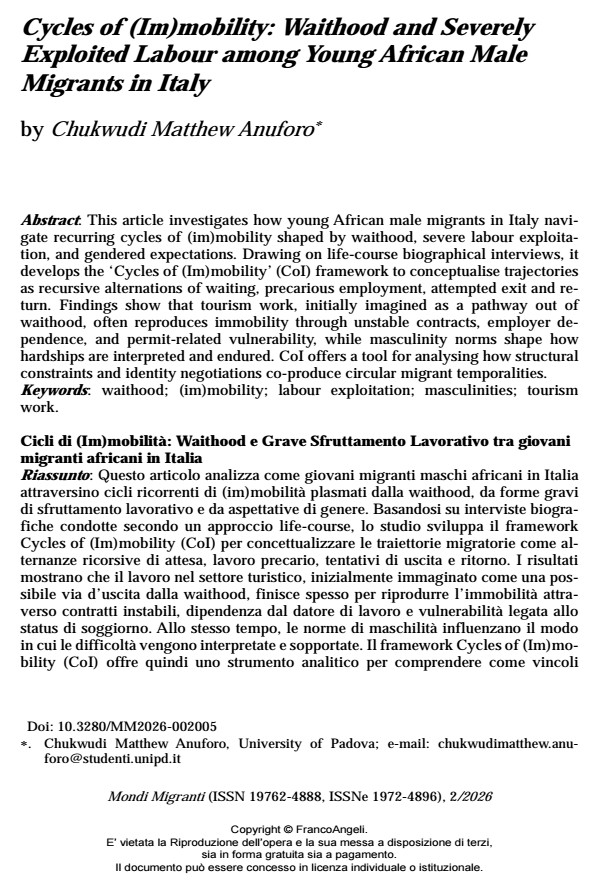
Qui sotto puoi vedere in anteprima la prima pagina di questo articolo.
Se questo articolo ti interessa, lo puoi acquistare (e scaricare in formato pdf) seguendo le facili indicazioni per acquistare il download credit. Acquista Download Credits per scaricare questo Articolo in formato PDF
FrancoAngeli è membro della Publishers International Linking Association, Inc (PILA), associazione indipendente e non profit per facilitare (attraverso i servizi tecnologici implementati da CrossRef.org) l’accesso degli studiosi ai contenuti digitali nelle pubblicazioni professionali e scientifiche.
This article investigates how young African male migrants in Italy navigate recurring cycles of (im)mobility shaped by waithood, severe labour exploitation, and gendered expectations. Drawing on life-course biographical interviews, it develops the ‘Cycles of (Im)mobility’ (CoI) framework to conceptualise trajectories as recursive alternations of waiting, precarious employment, attempted exit and return. Findings show that tourism work, initially imagined as a pathway out of waithood, often reproduces immobility through unstable contracts, employer dependence, and permit-related vulnerability, while masculinity norms shape how hardships are interpreted and endured. CoI offers a tool for analysing how structural constraints and identity negotiations co-produce circular migrant temporalities.
Questo articolo analizza come giovani migranti maschi africani in Italia attraversino cicli ricorrenti di (im)mobilità plasmati dalla waithood, da forme gravi di sfruttamento lavorativo e da aspettative di genere. Basandosi su interviste biografiche condotte secondo un approccio life-course, lo studio sviluppa il framework Cycles of (Im)mobility (CoI) per concettualizzare le traiettorie migratorie come alternanze ricorsive di attesa, lavoro precario, tentativi di uscita e ritorno. I risultati mostrano che il lavoro nel settore turistico, inizialmente immaginato come una possibile via d’uscita dalla waithood, finisce spesso per riprodurre l’immobilità attraverso contratti instabili, dipendenza dal datore di lavoro e vulnerabilità legata allo status di soggiorno. Allo stesso tempo, le norme di maschilità influenzano il modo in cui le difficoltà vengono interpretate e sopportate. Il framework Cycles of (Im)mobility (CoI) offre quindi uno strumento analitico per comprendere come vincoli strutturali e processi di negoziazione identitaria co-producono temporalità migratorie circolari.
Parole chiave:waithood; (im)mobilità; sfruttamento lavorativo; maschilità; lavoro turistico.
- Agina, M., Khairy H., Fatah M.A., Manaa Y., Abdallah R., Aliane N., Afaneh J. and Al-Romeedy B. (2023). Distributive injustice and work disengagement in the tourism and hospitality industry: mediating roles of the workplace negative gossip and organizational cynicism. Sustainability, 15, 20: 15011;
- Alberti G. and Iannuzzi F.E. (2020). Embodied intersectionality and the intersectional management of hotel labour: The everyday experiences of social differentiation in customer-oriented work. Gender, Work & Organization, 27, 6: 1165-1180;
- Arthur-Holmes F. and Yeboah T. (2024). Reconceptualizing the youth and waithood notions: African youth agency and rural livelihoods in artisanal and small-scale mining. Journal of Rural Studies, 113, 103513;
- Batnitzky A., McDowell L. and Dyer S. (2009). Flexible and strategic masculinities: The working lives and gendered identities of male migrants in London. Journal of Ethnic and Migration Studies, 35, 8: 1275-1293; DOI: 10.1080/13691830903123088/
- Carling J. (2015). Pathways out of waithood: Initial steps towards a conceptual framework. In: The 6th European Conference on African Studies (pp. 1-6).
- Castellano V. (2023). “Time is on me”: Entangled Temporalities Between Italy and the Gambia. Journal of International Migration and Integration / Revue De L Integration Et De La Migration Internationale, 25, 3: 1153-1168;
- Cole M., Stuart M., Hardy K. and Spencer D. (2022). Wage Theft and the Struggle over the Working Day in Hospitality Work: A Typology of Unpaid Labour Time. Work, Employment and Society, 38, 1: 103-121;
- Connell R.W. and Messerschmidt J.W. (2005). Hegemonic masculinity. Gender & Society, 19, 6: 829-859; DOI: 10.1177/0891243205278639/
- Cuzzocrea V. (2018). ‘Rooted mobilities’ in young people’s narratives of the future: A peripheral case. Current Sociology, 66, 7: 1106-1123; DOI: 10.1177/0011392118776357/
- Donaldson M. (1993). What is hegemonic masculinity? Theory and Society, 22, 5: 643-657; http://www.jstor.org/stable/657988/.
- Elder G.H. (1994). Time, human agency, and social change: Perspectives on the life course. Social Psychology Quarterly, 57, 1: 4-15.
- Fontanari E. and Dimitriadis I. (2024). The Temporalities of Non-deportability. Rejected Asylum-Seekers Trapped Between Labour Market Forces, Control, and Integration Policies. Italian Sociological Review, 14, 9S: 211-232;
- Giele J.Z. and Elder G.H. (1998). Methods of Life Course Research: Qualitative and Quantitative Approaches. Sage.
- Grabska K. (2019). Masculinities and migration: Local struggles, transnational aspirations. Gender, Place & Culture, 26, 4: 492-512.
- Honwana A. (2012). The Time of Youth: Work, Social Change, and Politics in Africa. Kumarian Press.
- Iannuzzi F.E. and Sacchetto D. (2022). Outsourcing and workers’ resistance practices in Venice’s hotel industry: The role of migrants employed by cooperatives. Economic and Industrial Democracy, 43, 2: 877-897; DOI: 10.1177/0143831X20960227/
- Iannuzzi F. and Marrone M. (2024). Rethinking tourism work: bridging gaps, making connections and exploring new frontiers. Cambio. Rivista Sulle Trasformazioni Sociali, 14, 28: 5-16;
- Jeffrey C. and Dyson J. (2022). Viable geographies. Progress in Human Geography, 46, 6: 1331-1348; DOI: 10.1177/03091325221122321/
- Kalir B. (2013). Moving subjects, stagnant paradigms: Can the ‘Mobilities paradigm’ transcend methodological nationalism?. Journal of Ethnic and Migration Studies, 39, 2: 311-327;
- Linge T.T., Furunes T., Baum T. and Duncan T. (2020). Hospitality Through Hospitableness: Offering a Welcome to Migrants Through Employment in the Hospitality Industry. In: Walmsley A., Åberg K., Blinnikka P. and Jóhannesson G., eds., Tourism Employment in Nordic Countries. Palgrave Macmillan, Cham; DOI: 10.1007/978-3-030-47813-1_19/
- Melián-González S. (2024). Job characteristics in hospitality occupations. Annals of Tourism Research, 1-4;
- Monsutti A. (2007). Migration as a rite of passage: Young Afghans building masculinity and adulthood in Iran. Iranian Studies, 40, 2: 167-185; DOI: 10.1080/00210860701276183/
- Palillo M. (2023). “Now I must go”: Uncovering the relationship between masculinity and structural vulnerability in young African men’s stories of forced migration. International Migration Review; DOI: 10.1177/01979183231185124/
- Pasura D. and Christou A. (2017). Theorizing Black (African) transnational masculinities. Men and Masculinities, 21, 4: 521-546; DOI: 10.1177/1097184X17694992/
- Quondamatteo N. and Vianello F.A. (2025). Tides of labour. Forms of exploitation and practices of individual resistance in seasonal tourism industry. Cambio. Rivista Sulle Trasformazioni Sociali, 14, 28: 71-91;
- Sanò G. and Zanotelli F. (2023). After institutional reception: time, im-mobility and social networks in Southern Italy. Journal of Modern Italian Studies, 28, 4: 433-450; DOI: 10.1080/1354571X.2022.2139059/
- Schapendonk J. (2017). The multiplicity of transit: the waiting and onward mobility of African migrants in the European Union. International Journal of Migration and Border Studies, 3, 2/3: 208; https://www.inderscienceonline.com/doi/epdf/10.1504/IJMBS.2017.083247/.
- Schapendonk J., Bolay M. and Dahinden J. (2020). The conceptual limits of the ‘migration journey’. De-exceptionalising mobility in the context of West African trajectories. Journal of Ethnic and Migration Studies, 47, 14: 3243-3259; DOI: 10.1080/1369183X.2020.1804191/
- Sinatti G. (2013). Masculinities and intersectionality in migration: Transnational Wolof migrants negotiating manhood and gendered family roles. In: Truong T.D. and Bergh S., eds., Migration, gender and social justice: Perspectives on human security (pp. 215-226). Berlin/Heidelberg/New York: Springer.
- Smith C. (2006). The double indeterminacy of labour power. Work Employment and Society, 20, 2: 389-402; DOI: 10.1177/095001700606510
- Smith D.J. (2020). Masculinity, money, and the postponement of parenthood in Nigeria. Population and Development Review, 46, 1: 101-120.
- Turner L. (2019). The politics of labelling refugee men as “vulnerable.” Social Politics: International Studies in Gender, State & Society, 28, 1: 1-23;
- Wendt M., Jóhannesson G.T. and Skaptadóttir U.D. (2020). On the Move: Migrant Workers in Icelandic Hotels. In: Springer eBooks (pp. 123-142); DOI: 10.1007/978-3-030-47813-1_7/
- Wengraf T. (2001). Qualitative Research Interviewing: Biographic Narrative and Semi-Structured Methods. Sage.
- Zampoukos K. and Ioannides D. (2011). The tourism labour conundrum: agenda for new research in the geography of hospitality workers. Hospitality & Society, 1, 1: 25-45;
Chukwudi Matthew Anuforo, Cycles of (Im)mobility: Waithood and Severely Exploited Labour among Young African Male Migrants in Italy in "MONDI MIGRANTI" 2/2026, pp 76-93, DOI: 10.3280/MM2026-002005