Afferrare il toro per le corna. andando oltre il colloquio nelle sedute psicologiche

Titolo Rivista PSICOBIETTIVO
Autori/Curatori Luciano L'Abate
Anno di pubblicazione 2015 Fascicolo 2014/3
Lingua Italiano Numero pagine 34 P. 69-102 Dimensione file 170 KB
DOI 10.3280/PSOB2014-003005
Il DOI è il codice a barre della proprietà intellettuale: per saperne di più clicca qui

Qui sotto puoi vedere in anteprima la prima pagina di questo articolo.

Se questo articolo ti interessa, lo puoi acquistare (e scaricare in formato pdf) seguendo le facili indicazioni per acquistare il download credit. Acquista Download Credits per scaricare questo Articolo in formato PDF
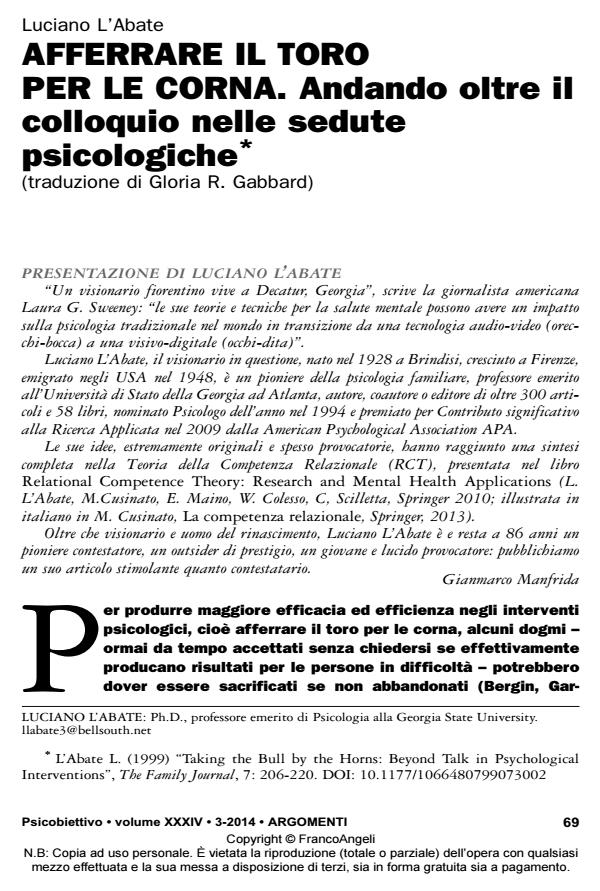
Anteprima articolo

FrancoAngeli è membro della Publishers International Linking Association, Inc (PILA), associazione indipendente e non profit per facilitare (attraverso i servizi tecnologici implementati da CrossRef.org) l’accesso degli studiosi ai contenuti digitali nelle pubblicazioni professionali e scientifiche.

Lo scopo di quest’articolo è discutere quanto poco progresso verrà raggiunto fintanto che la comunità terapeutica dipenderà sugli ormai ben accetti dogmi. I 5 sacri dogmi dell’intervento psicologico tradizionale (prevenzione, psicoterapia, e riabilitazione) si basano sui seguenti elementi: (a) colloquio; (b) contatto vis-à-vis; (c) lo stile e la personalità del terapeuta; (d) l’aggiunta di familiari, più ve sono e meglio è e (e) più sedute vengono fatte e meglio é. I nuovi interventi psicologici che possono mettere in difficoltà tali dogmi per come li conosciamo sono: (a) corsi mirati all’acquisizione di tecniche psico-educative; (b) interventi supportati dall’utilizzo del computer, compreso il neurobiofeedback verbale e visivo (per esempio la realtà virtuale); (c) terapie seguite come da manuale; (d) la desensibilizzazione e rielaborazione attraverso i movimenti oculari; e (e) la scrittura a distanza programmata come esemplificato nei testi di salute mentale. Inoltre, vengono forniti dei suggerimenti per minimizzare il linguaggio verbale e ottimizzare gli oggetti di scena orientati all’azione.

Parole chiave:Dialogo terapeutico; contatto vis-à-vis; interventi supportati dall’utilizzo del computer; scrittura a distanza

  1. Kendall P.C. (1998) “Directing misperceptions: Researching the issues facing manual-based treatments”, Clinical Psychology: Science and Practice, 3: 396-399
  2. Kochalka J., L’Abate L. (1997) “Linking evaluation with structured enrichment: The Family Profile Form”, American Journal of Family Therapy, 25: 361-374
  3. Kraut R., Patterson M., Lundmark V., Kiesler S., Mukopadhyay T., Scherlis W. (1998) “Internet paradox: A social technology that reduces social involvement and psychological well-being?”, American Psychologist, 53: 1017-1031
  4. L’Abate L. (1986) Systematic family therapy, Brunner/Mazel, New York
  5. L’Abate L. (1990) Building family competence: Strategies of primary and secondary prevention, Sage, Thousand Oaks, CA
  6. L’Abate L. (1991) “The use of writing in psychotherapy”, American Journal of Psychotherapy, 45: 87-98
  7. L’Abate L. (1992) Programmed writing: A self-administered approach for interventions with individuals, couples, and families, Brooks/Cole, Pacific Grove, CA
  8. L’Abate L. (1994) A theory of personality development, John Wiley, New York
  9. L’Abate L. (1997a) “Distance writing and computer assisted training”, in Sauber S.R. (ed.), Managed mental health care: Major diagnostic and treatment approaches, Brunner/Mazel, Bristol, PA, pp. 133-163
  10. L’Abate L. (1997b) Manual: Distance Writing and computer-assisted interventions in mental health, Institute for Life Empowerment, Atlanta, GA
  11. L’Abate L. (1997c) “The paradox of change: Better them than us!”, in Sauber S.R. (ed.), Managed mental health care: Major diagnostic and treatment approaches, Brunner/Mazel, Bristol, PA, pp. 40-66
  12. L’Abate L. (1997d) The self in the family: A classification of personality, criminality, and psychopathology, John Wiley, New York
  13. L’Abate L. (1998a) “Discovery of the family: From the inside to the outside”, American Journal of Family Therapy, 26: 265-280
  14. L’Abate L. (1998b) “Increasing intimacy in couples through distance writing and face-to-face approaches”, in Carlson J., Sperry L. (eds.), The intimate couple, Brunner/Mazel, Bristol, PA, pp. 327-339
  15. L’Abate L. (1998c) “Of clocks and rubber bands: On the use of props in family therapy”, in Nelson T.S., Trepper T.S. (eds.), 101 more interventions in family therapy, Haworth, New York, pp. 13-17
  16. L’Abate L. (1998d) The use of notes in psychotherapy, unpublished manuscript, Georgia State University
  17. L’Abate L. (1998e) Being together: Beyond acceptance, manuscript submitted for publication
  18. L’Abate L. (in press-a) “Programmed distance writing in therapy with acting-out adolescents”, in Schaefer C.E. (ed.), Innovative techniques in child and adolescent psychotherapy, John Wiley, New York
  19. L’Abate L. (in press-b) “Psychoeducational strategies”, in Carlson J., Sperry L. (eds.), Brief therapy strategies with individuals and couples, Zeig, Tucker & Co., Phoenix, AZ
  20. L’Abate L., Boyce J., Fraizer L., Russ D.A. (1992) “Programmed writing: Research in progress”, Comprehensive Mental Health Care, 2: 45-62
  21. L’Abate L., Harrison M.G. (1992) “Treating codependency”, in L’Abate L., Farrar J.E., Serritella D.A. (eds.), Handbook of differential treatments for addictions, Allyn & Bacon, Boston, pp. 286-306
  22. L’Abate L., Johnson J., Weeks G.R. (1979) “Forced holding: A technique for treating parentified children”, Family Therapy, 6: 124-132
  23. Abarbanel A. (1995) “Gates, states, rhythms, and resonances: The scientific basis of neurofeedback training”, Journal of Neurotherapy, 1: 15-38
  24. Austad C.S. (1998) Is long term psychotherapy unethical?, Jossey-Bass, San Francisco
  25. Barlow D.H., Craske M.G. (1994) Client workbook: Mastery of your anxiety and panic II, Psychological Corporation, San Antonio, TX
  26. Baucom D.H., Shoham V., Mueser K.T., Daiuto A.D., Stikle T.R. (1998) “Empirically supported coupled and family interventions for marital distress and adult mental health problems”, Journal of Consulting and Clinical Psychology, 66: 53-88
  27. Beck A. (1976) Cognitive therapy and the emotional disorders, Meridian Press, New York
  28. Berger R., Hannah M.T. (eds.) (1999) Handbook of preventative Approaches to couples therapy, Brunner/Mazel, Bristol, PA Bergin A.E., Garfield S.L. (1994) Handbook of psychotherapy and behavior change, John Wiley, New York
  29. Beutler L.E. (1979) “Toward specific psychological therapies for specific conditions”, Journal of Consulting and Clinical Psychology, 47: 882-897
  30. Beutler L.E. (1989) “Differential treatment selection: The role of diagnosis in psychotherapy”, Psychotherapy, 26: 271-281
  31. Beutler L.E., Clarkin J.F. (1990) Systematic treatment selection: Toward targeted therapeutic interventions, Brunner/Mazel, New York
  32. Biocca F., Levy M.R. (eds.) (1995) Communication in the age of virtual reality, Lawrence Erlbaum, Hillsdale, NJ
  33. Birren J.E., Hedlund B. (1987) “Contributions of autobiography to developmental psychology”, in Eisenberg N. (ed.), Contemporary topics in developmental psychology, John Wiley, New York, pp. 394-415
  34. Bloom B.L. (1992) “Computer-assisted psychological intervention: A review and commentary”, Clinical Psychology Review, 12: 169-197
  35. Bodin A.M. (1996) “Relationship conflict – verbal and physical: Conceptualizing an inventory for assessing process and content”, in Kaslow F.W. (ed.), Handbook of relational diagnosis and dysfunctional family patterns, John Wiley, New York, pp. 371-393
  36. Carr K., England R. (eds.) (1995) Simulated and virtual realities: Elements of perception, Taylor & Francis, London, UK
  37. Carson J.G., Chemtob C.M., Rusnak K., Hedlund N.L., Muraoke M.Y. (1998) “Eye movement desensitization and reprocessing for combat – related posttraumatic stress disorder”, Journal of Traumatic Stress, 11: 3-24.
  38. Chambless D.L. (1997) “In defense of dissemination of empirically supported psychological interventions”, Clinical Psychology: Science and Practice, 4: 230-235
  39. Craighead W.E., Craighead L.W. (1998) “Manual-based treatments; Suggestions for improving their clinical utility and acceptability”, Clinical Psychology: Science and Practice, 3: 403-407
  40. DeRubeis R.J., Crits-Christoph P. (1998) “Empirically supported individual and group psychological treatments for adult mental disorders”, Journal of Consulting and Clinical Psychology, 66: 37-52
  41. Strosahl K. (1998) “The dissemination of manual-based psychotherapies in managed care: Promises, problems, and prospects”, Clinical Psychology: Science and Practice, 3: 382-386
  42. Strupp H.H., Anderson T. (1997) “On the limitations of therapy manuals”, Clinical Psychology: Science and Practice, 4: 76-82
  43. Szapocznik J., Kurtines W., Foote F.H., Perez-Vidal A., Hervis O. (1983) “Conjoint versus one person family therapy: Some evidence for the effectiveness of conducting family therapy through a person”, Journal of Consulting and Clinical Psychology, 51: 881-889
  44. Szapocznik J., Murray E., Scopetta M., Hervis O., Rio A., Cohen R., Rivas-Vasquez A., Posada V., Kurtines W. (1989) “Structural family versus psychodynamic child therapy for problematic Hispanic boys”, Journal of Consulting and Clinical Psychology, 57: 571-578
  45. Szell E. (1994) Comparison of therapeutic interactions between face-to-face and telemediated communication conditions, unpublished doctoral dissertation, University of
  46. Miami, Florida
  47. Tolan P.H., Quintana E., Gorman-Smith D. (1998) “Prevention approaches for families”, in L’Abate L. (ed.), Family psychopathology: The relational roots of dysfunctional behavior, Guilford, New York, pp. 379-400
  48. Trabin T. (1996) The computerization of behavioral healthcare: How to enhance clinical practice, management, and communications, Jossey-Bass, San Francisco
  49. Weintraub M.D. (1981) Verbal behavior: Adaptations in psychopathology, Springer, New York
  50. Weissman M.M. (1995) Mastering depression: A patient’s guide to interpersonal psychotherapy, Psychological Corporation, San Antonio, TX
  51. Weissman M.M. (1998) Patient assessment forms: Workbook for interpersonal psychotherapy program, Psychological Corporation, San Antonio, TX
  52. Weissman M.M., Markowitz J.C. (1995) “Interpersonal psychotherapy: Current status”, Archives of General Psychiatry, 51: 599-606
  53. Williams J.B.W., Spitzer R.L. (1984) Psychotherapy research: Where are we and where should we go?, Guilford, New York
  54. Williams R.B., Boles M., Johnson R.E. (1995) “Patient use of a computer for prevention in primary care practice”, Patient Education and Counseling, 25: 283-292
  55. Wilson G.T. (1998) “Manual-based treatment and clinical practice”, Clinical Psychology: Science and Practice, 3: 363-375
  56. Wilson S.A., Becker L.A., Tinker R.H. (1997) “Fifteen-month follow-up of eye movement desensitization and reprocessing (EMDR) treatment for posttraumatic stress disorder and psychological trauma”, Journal of Consulting and Clinical Psychology, 65: 1047-1056
  57. Ziegler R.G. (1980) “Task-focused therapy with children and families”, American Journal of Psychotherapy, 34: 107-118
  58. L’Abate L., Odell M. (1995) “Expanding practices and roles of family clinicians”, in Harway M. (ed.), Treating the changing family: Handling normative and unusual events, John Wiley, New York, pp. 321-339
  59. L’Abate L., Platzman K. (1991) “The practice of programmed writing (PW) in therapy and prevention with families”, American Journal of Family Therapy, 19: 99-109
  60. L’Abate L., Torem M.S. (eds.) (in press) Distance writing and computer-assisted interventions in psychiatry and mental health, Ablex, Stamford, CT
  61. Lambert M.J. (1986) “Implications of psychotherapy outcome research for eclectic psychotherapy”, in Norcross J.C. (ed.), Handbook of eclectic psychotherapy, Brunner/Mazel, New York, pp. 436-662
  62. Lambert M.J. (1989) “The individual therapist’s contribution to psychotherapy process and outcome”, Clinical Psychology Review, 9: 469-485
  63. Lauterbach W. (1996) “The changing structure of Tanya’s conflicts: A case of online conflict assessment in psychotherapy”, Psychotherapy Research, 6: 277-290
  64. Levant R.F. (1986) Psychoeducational approaches to family therapy and counseling, Springer, New York
  65. Lombard D., Haddock C.K., Talcott G.W., Reynes R. (1998) “Cost-effectiveness analysis: A primer for psychologists”, Applied and Preventive Psychology, 7: 101-108
  66. Luborsky L., Crits-Christoph P., Mintz J., Auerbach A. (1988) Who will benefit from psychotherapy? Predicting therapeutic outcomes, Basic Books, New York
  67. Marcus S., Marquis P., Sakai C. (1997) “Controlled study of treatment of PTSD using EMDR in an HMO setting”, Psychotherapy, 34: 307-315
  68. Marks I., Shaw S., Parkin R. (1998) “Computer-aided treatments of mental health problems”, Clinical Psychology: Science and Practice, 5: 151-170
  69. Marques C. (1998) “Manual-based treatment and clinical practice”, Clinical Psychology: Science and Practice, 3: 4030-402
  70. McMahan O. (1998) Programmed writing, personality variables, and couples’ adjustment, unpublished doctoral dissertation, Georgia State University, Atlanta
  71. Mental health: Does therapy work? (1995) Consumer Reports, 60: 734-739
  72. Miller M.J., Hammond K.W., Hile M.G. (eds.) (1996) Mental health computing, Springer, New York
  73. Mirin S.M., Gossett J.T., Grob M.C. (eds.) (1991) Psychiatric treatment: Advances in outcome research, American Psychiatric Press, Washington, DC
  74. Moos R.H. (1976) The human context: Environmental determinants of behavior, Wiley-Interscience, New York Mrazek P.J., Haggerty R.J. (eds.) (1994) Reducing risks for mental disorders: Frontiers for preventive intervention research, National Academy Press, Washington, DC
  75. Murray B. (1998) “The latest techno tool: Essay-grading computers”, Psychological Monitor, 29: 43
  76. Nathan P.E., Gorman J.M. (eds.) (1998) A guide to treatments that work, Oxford University Press, New York
  77. North M.M., North S.M., Coble J.R. (1996) Virtual reality therapy: An innovative paradigm, IPI Press, Colorado Springs, CO
  78. Ogles B.M., Lambert M.J., Masters K.S. (1996) Assessing outcome in clinical practice, Allyn & Bacon, Boston
  79. Parks M.R., Roberts L.D. (1998) “‘Making moosic’: The development of personal relationships on line and a comparison to their off-line counterparts”, Journal of Social and Personal Relationships, 15: 517-537
  80. Parloff M.B. (1998) “Is psychotherapy more than manual labor?”, Clinical Psychology: Science and Practice, 3: 376-381
  81. Pennebaker J.W. (1997) Opening up: The healing power of confiding in others, Guilford, New York
  82. Perry S., Frances A., Clarkin J. (1990) A DSM-III-R casebook of treatment selection, Brunner/Mazel, New York
  83. Phillips E.L. (1990) “The delivery system as a prime therapeutic determinant”, in Zeig J.K., Munion W.M. (eds.), What is psychotherapy? Contemporary perspectives, Jossey-Bass, San Francisco, pp. 115-119
  84. Piaget J. (1960) The child’s conception of the world, Routledge, London
  85. Progoff I. (1980) The practice of process mediation: The intensive journal way to spiritual experience, Dialogue House Library, New York
  86. Rabasca L. (1998) “Study probes how patients are affected by telehealth”, Psychological Monitor, 29: 31
  87. Riordan R.J. (1996) “Scriptotherapy: Therapeutic writing as a counseling adjunct”, Journal of Counseling and Development, 74: 263-269
  88. Rogers C.R. (1957) “The necessary and sufficient conditions of therapeutic personality change”, Journal of Consulting Psychology, 21: 95-103
  89. Roth A., Fonagy P. (1996) What works for whom? A critical review of psycho-therapy research, Guilford, New York
  90. Safran J.D., Muran J.C. (1998) The therapeutic alliance in brief psychotherapy, American Psychological Association, Washington, DC
  91. Sanders M.R. (1998) “The empirical status of psychological interventions with families of children and adolescents”, in L’Abate L. (ed.), Family psycho-pathology: The relational roots of dysfunctional behavior, Guilford, New York, pp. 427- 465
  92. Shapiro D.A., Startup M., Bird D., Harper H., Reynolds S., Suokas A. (1994) “The high-water mark of the drug metaphor: A meta-analytic critique of process-outcome research”, in Russell R.L. (ed.), Reassessing psychotherapy research, Guilford, New York, pp. 1-35
  93. Shapiro F., Forrest M. (1997) EMDR, Basic Books, New York
  94. Shook D. (1998) “Number on probation or parole tops record”, Atlanta Journal-Constitution, p. A6
  95. Simon L. (1998) “Do offender treatments work?”, Applied and Preventive Psychology, 7: 137-159
  96. Smyth J.M. (1998) “Written emotional expression: Effect size, outcome types, and moderating variables”, Journal of Consulting and Clinical Psychology, 66: 174-184
  97. Smyth J.M., L’Abate L. (in press) “A meta-analytic evaluation of workbooks in medicine and mental health”, in L’Abate L., Torem M.S. (eds.), Distance writing and computer-assisted interventions in psychiatry and mental health, Ablex, Stamford, CT
  98. Snyder D.K. (1981) Manual for Marital Satisfaction Inventory, Western Psychological Services, Los Angeles
  99. Snyder D.K., Costin S.E. (1994) “Marital Satisfaction Inventory”, in Maruish M.E. (ed.), The use of psychological testing for treatment planning and outcome assessment, Lawrence Earlbaum, Hillsdale, NJ, pp. 322-351
  100. Snyder D.K., Lacher D., Wills R.M. (1988) “Computer-based interpretation of the Marital Satisfaction Inventory: Use in treatment planning”, Journal of Marital and Family Therapy, 14: 397-409
  101. Sperry L., Brill P.L., Howard K.I., Grissom G.R. (1996) Treatment outcomes in psychotherapy and psychiatric interventions, Brunner/Mazel, New York
  102. Sprafkin R.P., Gershaw N.J., Goldstein A.P. (1993) Social skills for mental health: A structured learning approach, Allyn & Bacon, Boston
  103. Stiles W.B., Shapiro D.A., Harper H. (1994) “Finding the way from process to outcome: Blind alleys and unmarked trails”, in Russell R.L. (ed.), Reassessing psychotherapy research, Guilford, New York, pp. 36-64
  104. de Vries B., Birren J.E., Deutchman D.E. (1990) “Adult development through guided autobiography: The family context”, Family Relations, 39: 3-7
  105. Dobson K.S., Craig K.D. (eds.) (1998) Empirically supported therapies: Best practice in professional psychology, Sage, Thousand Oaks, CA
  106. Esterling B.A., Antoni M.H., Fletcher M.A., Margulies S., Schneiderman N. (1994) “Emotional disclosure through writing or speaking modulates latent Epstein-Burr virus antibody titers”, Journal of Consulting and Clinical Psychology, 62: 130-140
  107. Esterling B.A., L’Abate L., Murray E., Pennebaker J.M. (1999) “Empirical foundations for writing in prevention and psychotherapy: Mental and physical health outcomes” Clinical Psychology Review, 19: 79-96
  108. Gould R.L. (1996a) “Development, problem solving, and generalized learning: The Therapeutic Learning Program (TLP)”, in Miller M.J., Hammond K.W., Hile M.G. (eds.), Mental health computing, Springer, New York, pp. 86-105
  109. Gould R.L. (1996b) “The use of computers in therapy”, in Trabin T. (ed.), The computerization of behavioral healthcare, Jossey-Bass, San Francisco, pp. 39-62
  110. Greenberg L.S. (1994) “The investigation of change: Its measurement and explanation”, in Russell R.L. (ed.), Reassessing psychotherapy research, Guilford, New York, pp. 114-143
  111. Greenberg L.S., Paivio S.C. (1997) Working with emotions in psychotherapy, Guilford, New York
  112. Havik O.E., VandenBos G.R. (1996) “Limitations of manualized psychotherapy for everyday clinical practice”, Clinical Psychology: Science and Practice, 3: 264-267
  113. Hayes S.C., Follette V.M., Dawes R.M., Grady K.E. (1995) Scientific standards of psychological practice: Issues and recommendations, Context Press, Reno, NV
  114. Heimberg R.G. (1998) “Manual-based treatment: An essential ingredient of clinical practice in the 21st Century”, Clinical Psychology: Science and Practice, 5: 387-390
  115. Hermann C., Blanchard E.B., Flor H. (1997) “Biofeedback treatment for pediatric migraine: Prediction of treatment outcome”, Journal of Consulting and Clinical Psychology, 65: 611-616
  116. Hogue A., Liddle H.A., Rowe C., Turner R.M., Dakof G.A., LaPann K. (1998) “Treatment adherence and differentiation in individuals versus family therapy for adolescent substance abuse”, Journal of Counseling Psychology, 45: 104-111
  117. Howard K.I., Krause M.S., Orlinsky D.E. (1986) “The attrition dilemma: Toward a new strategy for psychotherapy research”, Journal of Consulting and Clinical Psychology, 54: 106-110
  118. Hurt S.W., Reznikoff M., Clarkin J.F. (1991) Psychological assessment, psychiatric diagnosis, treatment planning, Brunner/Mazel, New York
  119. Jensen P.S., Josephson A.M., Frey J.III. (1994) “Informed consent as a framework for treatment: Ethical and therapeutic considerations”, American Journal of Psychotherapy, 48: 378-386
  120. Jordan K., L’Abate L. (1995) “Programmed writing and psychotherapy with symbiotically enmeshed patients”, American Journal of Psychotherapy, 49: 225-236
  121. Kadzin A.E. (1997) “Validated treatments: Multiple perspectives and issues: Introduction to the series”, Clinical Psychology: Science and Practice, 4: 216-217
  122. Kadzin A.E. (1998) “Manual-based treatment in clinical practice: Introduction to the series”, Clinical Psychology: Science and Practice, 5: 361-362
  123. Kadzin A.E., Weiss J.R. (1998) “Identifying and developing empirically supported child and adolescent treatments”, Journal of Consulting and Clinical Psychology, 66: 19-36.

Luciano L'Abate, Afferrare il toro per le corna. andando oltre il colloquio nelle sedute psicologiche in "PSICOBIETTIVO" 3/2014, pp 69-102, DOI: 10.3280/PSOB2014-003005