Invecchiare nelle aree interne: tra reti sociali, accesso ai servizi e benessere della popolazione anziana

Titolo Rivista SALUTE E SOCIETÀ
Autori/Curatori Marco Alberio, Rebecca Plachesi
Anno di pubblicazione 2026 Fascicolo 2026/1
Lingua Italiano Numero pagine 15 P. 85-99 Dimensione file 387 KB
DOI 10.3280/SES2026-001006
Il DOI è il codice a barre della proprietà intellettuale: per saperne di più clicca qui

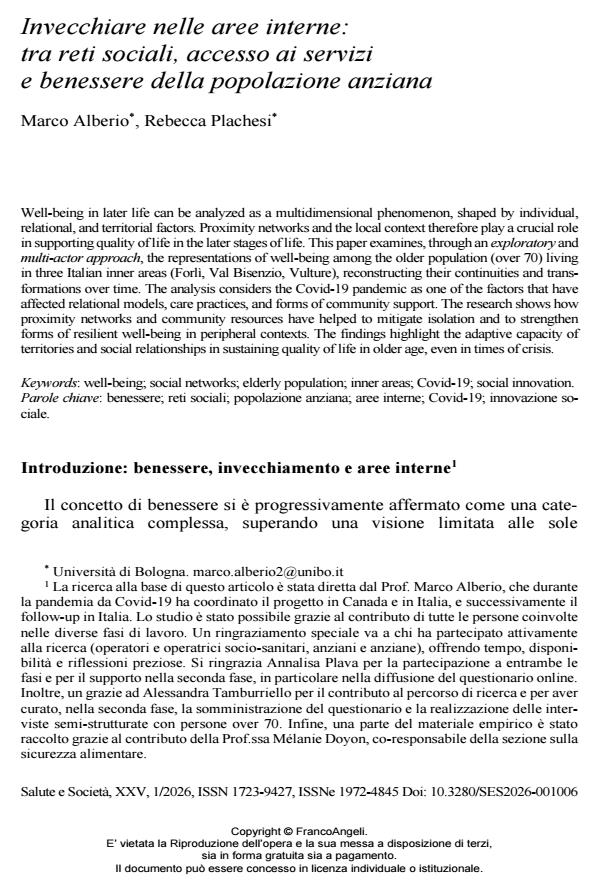
Qui sotto puoi vedere in anteprima la prima pagina di questo articolo.

Se questo articolo ti interessa, lo puoi acquistare (e scaricare in formato pdf) seguendo le facili indicazioni per acquistare il download credit. Acquista Download Credits per scaricare questo Articolo in formato PDF
Anteprima articolo

FrancoAngeli è membro della Publishers International Linking Association, Inc (PILA), associazione indipendente e non profit per facilitare (attraverso i servizi tecnologici implementati da CrossRef.org) l’accesso degli studiosi ai contenuti digitali nelle pubblicazioni professionali e scientifiche.

Well-being in later life can be analyzed as a multidimensional phenomenon, shaped by individual, relational, and territorial factors. Proximity networks and the local context therefore play a crucial role in supporting quality of life in the later stages of life. This paper examines, through an exploratory and multi-actor approach, the representations of well-being among the older population (over 70) living in three Italian inner areas (Forlì, Val Bisenzio, Vulture), reconstructing their continuities and transformations over time. The analysis considers the Covid-19 pandemic as one of the factors that have affected relational models, care practices, and forms of community support. The research shows how proximity networks and community resources have helped to mitigate isolation and to strengthen forms of resilient well-being in peripheral contexts. The findings highlight the adaptive capacity of territories and social relationships in sustaining quality of life in older age, even in times of crisis.

Parole chiave:benessere; reti sociali; popolazione anziana; aree interne; Covid-19; innovazione sociale.

  1. Alberio M., Labarchède M., Mbaye M.S. (2022). Les territoires ruraux de l’est du Québec à l’épreuve de la Covid19. Marginalisation et exclusion sociales des personnes aînées?. Crisis & Sociètè, 1: 1-29.
  2. Alberio M., Longo M., Vultur M. (2019). Une jeunesse territorialisée. Revue Jeunes et Société, 4(2): 7-28.
  3. Alberio M., Plachesi R. (2024a). Between Old and New Needs: The Issue of Inclusion of the Elderly before, during and after COVID-19. The Case of Rural Areas in Canada-Québec and Italy. Revue Interventions économiques, 71 : 83-106.
  4. Alberio M., Plachesi R. (2024b). L’innovazione socio-territoriale in un contesto di crisi sanitaria: il caso studio dell’assistenza agli anziani in tre aree interne italiane. In: Ecchia G., Ganugi G., Prandini R., a cura di, Verso (Eco)Sistemi di Innovazione Sociale. Un percorso di capacity building. Milano: FrancoAngeli.
  5. Barrett A.E., Barbee H. (2022). The subjective life course framework: Integrating life course sociology with gerontological perspectives on subjective aging. Advances in Life Course Research, 51: 100448.
  6. Berardo F., Vascelli L., Iacomini S., Cavallini F., Scorza M. (2024). Effetto dell’uso delle videochiamate sul benessere della persona anziana: una revisione sistematica. Psicologia della Salute, 2: 153-175. DOI: 10.3280/PDS2024-00201
  7. Bertani M., Marzulli M., Pastore A. (2025). Cosa rende una città a misura di anziani? Evidenze dal database AFCCQ-IT. Salute e Società, 2: 36-48. DOI: 10.3280/SES2025-00200
  8. Blokland T. (2017). Community as Urban Practice. Cambridge: Polity.
  9. Campbell A., Converse E.P., Rodgers W.L. (1976). The quality of American life: perceptions, evaluations, and satisfactions. New York: Russel Sage Foundation.
  10. Carlo S., Bonifacio F. (2021). Ageing in rural Italy through digital media. Health and everyday life. Rassegna Italiana di Sociologia, 2: 459-486. DOI: 10.1423/10185
  11. Carrosio G., De Toni A., De Vidovich L., Osti G. (2023). Le sociologie della marginalità territoriale alla prova della pandemia. Sociologia Urbana e Rurale, 130: 128-143. DOI: 10.3280/SUR2020-12300
  12. Dodge R., Daly A.P., Huyton J., Sanders L.D. (2012). The challenge of defining wellbeing. International Journal of Wellbeing, 2(3): 222-235.
  13. Hussain B., Mirza M., Baines R., Burns L., Stevens S., Asthana S., Chatterjee A. (2023). Loneliness and social networks of older adults in rural communities: a narrative synthesis systematic review. Frontiers in Public Health, 11: 1113864.
  14. Jopp D., Smith J. (2006). Resources and Life-Management Strategies as Determinants of Successful Aging: on the protective effect of Selection, Optimization, and Compensation. Psychology and Aging, 21: 253-265. DOI: 10.1037/0882-7974.21.2.25
  15. Keyes C.L.M. (1998). Social Well-being. Social Psychology Quarterly, 61(2): 121-140. DOI: 10.2307/278706
  16. Labarchède M., Alberio M. (2025). Les territoires ruraux protègent-ils les personnes aînées? Solidarités et sociabilités à l’épreuve de la pandémie. Retraite et sociètè, 93(2): 85-112.
  17. Lefebvre H. (1974). La Production de l’espace. Paris: Anthropos.
  18. Liu Y.F., Dijst M., Geertman S. (2017). The subjective well-being of older adults in Shanghai: The role of residential environment and individual resources. Urban Studies, 54(7): 1692-1714. DOI: 10.1177/004209801663051
  19. Nordbakke S., Schwanen T. (2013). Well-being and mobility: A theoretical framework and literature review focusing on older people. Mobilities, 9(1): 104-129. DOI: 10.1080/17450101.2013.78454
  20. Padeiro M., de São José J., Amado C., Sousa L., Roma Oliveira C., Esteves A., McGarrigle J. (2022). Neighborhood Attributes and Well-Being Among Older Adults in Urban Areas: A Mixed-Methods Systematic Review. Research on Aging, 44(5-6): 351-368. DOI: 10.1177/016402752199998
  21. Steverink N., Lindenberg S. (2006). Which social needs are important for subjective well-being? What happens to them with aging?. Psychology of Aging, 21(2): 281-290. DOI: 10.1037/0882-7974.21.2.28
  22. Walsh K., Scharf T., Keating N. (2018). Social exclusion of older persons: a scoping review and conceptual framework. European Journal of Aging, 16(1): 129.
  23. Zambianchi M., Ricci Bitti P.E. (2013). Il ruolo del supporto sociale, del genere e della scolarità nel benessere sociale in età anziana. Psicologia della Salute, 1: 111-123. DOI: 10.3280/PDS2013-00100

Marco Alberio, Rebecca Plachesi, Invecchiare nelle aree interne: tra reti sociali, accesso ai servizi e benessere della popolazione anziana in "SALUTE E SOCIETÀ" 1/2026, pp 85-99, DOI: 10.3280/SES2026-001006