Dal frame al contro-frame: lo scetticismo climatico e le sue narrazioni nelle community italiane di Facebook
Titolo Rivista SOCIOLOGIA DELLA COMUNICAZIONE
Autori/Curatori Niccolò Sirleto
Anno di pubblicazione 2026 Fascicolo 2026/71
Lingua Italiano Numero pagine 18 P. 90-107 Dimensione file 143 KB
DOI 10.3280/SC2026-071005
Il DOI è il codice a barre della proprietà intellettuale: per saperne di più
clicca qui
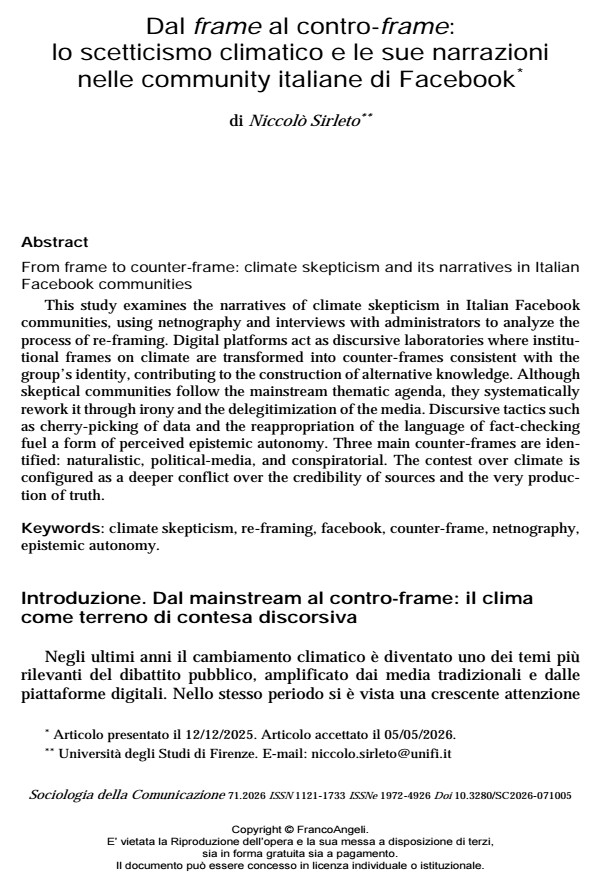
Qui sotto puoi vedere in anteprima la prima pagina di questo articolo.
Se questo articolo ti interessa, lo puoi acquistare (e scaricare in formato pdf) seguendo le facili indicazioni per acquistare il download credit. Acquista Download Credits per scaricare questo Articolo in formato PDF
FrancoAngeli è membro della Publishers International Linking Association, Inc (PILA), associazione indipendente e non profit per facilitare (attraverso i servizi tecnologici implementati da CrossRef.org) l’accesso degli studiosi ai contenuti digitali nelle pubblicazioni professionali e scientifiche.
This study examines the narratives of climate skepticism in Italian Facebook communities, using netnography and interviews with administrators to analyze the process of re-framing. Digital platforms act as discursive laboratories where institutional frames on climate are transformed into counter-frames consistent with the group’s identity, contributing to the construction of alternative knowledge. Although skeptical communities follow the mainstream thematic agenda, they systematically rework it through irony and the delegitimization of the media. Discursive tactics such as cherry-picking of data and the reappropriation of the language of fact-checking fuel a form of perceived epistemic autonomy. Three main counter-frames are identified: naturalistic, political-media, and conspiratorial. The contest over climate is configured as a deeper conflict over the credibility of sources and the very production of truth.
Parole chiave:climate skepticism, re-framing, facebook, counter-frame, netnography, epistemic autonomy.
- Brulle R.J., Roberts J.T., Spencer M.C. (eds.) (2024), Climate obstruction across Europe, Oxford University Press, Oxford.
- Bentivegna S., Rega R. (2020), I discorsi d’odio online in una prospettiva comunicativa: un’agenda per la ricerca, in «Mediascapes journal», 16, pp. 151-171.
- Benkler A., Faris R., Roberts H. (2018), Network Propaganda: Manipulation, Disinformation, and Radicalization in American Politics, Oxford University Press, Oxford.
- Berger P., Luckmann T. (1966), The Social Construction of Reality: A Treatise in the Sociology of Knowledge, Doubleday, New York.
- Bessi A., Petroni F., Del Vicario M., Zollo F., Anagnostopoulos A., Scala A., Caldarelli G., Quattrociocchi W. (2015), Science vs Conspiracy: Collective Narratives in the Age of Misinformation, in «PLOS ONE», 10(3).
- Biancalana C., Ladini R. (2022), Climate change in Italian public opinion, media, and parties: State of the art and research agenda, in «Polis», 36(3), pp. 455-472.
- Boccia Artieri G., Colombo F., Gili G. (2022), Comunicare. Persone, relazioni, media, Laterza, Roma-Bari.
- Bory P., Giardullo P., Tosoni S., Turrini V. (2023), “We will multiply the fires of resistance”: The catalysts of dissent against institutional science and their interplay with refused knowledge communities, in «Public Understanding of Science», 32(1), pp. 2-19. DOI: 10.1177/0963662522111352
- Brubaker R. (2021), Paradoxes of populism during the pandemic, in «Thesis Eleven», 164(1), pp. 73-87.
- Brulle R.J., Dunlap R.E. (2015). Sociology and global climate change: Introduction, in Dunlap R.E., Brulle R.J. (eds.) (2015), Climate change and society: Sociological perspectives, Oxford University Press, Oxford, pp. 1–31.
- Capstick S.B., Pidgeon N.F. (2014), What is climate change scepticism? Examination of the concept using a mixed methods study of the UK public, in «Global Environmental Change», 24, pp. 389-401.
- Cologna V., Kotcher J., Mede N.G., Besley J., Maibach E.W., Oreskes N. (2024), Trust in climate science and climate scientists: A narrative review, in «PLoS Climate», 3(5).
- Cook J., Nuccitelli D., Green S.A., Richardson M., Winkler B., Painting R., Way R., Jacobs P., Skuce A. (2013), Quantifying the consensus on anthropogenic global warming in the scientific literature, in «Environmental Research Letters», 8(2). DOI: 10.1088/1748-9326/8/2/024024
- Drieschova A. (2023), The social media revolution and shifts in the climate change discourse, in Bjola C., Kornprobst M. (eds.) (2023) Digital International Relations, Routledge, London, pp. 227-257.
- Dunlap R., McCright A. (2011), Organized Climate Change Denial, in Dryzek J., Norgaard R., Schlosberg D. (eds.), The Oxford Handbook of Climate Change and Society, Oxford University Press, Oxford, pp. 144-160.
- Dunlap R.E. (2013), Climate Change Skepticism and Denial: An Introduction, in «American Behavioral Scientist», 57(6), pp. 691–698. DOI: 10.1177/0002764213477097
- Engels A. (2013), The Social and Political Construction of Climate Skepticism, in «WIREs Climate Change», 4(4), pp. 345–354.
- Entman R. (1993), Framing: Toward Clarification of a Fractured Paradigm, in «Journal of Communication», 43(4), pp. 51–58.
- Eyal G. (2019), The crisis of expertise, John Wiley & Sons, Hoboken.
- Falkenberg M., Galeazzi A., Torricelli M., Di Marco N., Larosa F., Sas M., Mekacher A., Pearce W., Zollo F., Quattrociocchi W., Baronchelli A. (2022), Growing polarization around climate change on social media, in «Nature Climate Change», 12(3), pp. 363–369.
- Frickel S., Gross N. (2005), A general theory of scientific/intellectual movements, in «American Sociological Review», 70(2), pp. 204-232. DOI: 10.1177/00031224050700020
- Gamson W. (1992), Talking Politics, Cambridge University Press, Cambridge.
- Giardullo P. (2024), Do the Media Refuse Refused Knowledge?, in Neresini F., Agodi M.C., Crabu S., Tosoni S. (eds.) Manufacturing Refused Knowledge in the Age of Epistemic Pluralism: Discourses, Imaginaries, and Practices on the Border of Science, Springer Nature, Singapore, pp. 225-256.
- Gil-Clavel S., Zagheni E. (2019), Demographic differentials in Facebook usage around the world, in «Proceedings of the 13th International AAAI Conference on Web and Social Media (ICWSM)», 13(01), pp. 647–650.
- Goffman E. (1974), Frame Analysis: An Essay on the Organization of Experience, Harper & Row, New York.
- Guenther L., Jörges S., Mahl D., Brüggemann M. (2024), Framing as a bridging concept for climate change communication: A systematic review based on 25 years of literature, in «Communication Research», 51(4), pp. 367-391. DOI: 10.1177/00936502221137165
- Harambam J. (2020), Contemporary conspiracy culture: Truth and knowledge in an era of epistemic instability, Routledge, Londra.
- Harambam J., Grusauskaite K., de Wildt L. (2022). Poly-truth, or the limits of pluralism: Popular debates on conspiracy theories in a post-truth era in «Public Understanding of Science», 31(6), pp. 784-798.
- Hine C. (2015), Ethnography for the Internet: Embedded, Embodied and Everyday, UCL Press, Londra.
- Hobson K., Niemeyer S. (2013), “What sceptics believe”: The effects of information and deliberation on climate change scepticism, in «Public Understanding of Science», 22(4), pp. 396–412. DOI: 10.1177/0963662511430459
- Huber R.A., Greussing E., Eberl J.M. (2022), From populism to climate scepticism: the role of institutional trust and attitudes towards science, in «Environmental Politics», 31(7), pp. 1115-1138. DOI: 10.1080/09644016.2021.197820
- Koopmans R., Statham P. (1999), Political claims analysis: Integrating protest event and political discourse approaches, in «Mobilization: an international quarterly», 4(2), pp. 203-221.
- Kozinets R. (2010), Netnography: Doing Ethnographic Research Online, SAGE Publications, Londra.
- Lahsen M. (2013), Anatomy of dissent: A cultural analysis of climate skepticism, in «American Behavioral Scientist», 57(6), pp. 732-753. DOI: 10.1177/0002764212469799
- Lazer D.M., Baum M.A., Benkler Y., Berinsky A.J., Greenhill K.M., Menczer F., Zittrain J.L. (2018), The science of fake news, in «Science», 359(6380), pp. 1094-1096.
- Lello E., Bertuzzi N., Pedroni M., Raffini L. (2022), Vaccine hesitancy and refusal during the Covid-19 pandemic in Italy: Individualistic claims or repoliticisation?, in «Partecipazione e conflitto», 3, pp. 672-696.
- Lewandowsky S., Gignac G.E., Oberauer K. (2015), The Role of Conspiracy Theories in the Spread of Misinformation, in «PLOS ONE», 10(9).
- McCombs M., Shaw D. (1972), The Agenda-Setting Function of Mass Media, in «Public Opinion Quarterly», 36(2), pp. 176–187. DOI: 10.1086/267990
- McCright A.M., Dunlap R.E. (2010), Anti-reflexivity: The American conservative movement’s success in undermining climate science and policy, in «Theory, Culture & Society», 27(2-3), pp. 100-133. DOI: 10.1177/0263276409356001
- Mede N.G., Cologna V., Berger S., et al. (2025), Perceptions of science, science communication, and climate change attitudes in 68 countries–the TISP dataset, in «Scientific Data», 12(1), 114.
- Mede N.G., Schäfer M.S. (2020), Science-related populism: Conceptualizing populist demands toward science, in «Public Understanding of Science», 29(5), pp. 473-491. DOI: 10.1177/096366252092425
- Morsello B. (2024), Respecifying fieldwork: Refused knowledge communities explored through the reflexive lens, in Neresini F., Agodi M.C., Crabu S., Tosoni S. (eds.) Manufacturing Refused Knowledge in the Age of Epistemic Pluralism: Discourses, Imaginaries, and Practices on the Border of Science, Springer Nature, Singapore, pp. 257-284.
- Morsello B., Neresini F., Agodi M.C. (2024), “This is the real face of Covid-19!”: How Refused Knowledge Communities Entered the Pandemic Arena, in Neresini F., Agodi M.C., Crabu S., Tosoni S. (eds.), Manufacturing Refused Knowledge in the Age of Epistemic Pluralism: Discourses, Imaginaries, and Practices on the Border of Science, Springer Nature, Singapore, pp. 195-223.
- Murru F. (2013), Media e partecipazione: Public Engagement e pratiche digitali, FrancoAngeli, Milano.
- Neresini F. (2024), Can we look at refused knowledge differently?, in Neresini F., Agodi M.C., Crabu S., Tosoni S. (eds.), Manufacturing Refused Knowledge in the Age of Epistemic Pluralism: Discourses, Imaginaries, and Practices on the Border of Science, Springer Nature, Singapore, pp. 21-52.
- Neresini F., Agodi M.C., Crabu S., Tosoni S. (eds.) (2024), Manufacturing refused knowledge in the age of epistemic pluralism: Discourses, imaginaries, and practices on the border of science, Springer Nature, Singapore.
- Niederer S. (2013), ‘Global warming is not a crisis!’ – Studying climate change skepticism on the Web, in «European Journal of English Studies», 17(1), pp. 91–105. DOI: 10.5117/NECSUS2013.1.NIE
- Nyhan B., Reifler J. (2010), When Corrections Fail: The Persistence of Political Misperceptions, in «Political Behavior», 32(3), pp. 303–330.
- O’Neill S., Boykoff M. (2010). Climate denier, skeptic, or contrarian?, in «Proceedings of the National Academy of Sciences», 107(39), E151-E151.
- Oreskes N., Conway E.M. (2010), Defeating the merchants of doubt, in «Nature», 465(7299), pp. 686-687.
- Pariser E. (2011), The Filter Bubble: What the Internet Is Hiding from You, Penguin Press, New York.
- Schäfer M.S., O’Neill S. (2017), Frame analysis in climate change communication, in «Oxford Research Encyclopedias of Climate Science», Oxford University Press, New York.
- Scheufele D.A., Iyengar S. (2014), The state of framing research: A call for new directions, in Kenski K., Hall Jamieson K. (a cura di), The Oxford handbook of political communication, Oxford University Press, Oxford, pp. 619–632.
- Semi G. (2010), Ethnography Matters: Le tecniche etnografiche nella ricerca sociale, Laterza, Roma-Bari.
- Snow D., Benford R. (1988), Ideology, Frame Resonance, and Participant Mobilization, in «International Social Movement Research», 1, pp. 197–217.
- Sirleto N. (2025), Climate change e negazionismo: uno studio sui gruppi di discussione online, Tesi di dottorato, Dipartimento di Scienze della Comunicazione, Studi Umanistici e Internazionali, Università di Urbino Carlo Bo.
- Treen K.M. Williams H.T.P., O’Neill S.J. (2020), Online misinformation about climate change, in «WIREs Climate Change», 11(5).
- Van Dijk T.A. (1993), Elite Discourse and Racism, SAGE Publications, Newbury Park.
- Van Zoonen L. (2012), I-Pistemology: Changing truth claims in popular and political culture, in «European Journal of Communication», 27(1), pp. 56-67. DOI: 10.1177/0267323112438808
- Wong-Parodi G., Feygina I. (2020), Understanding and countering the motivated roots of climate change denial, in «Current Opinion in Environmental Sustainability», 42, pp. 60–64.
- Zeng J., Schäfer M.S. (2021), Conceptualizing “dark platforms”. Covid-19-related conspiracy theories on 8kun and Gab, in «Digital Journalism», 9(9), pp. 1321-1343. DOI: 10.1080/21670811.2021.1938165
Niccolò Sirleto, Dal frame al contro-frame: lo scetticismo climatico e le sue narrazioni nelle community italiane di Facebook in "SOCIOLOGIA DELLA COMUNICAZIONE " 71/2026, pp 90-107, DOI: 10.3280/SC2026-071005