Association between Adverse Childhood Experiences (ACEs) and Eating Disorders: The Role of Post-Traumatic Symptoms and Emotional Dysregulation
Journal title MALTRATTAMENTO E ABUSO ALL’INFANZIA
Author/s Elena Camisasca
Publishing Year 2026 Issue 2026/1
Language Italian Pages 19 P. 75-93 File size 144 KB
DOI 10.3280/MAL2026-001005
DOI is like a bar code for intellectual property: to have more infomation
click here
Below, you can see the article first page
If you want to buy this article in PDF format, you can do it, following the instructions to buy download credits
FrancoAngeli is member of Publishers International Linking Association, Inc (PILA), a not-for-profit association which run the CrossRef service enabling links to and from online scholarly content.
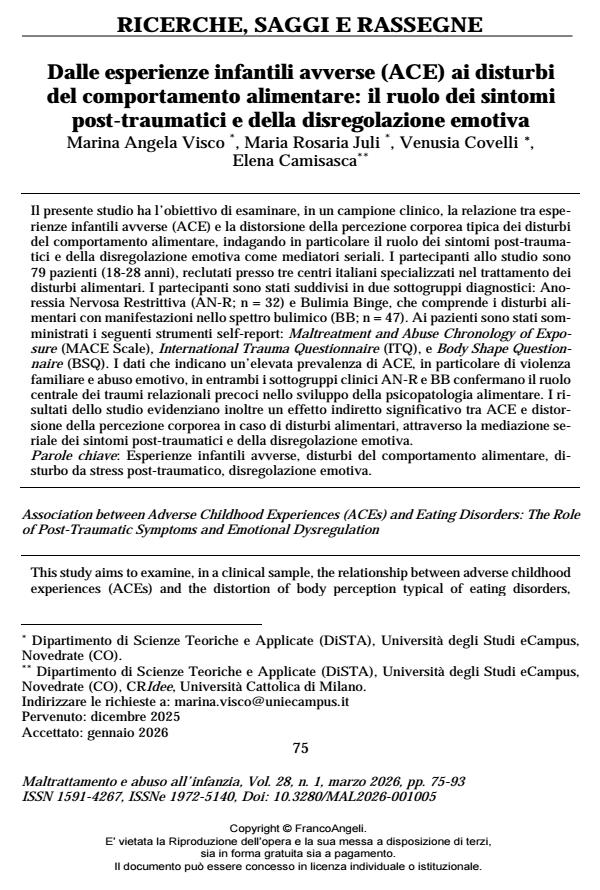
This study aims to examine, in a clinical sample, the relationship between adverse childhood experiences (ACEs) and the distortion of body perception typical of eating disorders, investigating in particular the role of post-traumatic symptoms and emotional dysregulation as serial mediators. The study participants were 79 patients (aged 18-28) recruited from three Italian centers specializing in the treatment of eating disorders. Participants were divided into two diagnostic subgroups: Restrictive Anorexia Nervosa (AN-R; n = 32) and Binge Bulimia, which includes eating disorders with bulimic manifestations (BB; n = 47). Patients were administered the following self-report instruments: Maltreatment and Abuse Chronology of Exposure (MACE Scale), International Trauma Questionnaire (ITQ), and Body Shape Questionnaire (BSQ). Data indicating the high prevalence of ACEs (and in particular family violence and emotional abuse) in both the AN-R and BB clinical subgroups confirm the central role of early relational trauma in the development of eating psychopathology. The study results also highlight a significant indirect effect between ACEs and altered body perception in cases of eating disorders, through the serial mediation of post-traumatic symptoms and emotional dysregulation.
Keywords: Adverse Childhood Experiences, Eating Disorders, Post Traumatic Stress Disorder, Emotional Dysregulation
- American Psychiatric Association (2022). Diagnostic and statistical manual of mental disorders (5th ed., text rev.). American Psychiatric Publishing.
- Amianto, F., Spalatro, A. V., Rainis, M., Andriulli, C., Lavagnino, L., Abbate-Daga, G., & Fassino, S. (2018). Childhood emotional abuse and neglect in obese patients with and without binge eating disorder: Personality and psychopathology correlates in adulthood. Psychiatry research, 269, 692-699.
- Brewerton, T. D. (2007). Eating disorders, trauma, and comorbidity: Focus on PTSD. Eating Disorders, 15(4), 285-304. DOI: 10.1080/10640260701454311
- Brustenghi, F., Mezzetti, F. A. F., Di Sarno, C., Giulietti, C., Moretti, P., & Tortorella, A. (2019). Eating Disorders: the Role of Childhood Trauma and the Emotion Dysregulation. Psychiatria Danubina, 31(Suppl 3), 509-511.
- Burns, E. E., Fischer, S., Jackson, J. L., & Harding, H. G. (2012). Deficits in emotion regulation mediate the relationship between childhood abuse and later eating disorder symptoms. Child abuse & neglect, 36(1), 32-39.
- Caslini, M., Bartoli, F., Crocamo, C., Dakanalis, A., Clerici, M., & Carrà, G. (2016). Disentangling the Association Between Child Abuse and Eating Disorders: A Systematic Review and Meta-Analysis. Psychosomatic medicine, 78(1), 79-90. DOI: 10.1097/PSY.0000000000000233
- Ciringione, L., Perinelli, E., Mancini, F., & Prunetti, E. (2025). Beyond the Scars: An Analysis of Adverse Childhood Experiences and the Interconnections Between Emotion Dysregulation, Dissociation, and Trauma in Patients with Borderline Personality Disorder. Brain Sciences, 15(8), 889.
- Cooper, P. J., Taylor, M. J., Cooper, Z., & Fairbum, C. G. (1987). The development and validation of the Body Shape Questionnaire. International Journal of eating disorders, 6(4), 485-494.
- Cortés-García, L., Takkouche, B., Seoane, G., & Senra, C. (2019). Mediators linking insecure attachment to eating symptoms: A systematic review and meta-analysis. PloS one, 14(3), e0213099.
- Cloitre, M., Shevlin, M., Brewin, C. R., Bisson, J. I., Roberts, N. P., Maercker, A., Karatzias, T., & Hyland, P. (2018). The International Trauma Questionnaire: development of a self-report measure of ICD-11 PTSD and complex PTSD. Acta psychiatrica Scandinavica, 138(6), 536-546.
- Crisafi, C., Ragonese, N., & Caretti, V. (2015). Il ruolo del trauma infantile nell’insorgenza del Binge Eating Disorder. Maltrattamento e abuso all’infanzia, 17(1), 13-30.
- Day, S., Hay, P., Tannous, W. K., Fatt, S. J., & Mitchison, D. (2024). A systematic review of the effect of PTSD and trauma on treatment outcomes for eating disorders. Trauma, Violence, & Abuse, 25(2), 947-964. DOI: 10.1177/15248380231167399
- Eielsen, H. P., Ulvenes, P., Hoffart, A., Rø, Ø., Rosenvinge, J. H., & Vrabel, K. (2024). Childhood trauma and outcome trajectories in patients with longstanding eating disorders across 17 years. International journal of eating disorders, 57(1), 81-92.
- Felitti, V. J., Anda, R. F., Nordenberg, D., Williamson, D. F., Spitz, A. M., Edwards, V., Koss, M. P., & Marks, J. S. (1998). Relationship of childhood abuse and household dysfunction to many of the leading causes of death in adults. The Adverse Childhood Experiences (ACE) Study. American journal of preventive medicine, 14(4), 245-258.
- Gratz, K. L., & Roemer, L. (2004). Multidimensional assessment of emotion regulation and dysregulation: Development, factor structure, and initial validation of the difficulties in emotion regulation scale. Journal of Psychopathology and Behavioral Assessment, 26: 41-54. (Erratum published December 2008, Journal of Psychopathology and Behavioral Assessment, 30, 315) adattamento italiano a cura di Sighinolfi, C., Norcini Pala, A., Chiri, L., Marchetti, I., Sica, C. (2010). Difficulties in Emotion Regulation Scale (DERS): Psicoterapia Cognitiva E Comportamentale, 16(2), 141-170.
- Guillaume, S., Jaussent, I., Maimoun, L., Ryst, A., Seneque, M., Villain, L., Hamroun, D., Lefebvre, P., Renard, E., & Courtet, P. (2016). Associations between adverse childhood experiences and clinical characteristics of eating disorders. Scientific reports, 6, 35761.
- Harrison, A., Sullivan, S., Tchanturia, K., & Treasure, J. (2010). Emotional functioning in eating disorders: Attentional bias, emotion recognition and emotion regulation. Psychological Medicine, 40(11), 1887-1897. DOI: 10.1017/S0033291710000036
- Haynos, A. F., Wang, S. B., & Fruzzetti, A. E. (2018). Restrictive eating is associated with emotion regulation in a non-clinical sample. Eating disorders, 26(1), 5-12. DOI: 10.1080/10640266.2018.1418264
- Hicks White, A. A., Pratt, K. J., & Cottrill, C. (2018). The relationship between trauma and weight status among adolescents in eating disorder treatment. Appetite, 129, 62-69.
- Hoover, L. V., Yu, H. P., Duval, E. R., & Gearhardt, A. N. (2022). Childhood trauma and food addiction: The role of emotion regulation difficulties and gender differences. Appetite, 177, 106137.
- Hughes, K., Bellis, M. A., Hardcastle, K. A., Sethi, D., Butchart, A., Mikton, C., Jones, L., & Dunne, M. P. (2017). The effect of multiple adverse childhood experiences on health: a systematic review and meta-analysis. The Lancet. Public health, 2(8), e356-e366. DOI: 10.1016/S2468-2667(17)30118-4
- Kent, A., & Waller, G. (2000). Childhood emotional abuse and eating psychopathology. Clinical psychology review, 20(7), 887-903.
- Koçak, Z., & Çagatay, S. E. (2024). Childhood traumas and emotional eating: The mediating role of self-esteem, and emotion dysregulation. Current Psychology: A Journal for Diverse Perspectives on Diverse Psychological Issues, 43(25), 21783-21791.
- Lavender, J. M., Wonderlich, S. A., Engel, S. G., Gordon, K. H., Kaye, W. H., & Mitchell, J. E. (2015). Dimensions of emotion dysregulation in anorexia nervosa and bulimia nervosa: A conceptual review of the empirical literature. Clinical psychology review, 40, 111-122.
- Li, Y., He, Z., Liu, Z., Peng, N., Xiao, Y., Ye, Y., & Zhou, X. (2025). Adverse Childhood Experiences and the Diagnosis of ICD-11 Post-traumatic Stress Disorder or Complex Post-traumatic Stress Disorder: A Systematic Review and Three-level Meta-analysis. Trauma, Violence, & Abuse. DOI: 10.1177/15248380251336188
- McKay, M. T., Kilmartin, L., Meagher, A., Cannon, M., Healy, C., & Clarke, M. C. (2022). A revised and extended systematic review and meta-analysis of the relationship between childhood adversity and adult psychiatric disorder. Journal of psychiatric research, 156, 268-283.
- Miethe, S., Wigger, J., Wartemann, A., Fuchs, F. O., & Trautmann, S. (2023). Posttraumatic stress symptoms and its association with rumination, thought suppression and experiential avoidance: A systematic review and meta-analysis. Journal of Psychopathology and Behavioral Assessment, 45(2), 480-495.
- Mitchell, K. S., Mazzeo, S. E., Schlesinger, M. R., Brewerton, T. D., & Smith, B. N. (2012). Comorbidity of partial and subthreshold PTSD among men and women with eating disorders in the National Comorbidity Survey- Replication Study. International Journal of Eating Disorders, 45, 307-315.
- Molendijk, M. L., Hoek, H. W., Brewerton, T. D., & Elzinga, B. M. (2017). Childhood maltreatment and eating disorder pathology: a systematic review and dose-response meta-analysis. Psychological medicine, 47(8), 1402-1416. DOI: 10.1017/S0033291716003561
- Monteleone, A. M., Cascino, G., Pellegrino, F., Ruzzi, V., Patriciello, G., Pellegrino, F., & Monteleone, P. (2018). Emotional dysregulation and traumatic experiences in eating disorders: Clinical implications. Frontiers in Psychology, 9, 2303.
- Monteleone, A. M., Cascino, G., Pellegrino, F., Ruzzi, V., Patriciello, G., Marone, L., De Felice, G., Monteleone, P., & Maj, M. (2019). The association between childhood maltreatment and eating disorder psychopathology: A mixed-model investigation. European psychiatry: the journal of the Association of European Psychiatrists, 61, 111-118.
- Monteleone, A. M., Ruzzi, V., & Monteleone, P. (2021). The role of trauma and emotion dysregulation in eating disorders: Emerging evidence. Neuroscience & Biobehavioral Reviews, 129, 1-10.
- Palmisano, G. L., Innamorati, M., & Vanderlinden, J. (2016). Life adverse experiences in relation with obesity and binge eating disorder: A systematic review. Journal of behavioral addictions, 5(1), 11-31. DOI: 10.1556/2006.5.2016.018
- Pugh, M., Waller, G., & Esposito, M. (2018). Childhood trauma, dissociation, and the internal eating disorder ‘voice’. Child Abuse & Neglect, 86, 197-205.
- Rabito-Alcón, M. F., Baile, J. I., & Vanderlinden, J. (2021). Mediating Factors between Childhood Traumatic Experiences and Eating Disorders Development: A Systematic Review. Children (Basel, Switzerland), 8(2), 114.
- Racine, S. E., & Wildes, J. E. (2015). Emotion dysregulation and anorexia nervosa: an exploration of the role of childhood abuse. The International journal of eating disorders, 48(1), 55–58.
- Russo, J. E., Dhruve, D. M., & Oliveros, A. D. (2023). Childhood Trauma and PTSD Symptoms: Disentangling the Roles of Emotion Regulation and Distress Tolerance. Research on child and adolescent psychopathology, 51(9), 1273-1287.
- Schweitzer, C., DiGiovanni, A., Bu, D., Burynski, R., Kassim, A., Sabry, A., Russell, M., & Sandelich, S. (2025). The impact of adverse childhood experiences on emotional regulation in adult ED patients. Journal of affective disorders, 393(Pt B), 120419.
- Speranza, A. M., & Alberigi, E. (2006). La relazione tra abuso e disturbi alimentari: il ruolo della dissociazione. Maltrattamento e abuso all’infanzia, 1.
- Teicher, M. H., & Parigger, A. (2015). The 'Maltreatment and Abuse Chronology of Exposure' (MACE) scale for the retrospective assessment of abuse and neglect during development. PloS one, 10(2), e0117423.
- Trottier, K., & MacDonald, D. E. (2017). Update on Psychological Trauma, Other Severe Adverse Experiences and Eating Disorders: State of the Research and Future Research Directions. Current psychiatry reports, 19(8), 45.
- Vajda, A., & Láng, A. (2014). Emotional abuse, neglect in eating disorders and their relationship with emotion regulation. Procedia-Social and Behavioral Sciences, 131, 386-390.
- Visco, M.A., Juli M.R., Covelli, V., & Camisasca, E. (2025). Associations between Adverse Childhood Experiences Subtypes and Eating Disorders: A Systematic Review. Maltrattamento e Abuso all’infanzia, 1, 13-44. DOI: 10.3280/MAL2025-001002
- Wiss, D. A., & Lafata, E. M. (2025). Structural equation modeling of adverse childhood experiences, ultra-processed food intake, and symptoms of post-traumatic stress disorder, ultra-processed food addiction, and eating disorder among adults seeking nutrition counseling in Los Angeles, CA. Appetite, 208, 107938.
- Zelkowitz, R. L., Zerubavel, N., Zucker, N. L., & Copeland, W. E. (2021). Longitudinal associations of trauma exposure with disordered eating: Lessons from the Great Smoky Mountains Study. Eating disorders, 29(3), 208-225. DOI: 10.1080/10640266.2021.1921326
Elena Camisasca, Dalle esperienze infantili avverse (ACE) ai disturbi del comportamento alimentare: il ruolo dei sintomi post-traumatici e della disregolazione emotiva in "MALTRATTAMENTO E ABUSO ALL’INFANZIA" 1/2026, pp 75-93, DOI: 10.3280/MAL2026-001005