Diventare madre mentre si cresce. Influenza dei processi di differenziazione del Sé sull’adattamento al ruolo genitoriale delle madri adolescenti

Titolo Rivista TERAPIA FAMILIARE
Autori/Curatori Monica Tosto, Alessandra Salerno, Iolanda Raciti, Aluette Merenda
Anno di pubblicazione 2025 Fascicolo 2025/138
Lingua Italiano Numero pagine 22 P. 71-92 Dimensione file 200 KB
DOI 10.3280/TF2025-138006
Il DOI è il codice a barre della proprietà intellettuale: per saperne di più clicca qui

Qui sotto puoi vedere in anteprima la prima pagina di questo articolo.

Se questo articolo ti interessa, lo puoi acquistare (e scaricare in formato pdf) seguendo le facili indicazioni per acquistare il download credit. Acquista Download Credits per scaricare questo Articolo in formato PDF
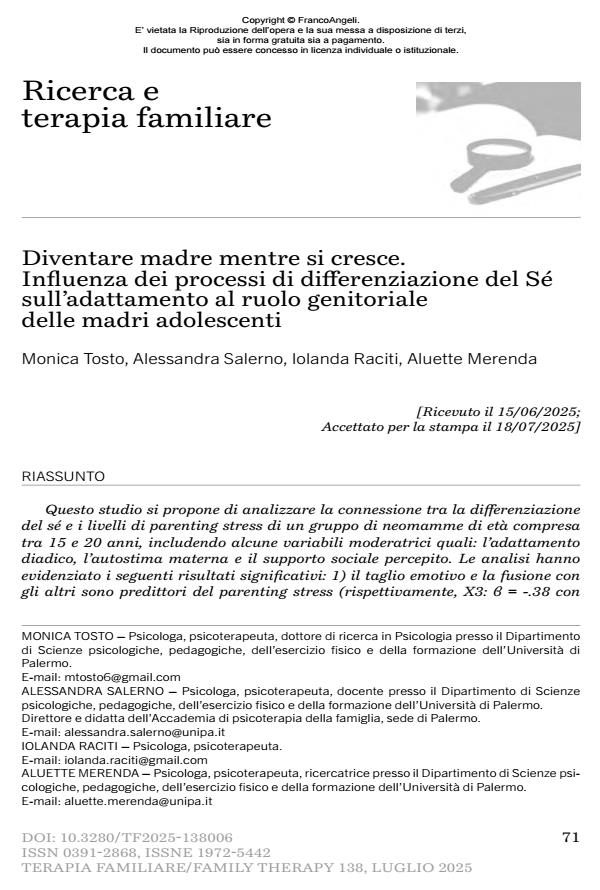
Anteprima articolo

FrancoAngeli è membro della Publishers International Linking Association, Inc (PILA)associazione indipendente e non profit per facilitare (attraverso i servizi tecnologici implementati da CrossRef.org) l’accesso degli studiosi ai contenuti digitali nelle pubblicazioni professionali e scientifiche

Questo studio si propone di analizzare la connessione tra la differenziazione del sé e i livelli di parenting stress di un gruppo di neomamme di età compresa tra 15 e 20 anni, includendo alcune variabili moderatrici quali: l’adattamento diadico, l’autostima materna e il supporto sociale percepito. Le analisi hanno evidenziato i seguenti risultati significativi: 1) il taglio emotivo e la fusione con gli altri sono predittori del parenting stress (rispettivamente, X3: ß = -.38 con ? < .05; X4: ß = .36, con ? = .05); il taglio emotivo si è inoltre rivelato un predittore significativo dell’interazione disfunzionale genitore-figlio (ß = -.42 con ? < .05), mentre la fusione con gli altri predice un bambino difficile (ß = .39, con ? < .05). È stato riscontrato un effetto predittivo della sottodimensione positiva dell’autostima sul bambino difficile (ß = -.37; ? < .05), e un effetto predittivo della coesione diadica sul bambino difficile (ß = -.40; ? < .05). I risultati sono discussi in una prospettiva socio-culturale e considerando le loro implicazioni sulla maternità precoce, soprattutto in Italia.

Parole chiave:maternità in adolescenza; parenting stress; differenziazione del Sé; famiglie adolescenti; adattamento diadico; parenting.

  1. Abidin R.R. (1995). Parenting Stress Index. Professional Manual, III ed. Lutz: Psychological Assessment Resources Inc.
  2. Allen J.P. (2008). The attachment system in adolescence. In: Cassidy J. & Shaver P.R. (eds.), Handbook of attachment: Theory, research, and clinical application (II ed., pp. 181-190). New York: Guilford.
  3. Allen J.P. & Miga E.M. (2010). Attachment in adolescence: A move to the level of emotion regulation. Journal of Social & Personal Relationships, 3: 181-190. DOI: 10.1177/0265407509360898
  4. Belsky J. (1984). The determinants of parenting: A process model. Child Development, 55: 83-96. DOI: 10.2307/1129836
  5. Birkeland R., Thompson J.K. & Phares V. (2005). Adolescent motherhood and postpartum depression. Journal of Clinical Child & Adololescent Psychology, 34: 292-300. DOI: 10.1177/0884217504272802
  6. Bohr Y., Dhayanandhan B., Summer J. & Kanter D. (2011). A phenomenological approach to understanding the experience of developmental asynchrony among adolescent mothers and fathers. In: Proceedings of the Biennal Meeting of the Society for Research in Child Development. Montreal, Canada, March 2011.
  7. Borkowski J.g., Farris J., Whitman T.L., Carothers S.S., Weed K. & Keogh D.A. (2007). Risk and resilience: adolescent mothers and their children grow up. Mahwah: Lawrence Erlbaum Associates.
  8. Bowen M. (1966). The use of family theory in clinical practice. Comprehensive Psychology, 7: 345-374.
  9. Bowen M. (1979). Dalla famiglia all’individuo. La Differenziazione del Sé nel sistema familiare. Roma: Astrolabio.
  10. Colletta N.D. & gregg C.H. (1981). Adolescent Mothers’ Vulnerability to Stress. Journal of Nervous & Mental Disease, 169: 50-54. DOI: 10.1097/00005053198101000-00007
  11. Contreras J., López I., Rivera E., Raymond-Smith L. & Rothstein K. (1999). Social support among Puerto Rican adolescent mothers: The moderating effect of acculturation. Journal of Family Psychology, 13: 228-243. DOI: 10.1037/0893-3200.13.2.228
  12. Cowan C. & Cowan P. (1992). Is there love after baby? Psychology Today, 25: 58-66. Florsheim P. & Smith A. (2005). Expectant adolescent couples’ relations and subsequent parenting behavior. Infant Mental Health Journal, 26: 533-548. DOI: 10.1002/imhj.20076.
  13. Florsheim P., Moore D., Zollinger L. et al. (1999). The Transition to Parenthood Among Adolescent Fathers and Their Partners: Does Antisocial Behavior Predict Problems in Parenting? Applied Developmental Science, 3: 178-191.
  14. gentili P., Contreras L., Cassanti M., & D’Artista F. (2002). La Dyadic Adjustment Scale. Una misura dell’adattamento di coppia. Minerva Psichiatrica, 4: 107-116. guarino A., Di Blasio P., D’Alessio M., Camisasca E. & Serantoni g. (2008). PSI. Parenting Stress Index. Manuale. Firenze: Giunti.
  15. Huang C.Y., Costeines J., Ayala C. & Kaufam J.S. (2014). Parenting Stress, Social Support, and Depression for Ethnic Minority Adolescent Mothers: Impact on Child Development. Journal of Child & Family Studies, 23: 255-262.
  16. Kerr M.E. & Bowen M. (1988). Family evaluation: An approach based on Bowen theory. New York: Norton & Co.
  17. Knauth D.g. & Skowron E.A. (2004). Psychometric Evaluation of the Differentiation of Self Inventory for adolescent. Nursing Research, 53: 163-171. DOI: 10.1097/00006199-200405000-00003
  18. Lampis J., Buonasera A., Cataudella S., Tommasi M. & Skowron E.A. (2017). Psychometric properties of an Italian version of the differentiation of self-in-
  19. ventory-revised (it-DSI-R). Journal of Adolescent Development, 24: 144-154.
  20. Lampis J., Cataudella S., Speziale R. & Elat S. (2020). The Role of Differentiation of Self Dimensions in the Anxiety Problems. The Family Journal, 28: 90-97. DOI: 10.1177/1066480719894943
  21. Letourneau N., Stewart M. & Barnfther A. (2004). Adolescent mothers: Support needs, resources, and support-education interventions. Journal of Adolescence Health, 35: 509-525.
  22. Levine L., garcia-Coll C. & Oh W. (1984). Determinants of mother–infant interaction in adolescent mothers. Pediatrics, 75: 23-29.
  23. Logsdon M.C., Birkimer J.C., Simpson T. & Looney S. (2005). Postpartum depression and social support in adolescents. Journal of Obestetric, Gynecologic & Neonatal Nursing, 34: 46-54.
  24. Mahler M., Pine F. & Bergman A., (1975). The Psychological Birth of the Human Infant. Symbiosis and Individuation. New York: Basic Books (trad. it.: La nascita psicologica del bambino. Simbiosi e individuazione. Torino: Bollati Boringhieri, 1978).
  25. McElhaney K.B., Allen J.P., Stevenson J.C. & Hare A.L. (2009). Attachment and Autonomy during Adolescence. In: Lerner R.M. & Steinberg L.D. (eds.), Handbook of Adolescent Psychology. Individual bases of adolescent development (III ed., pp. 358-403). Hoboken: Wiley.
  26. Miller C.L., Miceli P.J., Whitman T.L. & Borkowski J.g. (1996). Cognitive readiness to parent and intellectual-emotional development in children of adolescent mothers. Developmental Psychology, 32: 533-541. DOI: 10.1037/0012-1649.32.3.533
  27. Moore M.R. & Brooks-gunn M.H. (2002). Adolescent Parenthood. In: Bornstein
  28. M.H. (eds.), Handbook of parenting. Being and Becoming a Parent (II ed., pp. 173-214). Mahwah: Erlbaum.
  29. Nath P.S., Borkowski J.g., Whitman T.L. & Schellenbach C.J. (1991). understanding Adolescent Parenting: The Dimensions and Functions of Social Support. Family Relations, 40: 411-420. DOI: 10.2307/584898
  30. Obeidallah D.A. & Burton L.M. (1998). Affective ties between mother and daughters in adolescent childbearing families. In: Cox M.J. & Brooks-gunn J. (eds.), Conflict and cohesion in families. Causes and Consequences (I ed., pp. 173-214). London: Routledge.
  31. Passino AW., Whitman T.L., Borkowski J.G., Schellenbach C.J., Mazwell S.E., Keogh D. & Rellinger E. (1993). Personal Adjustment during Pregnancy and Adolescent Parenting. Adolescence, 28: 97-122.
  32. Prezza M. & Principato M.C. (2002). La rete sociale e il sostegno sociale. In: Prezza
  33. M. & Santinello M. (eds.), Conoscere la comunità. L’analisi degli ambienti di vita quotidiana (pp. 193-234). Bologna: il Mulino.
  34. Prezza M., Trombaccia R.F. & Armento L. (1997). La scala dell’autostima di Rosenberg: traduzione e validazione italiana. Firenze: Giunti.
  35. Richardson R.A., Barbour N.E. & Bubenzer D.L. (1995). Peer relationships as a source of support for adolescent mothers. Journal of Adolescent Research, 10: 278-290. DOI: 10.1177/0743554895102005
  36. Rosenberg M. (1965). Society and the adolescence self-image. Princeton: Princeton University Press.
  37. Sadler L. & Catrone C. (1983). The adolescent parent: A dual developmental crisis. Journal of Adolescent Health Care, 4: 100-105. DOI: 10.1016/S0197-0070(83)80027-8
  38. Saisto T., Salmela-aro K., Nurmiä J. & Halmesmäki E. (2008). Longitudinal study on the predictors of parental stress in mothers and fathers of toddlers. Journal of Psychosomatic Obstetrics & Gynecology, 29: 213-222. DOI: 10.1080/01674820802000467
  39. Schellenbach C.J., Whitman T.L. & Borkowski J.g. (1992). Toward an integrative model of adolescent parenting. Human Development, 35: 81-99. DOI: 10.1159/000277136
  40. Secco M.L. & Moffatt M.E.K. (2003). Situational, maternal, and infant influences on parenting stress among adolescent mothers. Issues in Comprehensive Pediatric Nursing, 26: 103-122. DOI: 10.1080/01460860390197862
  41. Skowron E.A. & Schimdt T.A. (2003). Assessing Interpersonal Fusion: Reliability and Validity of a New Dsi Fusion with Others Subscale. Journal of Marrriage & Family Therapy, 29: 209-222.
  42. Skowron E.A. & Friedlander M.L. (1998). The Differentiation of Self Inventory: Development and initial validation. Journal of Counseling Psychology, 45: 235-246. DOI: 10.1037/0022-0167.45.3.235
  43. Sommer K., Whitman T.L., Borkowsky J.g., Schellenbach C., Maxwell S. & Keogh
  44. D. (1993). Cognitive readiness and adolescent parenting. Developmental Psychology, 29: 389-398. DOI: 10.1037/0012-1649.29.2.389
  45. Spanier g.B. (1976). Measuring Dyadic Adjustment: New Scales for Assessing the Quality of Marriage and Similar Dyads. Journal of Marriage & Family Therapy, 38: 15-28. DOI: 10.2307/350547
  46. Spencer M.S., Kalil A., Larson N.C., Spieker S.J. & gilchrist L.D. (2002). Multigenerational Co-residence and Childrearing Conflict: Links to Parenting Stress in Teenage Mothers Across the First Two Years Postpartum. Applied Developmental Science, 6: 157-170. DOI: 10.1207/S1532480XADS0603_5
  47. Tosto M. (2014). I figli di madri adolescenti e il loro sviluppo. un percorso tra disordini evolutivi e rischi di adattamento. In: garro M. & Salerno A. (a cura di), Oltre il legame, Genitori e figli nei nuovi scenari familiari (pp. 22-37). Milano: FrancoAngeli.
  48. Tosto M. & Salerno A. (2012). Processi di parenting e di adattamento al ruolo genitoriale in adolescenza. Terapia Familiare, 99: 55-73. DOI: 10.3280/TF2012-099003
  49. Tosto M., Salerno A. & Fici E. (2015). L’esperienza della maternità in adolescenza e le azioni di supporto al benessere psicologico e sociale. Psicologia Clinica dello Sviluppo, 19: 219-246. DOI: 10.1449/80313
  50. Trute B., Worthinton C. & Hiebert-Murphy D. (2008). grandmother Support for Parents of Children with Disabilities: gender Differences in Parenting Stress. Family, Systems & Health, 26: 135-146 DOI: 10.1037/1091-7527.26.2.135
  51. Whitman T.L, Borkowski J.g., Keogh D.A. & Weed K. (eds.) (2008). Interwoven lives. Mahwah: Lawrence Erlbaum Associates.
  52. Zimet g.L., Dahlem N.W., Zimet S.g. & Farley g.K. (1988). The Multidimensional Scale of Perceived Social Support. Journal of Personality Assessment, 55: 610-617.

Monica Tosto, Alessandra Salerno, Iolanda Raciti, Aluette Merenda, Diventare madre mentre si cresce. Influenza dei processi di differenziazione del Sé sull’adattamento al ruolo genitoriale delle madri adolescenti in "TERAPIA FAMILIARE" 138/2025, pp 71-92, DOI: 10.3280/TF2025-138006