“The Tree of Colonization”: Eucalyptography and Labor Migration on Mediterranean Frontiers (ca. 1860-1880)
Journal title SOCIETÀ E STORIA
Author/s Jackson Perry
Publishing Year 2025 Issue 2025/189
Language Italian Pages 30 P. 619-648 File size 249 KB
DOI 10.3280/SS2025-189005
DOI is like a bar code for intellectual property: to have more infomation
click here
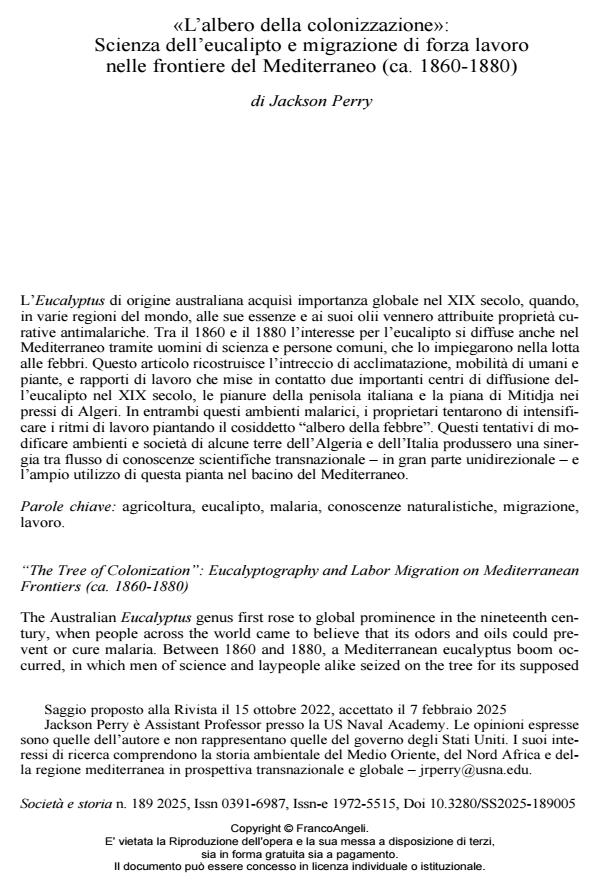
Below, you can see the article first page
If you want to buy this article in PDF format, you can do it, following the instructions to buy download credits
FrancoAngeli is member of Publishers International Linking Association, Inc (PILA), a not-for-profit association which run the CrossRef service enabling links to and from online scholarly content.
The Australian Eucalyptus genus first rose to global prominence in the nineteenth century, when people across the world came to believe that its odors and oils could prevent or cure malaria. Between 1860 and 1880, a Mediterranean eucalyptus boom occurred, in which men of science and laypeople alike seized on the tree for its supposed fever-fighting virtues. This article identifies an entangled history of acclimatization, human and plant migrations, and labor relations between two of the most important hubs of nineteenth-century eucalyptus enthusiasm: Italy’s lowlands and the Mitidja plain outside Algiers. In each malarial environment, landowners sought to change labor migration patterns by planting the so-called “fever tree.” Their efforts to transform the environments and societies of lowland Algeria and Italy drove the transnational, if largely unidirectional, flow of scientific knowledge and the widespread adoption of eucalyptography across the Mediterranean.
Keywords: Agriculture, eucalyptus, malaria, natural knowledge, migration, labor.
- Abi-Mershed O. (2010), Apostles of Modernity: Saint-Simonians & the Civilizing Mission in Algeria, Stanford, Stanford University Press.
- Almeida Sampaio B.C. (1874), Duas palavras sobre agricultura, in «Jornal de horticultura prática», 5, pp. 90-92.
- Arrigoni T. (2008), Come in America. La Maremma e la frontiera, Piombino, La Bancarella.
- Augello M. e Guidi M. (a cura di) (2003), Associazionismo economico e diffusione dell’economia politica nell’Italia dell’ottocento, vol. 1, Società economiche e accademie pre-unitarie, Milano, FrancoAngeli.
- Banti A.M. (1990), I proprietari terrieri nell’Italia centro-settentrionale, in Storia dell’agricoltura italiana, vol. 2, Uomini e classi, a cura di P. Bevilacqua, Venezia, Marsilio, pp. 45-103.
- Barsanti D. (2010), Ricasoli e il primo tentative di meccanizzazione dell’agricoltura maremmana, in «Rivista di Storia dell’Agricoltura», 50, 2, pp. 127-146.
- Bennett B. (2011), A Global History of Australian Trees, in «Journal of the History of Biology», 44, 1, pp. 125-145.
- Bersange J. (1885), Dom François Régis, Paris, Dumoulin.
- Bertherand É.-L. (1876), L’Eucalyptus au point de vue de l’hygiéne en Algérie, Alger, V. Aillaud.
- Bevilacqua P. e Rossi-Doria M. (a cura di) (1984), Le bonifiche in Italia dal ‘700 a oggi, Roma-Bari, Laterza.
- Biagioli G. e Pazzagli R. (a cura di) (2004), Agricoltura come manifattura. Istruzione agraria professionalizzazione e sviluppo agricolo nell’ottocento, Firenze, Olschki. Biasillo R. e Armiero M. (2018), Seeing the Nation for the Trees: At the Frontier of Italian Nineteenth-Century Modernity, in «Environment and History», 24, 4, pp. 497-518.
- Boccardo G. (1874), L’emigrazione e le colonie, in «Nuova Antologia», 27, pp. 621650.
- Bonelli F. (1966), La malaria nella storia demografica ed economica d’Italia: Primi lineamenti di una ricerca, in «Studi Storici», 7, 4, pp. 659-687.
- Bonificamento delle regioni di malaria lungo le ferrovie d’Italia, in Atti parlamentari: Senato del Regno, sessione del 1880-81-82, documenti, n. 19, Roma, Forzani, pp. 1-71.
- Borghi L. (2021), Lancisi e I ‘Lancisiani’. Sapere medico e divulgazione nella Roma del Settecento, in Comunicare la scienza medica nel Settecento europeo: uno sguardo alle prospettive di ricerca, a cura di E. Agazzi, G. Iamartino e P. Mazzarello, Pavia, Istituto Lombardo. Accademia Di Scienze E Lettere, Incontri di Studio, pp. 117-130.
- Bruce-Chuvatt L.J. (1981), Alphonse Laveran’s discovery 100 years ago and today’s global fight against malaria, in «Journal of the Royal Society of Medicine», 74, 7, pp. 531-536.
- Capra C. (1978), Nobili, notabili, élites: Dal “modello” francese al caso italiano, in «Quaderni storici», 13, 37, 1, pp. 12-42.
- Caprotti F. (2007), Mussolini’s Cities: Internal Colonialism in Italy, 1930-1939, Youngstown, Cambria Press.
- Caprotti F. e Kaïka M (2008), Producing the ideal fascist landscape: nature, materiality and the cinematic representation of land reclamation in the Pontine Marshes, in «Social and Cultural Geography», 9, 6, pp. 613-634.
- Certeux A. (1877), Guide du planteur d’Eucalyptus, Alger, V. Aillaud.
- Ciuffoletti Z. (1975), Bettino Ricasoli fra High Farming e mezzadria: La tenuta sperimentale di Barbanella in Maremma (1855-1859), in «Studi Storici», 16, 2, pp. 495-522.
- Cohen J. (1852), Situation actuelle de la colonisation en Algérie, troisième article, in «Annales de la colonisation Algérienne», 1, 7, pp. 1-8.
- Conca Messina S. e Brilli C. (2022), Agriculture and nobility in Lombardy. Land, management and innovation (1815-1861), in «Business History», 64, 2, pp. 255-279. Cordier A. (1876), Della Seminagione e Piantagione dell’Eucalyptus, Roma, Tip. Artero e Comp.
- Csiszar A. (2018), The Scientific Journal: Authorship and the Politics of Knowledge in the Nineteenth Century, Chicago, University of Chicago Press.
- Curtin P. (1989), Death by Migration: Europe’s Encounter with the Tropical World in the Nineteenth Century, Cambridge, Cambridge University Press.
- Cutler B. (2011), Evoking the State: Environmental Disaster and Colonial Policy in Algeria, 1840-1870, PhD thesis., University of California-Irvine.
- Davis D.K. (2007), Resurrecting the Granary of Rome: Environmental History and French Colonial Expansion in North Africa, Athens, Ohio University Press.
- De Ruggiero A. (2005), La conquista della Maremma: I viaggi di Leopoldo II nelle terre umide del Granducato, in «Rivista di storia dell’agricoltura», 45, 2, pp. 39-84.
- Donelli G. e Serinaldi E. (2003), Dalla lotta alla malaria alla nascita dell’Istituto di Sanità Pubblica: Il ruolo della Rockefeller Foundation in Italia: 1922-1934, Roma-Bari, Laterza.
- Doughty R. (2000), The Eucalyptus: A Natural and Commercial History of the Gum Tree, Baltimore, Johns Hopkins University Press.
- Duffy A. (2020), Some Like It Hot: Mediterranean Societies at the End of the Little Ice Age, in «Agricultural History», 94, 2, pp. 176-204.
- Duvivier F.F. (1841), Solution de la question de l’Algérie, Paris, Imprimerie et Libraire Militaire de Gualtier-Laguionie.
- Felisini D. (2016), Alessandro Torlonia: The Pope’s Banker, Cham, Springer.
- Felisini D. (2022), Far from the passive property. An entrepreneurial landowner in the nineteenth century Papal State, in «Business History», 64, 2, pp. 226-238.
- Fenzi E.O. (1891), Del Barone Vincenzo Ricasoli, botanico, in «Bulletino della R. Società Toscana di Orticultura», Serie 2, 6, 7, pp. XX-XXX.
- Franc J. (1923), Le climat de la Mitidja, in «Bulletin de la société de géographie d’Alger et de l’Afrique du nord», 28, pp. 169-181.
- Franc J. (1930), Un miracle colonial en Algérie, Boufarik 1830-1930, Alger, Ancienne Imprimerie V. Heintz.
- Gabellieri N. (2020), “Californian Dreamin”: Rural Planning and Agricultural Development in Italy’s Grosseto Plain, 1948-1965, in «Agricultural History», 94, 2, pp. 224-250.
- Gallo S. (2012), Riempire l’Italia: le migrazioni nei progetti di colonizzazione interna, 1868-1910, in «Meridiana», 75, pp. 59-83.
- Gänger S. (2021), A Singular Remedy: Cinchona Across the Atlantic World, 17511820, Cambridge, Cambridge University Press.
- García-Pereda I. e Rodrigues A.D. (2022), Eucalyptus Acclimatisation for Fighting Malaria: Environmental and Medical Experiments in the Iberian Nineteenth Century, in «Social History of Medicine», 35, 1, pp. 72-96.
- Ghirardo D. (1989), Building New Communities: New Deal America and Fascist Italy, Princeton, Princeton University Press.
- Giddens A. (1990), The Consequences of Modernity, Stanford, Stanford University Press.
- Gimbert J.L. (1873), Assainissement des terrains marécageux par l’Eucalyptus globulus, in «Comptes rendus de l’Académie des Sciences», 77, pp. 764-765.
- Gispert H. (1987), La correspondance de G. Darboux avec J. Houël. Chronique d’un rédacteur (déc. 1869-nov. 1871), in «Cahiers du séminaire d’histoire des mathématiques», 1, 8, pp. 67-202.
- Gouvernement Général de l’Algérie (1903), Notice sur la Mitidja en 1830 et aujourd’hui, Alger-Mustapha, Imprimerie Algérienne.
- Gratien C. (2017), The Ottoman Quagmire: Malaria, Swamps, and Settlement in the Late Ottoman Mediterranean, in «International Journal of Middle East Studies», 49, 4, pp. 583-604.
- Gratien C. (2022), The Unsettled Plain: An Environmental History of the Late Ottoman Frontier, Stanford, Stanford University Press.
- Hoerder D. (2013), Migration and Belongings, in A World Connecting, 1870-1945, a cura di E. Rosenberg, Cambridge, Harvard University Press, pp. 433-589.
- Isnard H. (1949), Vigne et colonisation en Algérie, in «Annales de géographie», 58, 311, pp. 212-219.
- La Salvia S. (1987), Il moderatismo in Italia, in Istituzioni e ideologie in Italia e in Germania tra le rivoluzioni, a cura di U. Corsini e R. Lill, Bologna, Il Mulino, pp. 169-310.
- Lancisi G.M. (1717), De Noxiis Paludum Effluviis Eorumque Remediis, Roma, Salvioni.
- Laveran A. (1881), Nature parasitaire des accidents de l’impaludisme, Paris, J.B. Baillière.
- Legg C.A. (2013), Imagining le peuple nouveau: medicine and the press in French Algeria, 1870-1914, PhD thesis, New York University.
- Lenormant F. (1881), La Grande-Grèce: paysage et histoire, vol. 1, Littoral de la mer Ionienne, Paris, A. Lévy.
- Leonardi G. (1882), Elogio accademico di Giacomo Sacchèro, in «Atti dell’accademia Gioenia di scienze naturali», Ser. 3, t. 16, Catania, Tip. C. Galatola, pp. XLVIILXXIV.
- Lupo S. (1990), I proprietari terrieri nel Mezzogiorno, in Storia dell’agricoltura italiana, vol. 2 Uomini e classi, a cura di P. Bevilacqua, Venezia, Marsilio, pp. 105149.
- Majori G. (2012), Short History of Malaria and Its Eradication in Italy with Short Notes on the Fight Against the Infection in the Mediterranean Basin, in «Mediterranean Journal of Hematology and Infectious Diseases», 4, disponibile al seguente URL: https://doi.org/10.4084/injhid.2012.016 (ultimo accesso 25/10/2024).
- Malatesta M. (1989), I signori della terra. L’organizzazione degli interessi agrari padani (1860-1914), Milano, FrancoAngeli.
- Marolda-Petilli F. (1879), Gli eucalitti, Roma, Forzani.
- Martin F. (1877), L’Eucalyptus et ses applications industrielles, Paris, Dunod. Meaume É. (1882), L’Eucalyptus a la colonie agricole des Trois-Fontaines, Landerneau, Desmoulins.
- Mercurio F. (1990), La frontiera del Tavoliere. Agricoltura bonifiche e società nel processo di modernizzazione del Mezzogiorno tra ‘800 e ‘900, Foggia, Amministrazione provinciale di Capitanata.
- Molina D. (2022), The Forced Retirement of a Hard Worker: The Rise and Fall of Eucalyptus in Bogotá, in «Environmental History», 27, 1, pp. 58-85.
- Nanni P. (a cura di) (2015), The Georgofili Academy, trad. Cathy Bargelli, Firenze, Accademia dei Georgofili.
- Novello E. (2003). La Bonifica in Italia: Legislazione, credito, e lotta alla malaria dall’Unità al fascismo, Milano, FrancoAngeli.
- Novello E. e McCann J. (2017), The Building of the Terra Firma: The Political Ecology of Land Reclamation in the Veneto from the Sixteenth through the Twenty-first Century, in «Environmental History», 22, 3, pp. 460-485.
- Oliveira e Silva A. J. (1871), Cultura do Eucalyptus na Argelia, in «Jornal de horticultura prática», 2, pp. 108-110.
- Oz-Salzberger F. (2006), The Enlightenment in Translation: Regional and European Aspects, in «European Review of History Revue européenne d’Histoire», 13, 3, pp. 385-409.
- Özgün C. (2013), Osmanli Agaç Kültüründe Yeni ve Egzotik Bir Tür: Okaliptüs, in «Çagdas Türkiye Tarihi Arastirmalari Dergisi», 13, 26, pp. 5-29.
- Pasqualino G. (2009), Giacomo Sacchero: un librettista catanese alla Scala di Milano, Foggia, Bastogi.
- Penslar D. (1991), Zionism and Technocracy: The Engineering of Jewish Settlement in Palestine, 1870-1918, Bloomington, Indiana University Press.
- Peut H. (1853), Bulletin général de colonisation, in «Annales de la colonisation Algérienne», 2, 2, pp. 292-315.
- Poettinger M. (2018), Carlo Lorenzini e la pedagogia illuminista, in «Studi sulla Formazione», 21, pp. 189-200.
- Porisini G. (1974), Le bonifiche nella politica economica dei governi Cairoli e Depretis, in «Studi Storici», 15, 3, pp. 589-623.
- Reilly B. (2021), Seasons in Italy: Northern European travelers, Rome, and malaria, in «Journal of Tourism and Cultural Change», 19, 1, pp. 59-78.
- Ricasoli V. (1877), Visita alla società agricola dei Trappisti, delle Tre Fontane presso Roma, in «Bulletino della R. Società Toscana di Orticultura», 2, 12, pp. 364-367.
- Ricasoli V. (1887), Corrispondenza Italiana, in «Bulletino della R. Società Toscana di Orticultura», 2, 12, pp. 375-376.
- Ricasoli V. (1888), Della utilità dei giardini d’acclimazione e della naturalizzazione delle piante, Firenze, Tip. Mariano Ricci.
- Richards J. (2003), The Unending Frontier: An Environmental History of the Early Modern World, Berkeley, University of California Press.
- Romanelli R. (1991), Political Debate, Social History, and the Italian Borghesia: Changing Perspectives in Historical Research, in «The Journal of Modern History», 63, 4, pp. 717-739.
- Ruedy J. (2005), Modern Algeria: The Origins and Development of a Nation, Bloomington, Indiana University Press (II edizione).
- Sacchero G. (1868), Utilità dell’Eucalyptus globulus, Catania, Stabilimento Tip. Caronda.
- Salinas C. (2005), Colonies Without Colonists: Colonial Emigration, Algeria, and Liberal Politics in France, 1848-1870, PhD thesis, Stanford University.
- Salvagnoli-Marchetti A. (1864-65), Rapporto della esposizione dei cotoni italiani tenuta in Torino nel Febbraio 1864, in «Atti della R. Accademia Economico-Agraria dei Georgofili di Firenze», 11-12, pp. 118-133.
- Sergent E., Sergent E., Parrot L., Foley H., Catanei A. e Senevet G. (1928), Carte du Paludisme en Algérie, Alger, Jules Carbonel.
- Shapin S. (1994), A Social History of Truth: Civility and Science in Seventeenth-Century England, Chicago, University of Chicago Press.
- Smith A. (2006), Colonial Memory and Postcolonial Europe: Maltese Settlers in Algeria and France, Bloomington, Indiana University Press.
- Snowden F. (2006), The Conquest of Malaria: Italy, 1900-1962, New Haven, Yale University Press.
- Stampacchia M. (2000), “Ruralizzare l’Italia!”: Agricoltura e bonifiche tra Mussolini e Serpieri, 1928-1943, Milano, FrancoAngeli.
- Stigand W. (1889), Report on the Wine Produce of Sicily, Foreign Office, Miscellaneous Series, 143, London, Harrison and Sons.
- Tabak F. (2008), The Waning of the Mediterranean, 1550-1870: A Geohistorical Approach, Baltimore, The Johns Hopkins University Press.
- Tino P. (2005), Malaria e modernizzazione in Italia dopo l’Unità, in «I frutti di Demetra, bollettino di storia e ambiente», 8, pp. 27-37.
- Tocqueville A. (1865), Voyage en Algérie, in Tocqueville A., Oeuvres complètes, vol. 7, Paris, Michel Lévy.
- Trottier F. (1876), Boisement et colonisation: Rôle de l’eucalyptus en Algérie au point de vue des besoins locaux de l’exportation et du développement de la population, Alger, V. Aillaud.
- Ventalló y Vintró P.A. (1877), Los Gomeros de Australia, Tarrasa, Imprenta y Litografia La Industrial.
- Vermeren H. (2017), Les Italiens à Bône (1865-1940), Rome, Ecole Française de Rome.
- Webb Jr. J.L.A. (2009), Humanity’s Burden: A Global History of Malaria, New York, Cambridge University Press.
- Zacharin R.F. (1978), Emigrant Eucalypts: Gum Trees as Exotics, Melbourne, Melbourne University Press.
- Zamagni V. (1993), The Economic History of Italy, 1860-1900, New York, Oxford University Press.
Jackson Perry, «L’albero della colonizzazione»: Scienza dell’eucalipto e migrazione di forza lavoro nelle frontiere del Mediterraneo (ca. 1860-1880) in "SOCIETÀ E STORIA " 189/2025, pp 619-648, DOI: 10.3280/SS2025-189005