Oppositional Defiant Disorder: From Diagnosis to Treatment in a Systemic Relational Perspective

Journal title TERAPIA FAMILIARE
Author/s Caterina Nardis, Costanza Giordani, Michela Quintaiè, Giulia Meneghetti, Grazia Armenia
Publishing Year 2025 Issue 2025/138
Language Italian Pages 17 P. 19-35 File size 151 KB
DOI 10.3280/TF2025-138003
DOI is like a bar code for intellectual property: to have more infomation click here

Below, you can see the article first page

If you want to buy this article in PDF format, you can do it, following the instructions to buy download credits
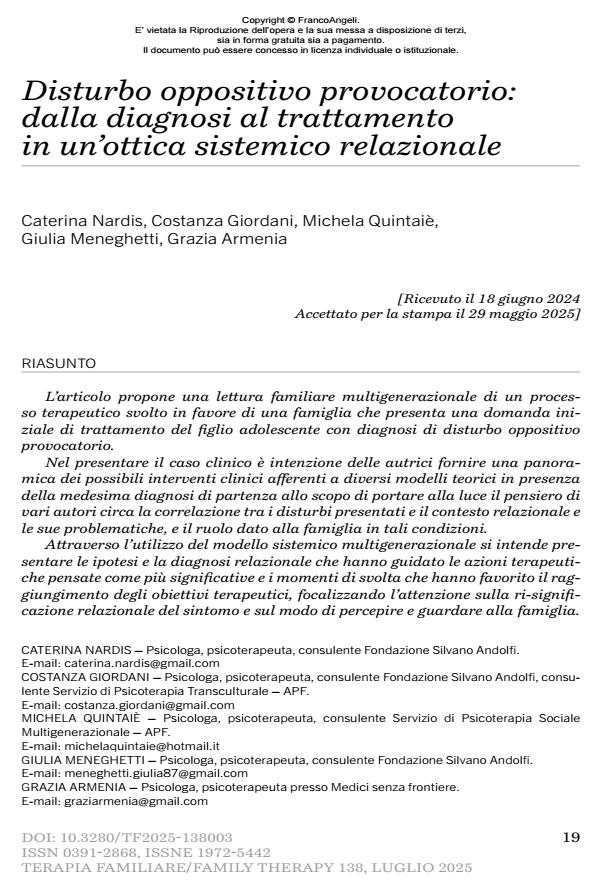
Article preview

FrancoAngeli is member of Publishers International Linking Association, Inc (PILA), a not-for-profit association which run the CrossRef service enabling links to and from online scholarly content.

This article proposes a therapeutic process from a multigenerational family point of view conducted for a family seeking initial treatment for their adolescent son diagnosed with oppositional defiant disorder. In presenting the clinical case, the authors intend to provide an overview of possible clinical interventions pertaining to different theoretical models for the same initial diagnosis. The aim is to highlight the thoughts of various authors regarding the correlation between the disorders presented and the relational context and its issues, as well as the role assigned to the family in such conditions. By utilizing the multigenerational systemic model, the intention is to present the hypotheses and relational diagnosis that guided the most significant therapeutic actions and the turning points that facilitated the achievement of therapeutic goals, focusing attention on the relational re-signification of the symptom and the way of perceiving and viewing the family. The aim of the article is to illustrate and support the effectiveness of using the multigenerational systemic model in approaching families with children diagnosed with oppositional defiant disorder. This model becomes an “ecological” treatment method that, through the active involvement of the entire family unit, aims to restore competence to families and reduce the use of medication to minors.

Keywords: diagnosis, treatment, multigenerational, oppositional defiant disorder, symptom.

  1. American Psychiatric Association (1996). Manuale diagnostico e statistico dei disturbi mentali: DSM-IV. Milano: Masson.
  2. Anderson J., Funke J., Elliot R., Smith P. (2003). Parental support and pressure and children’s extracurricular activities: Relationship with amount of involvement and affective experience of participation. Journal of Applied Developmental Psychology, 24(2): 241-258. DOI: 10.1016/S0193-3973(03)00046-7
  3. Andolfi M. & Angelo C. (1987). Tempo e mito in psicoterapia familiare. Torino: Boringhieri.
  4. Andolfi M. & Mascellani A. (2010). Storie di adolescenza. Milano: Raffaello Cortina.
  5. Andolfi M. (2015). La terapia familiare multigenerazionale. Strumenti e risorse del terapeuta. Milano: Raffaello Cortina.
  6. Andolfi M. (2017). Scacco matto al re. Come reinventare il padre. Terapia familiare, 113: 13-38. DOI 10.3280/TF2017-113002.
  7. Andolfi M., Angelo C. (1989). Quale diagnosi per quale Terapia? Terapia Familiare, 31: 41-52.
  8. Andolfi M., Falcucci M., Mascellani A., Santona A. & Sciamplicotti F. (2007). Il bambino come risorsa nella terapia familiare. Roma: APF.
  9. Andolfi M., Falcucci M., Mascellani A., Santona A. & Sciamplicotti F. (2006). La terapia di coppia in una prospettiva trigenerazionale. Roma: Accademia di Psicoterapia alla Famiglia.
  10. Bandura A. (1973). Aggression: A social learning analysis. New Jersey: Prenticehall.
  11. Barbiè I., Ferrero g. (2015). Quando essere famiglia è un’impresa. Riflessioni sistemiche sulle aziende a conduzione familiare. Terapia familiare, 108: 61-77. DOI 10.3280/TF2015-108003.
  12. Boszormenyi-Nagy I. & Spark g.M. (1988). Lealtà invisibili. Roma: Astrolabio.
  13. Bowen M. (1979). Dalla famiglia all’individuo. La differenzazione del sé nel sistema familiare. Roma: Astrolabio.
  14. Bowlby J. (1969). Attachment and loss, vol. 1: Attachment. New York: Basic Books (trad. it.: Attaccamento e perdita, vol. 1: L’attaccamento alla madre. Torino: Bollati Boringhieri, 1972).
  15. Bowlby J. (1973). Attachment and loss, vol. 2: Separation: Anxiety and anger. New York: Basic Books (trad. it.: Attaccamento e perdita, vol. 2: La separazione della madre, Torino, Bollati Boringhieri, 1975).
  16. Bowlby J. (1980). Attachment and loss, vol. 3: Loss: Sadness and depression. New York-London: Hogarth Press (trad. it.: Attaccamento e perdita, vol. 3: La perdita della madre. Torino: Boringhieri, 1983).
  17. Bowlby J. (1984). Violence in the family as a disorder of the attachment and caregiving Systems. American Journal of Psychoanalysis, 44: 9-27. DOI: 10.1007/BF01255416
  18. Bowlby J. (1988). A secure base. London: Routledge (trad. it.: Una base sicura. Milano: Raffaello Cortina, 1989).
  19. Cirillo S., Sorrentino A.M., Selvini M. (2022). L’équipe base sicura della sperimentazione dei formati in terapia familiare. Terapia familiare, 130(3): 21-37. DOI 10.3280/TF2022-130002.
  20. De Leo G., Mazzei D. (1989). Per un’analisi sistemica dell’azione violenta. Terapia Familiare, 30: 21-35.
  21. De Zulueta F. (1999). Dal dolore alla violenza: le origini traumatiche dell’aggressività. Milano: Raffaello Cortina.
  22. Dodge K.A. & Tettit g.S. (2003). A biopsychosocial model of the development of chronic conduct problems in adolescence. Developmental Psychology, 39: 349-371. DOI: 10.1037//0012-1649.39.2.349
  23. Eyberg S.M., Nelson M.M. & Boggs S.R. (2008). Evidence-based Psychosocial Treatments for Children and Adolescents with Distruptive Behaviour. Journal Clinical Child & Adolescents Psychology, 37(1): 215-237. DOI: 10.1080/15374410701820117
  24. Fonagy P., gergely g., Jurist E.L. & Target M. (2005). Regolazione affettiva, mentalizzazione e sviluppo del sé. Milano: Raffaello Cortina.
  25. Fraiberg S. (1980). Clinical studies in infant mental health: The first year of life. New York: Basic Books.
  26. gatta M., Sudati L., Sisti M., Miscioscia M., Calloni V. & Simonelli A. (2017). Il ruolo delle interazioni familiari nell’espressione del disagio psichico in adolescenza: uno studio preliminare. Psicologia Clinica dello Sviluppo, 21(3): 397-417.
  27. gottman J., gottman J.M. & Silver N. (1995). Why marriages succeed or fail: And how you can make yours last. New York: Simon and Schuster.
  28. Greenberg M.T., Weissberg R.P., O’Brien M.U., Zins J.E., Fredericks L., Resnik H. & Elias M.J. (2003). Enhancing school-based prevention and youth development through coordinated social, emotional, and academic learning. American Psychologist, 58: 466-474.
  29. Henggeler S.W. (1999). Multisystemic therapy: An overview of clinical procedures, outcomes, and policy implications. Child Psychology and Psychiatry Review, 4(1): 2-10. DOI: 10.1017/S1360641798001786
  30. Lochman J.E. & Wells K.C. (2002). The Coping Power Program at the middle school transition: universal and indicated prevention effects. Psychology of Additive Behaviors, 16: 40-54.
  31. Lochman J.E. & Dodge K.A. (1994). Social cognitive processis of severily violent, moderately, aggressive and non-aggressive boys. Journal of Consulting and Clinical Psychology, 62: 366-374. DOI: 10.1037/0022-006X.62.2.366
  32. Minuchin S. (1974). Famiglie e terapia della famiglia. Roma: Astrolabio, 1976. Moffit T.E. & Caspi A. (2001). Childhood predictors differentiate life-course persistent and adolescence-limited antisocial pathways among males and females. Development and Psychopathology, 13: 355-375.
  33. Muratori F.L. (2013). Psicopatologia e psicoterapia dei disturbi della condotta. Roma: Carocci Editore.
  34. Pallini S., Amann gainotti M. & Tabasso C. (2005). Continuità tra le relazioni d’attaccamento e i legami coniugali violenti. Psicobiettivo, 2: 47-66.
  35. Pandolfi E. (2010). I Disturbi Esternalizzanti nell’Infanzia: fattori di rischio e traiettorie di sviluppo. Psicoterapeuti in-formazione, 6: 50-69.
  36. Patterson G.R. (1982). Coercitive family process. Eugene: Castalia.
  37. Recalcati M. (2011). Cosa resta del padre? La paternità nell’epoca ipermoderna. Milano: Raffaello Cortina.
  38. Recalcati M. (2013). Il complesso di Telemaco. Milano: Feltrinelli.
  39. Ruglioni L., Muratori P., Polidori L., Milone A., Manfredi A. & Lambruschi F. (2009). Il trattamento multi-modale dei disturbi da comportamento dirompente in bambini di età scolare: presentazione di una esperienza. Cognitivismo clinico, 6(2): 196-210.
  40. Selvini M. (1994). Segreti familiari, quando il paziente non sa. Terapia Familiare, 45: 5-17.
  41. Speranza A.M. (2001). Disturbi da deficit di Attenzione/Iperattività e Disturbi della Condotta. In: Ammaniti M., Manuale di psicopatologia dell’infanzia (pp. 281295). Milano: Raffaello Cortina.
  42. Stern D.N. (2005). Il momento presente. Milano: Raffaello Cortina

Caterina Nardis, Costanza Giordani, Michela Quintaiè, Giulia Meneghetti, Grazia Armenia, Disturbo oppositivo provocatorio: dalla diagnosi al trattamento in un’ottica sistemico relazionale in "TERAPIA FAMILIARE" 138/2025, pp 19-35, DOI: 10.3280/TF2025-138003