Psychopathology of Adolescence and Clinical-Organizational Response: The Experience of the Aïda Day Center in Reggio Emilia

Journal title RIVISTA SPERIMENTALE DI FRENIATRIA
Author/s Michele Poletti, Valentina Iannuzzi, Omar Daolio
Publishing Year 2025 Issue 2025/2
Language Italian Pages 13 P. 77-89 File size 210 KB
DOI 10.3280/RSF2025-002006
DOI is like a bar code for intellectual property: to have more infomation click here

Below, you can see the article first page

If you want to buy this article in PDF format, you can do it, following the instructions to buy download credits
Article preview

FrancoAngeli is member of Publishers International Linking Association, Inc (PILA), a not-for-profit association which run the CrossRef service enabling links to and from online scholarly content.

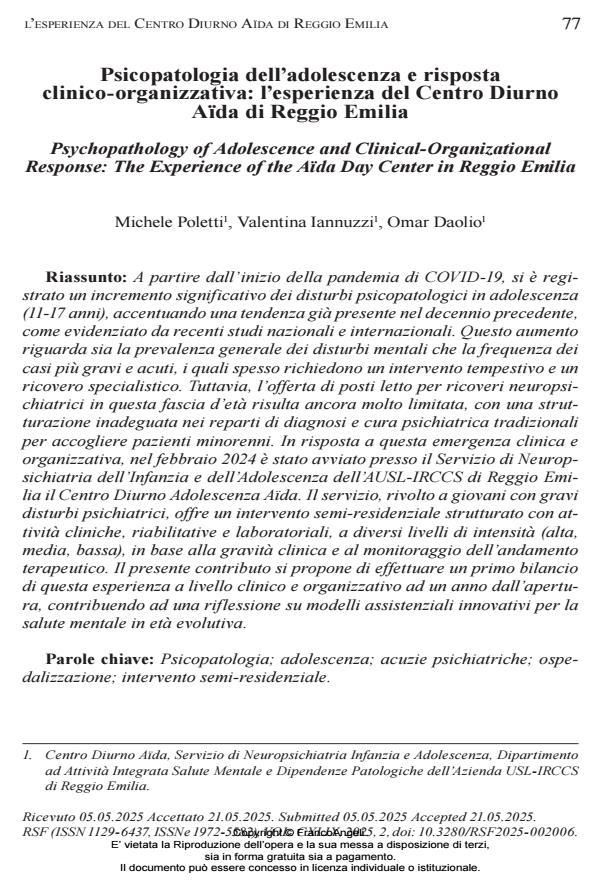
Since the beginning of the COVID-19 pandemic, there has been a significant increase in psychopathological disorders among adolescents (ages 11–17), intensifying a trend that had already been present in the previous decade, as highlighted by recent national and international studies. This increase concerns both the overall prevalence of mental disorders and the frequency of more severe and acute cases, which often require prompt intervention and specialized hospitalization. However, the availability of beds for neuropsychiatric admissions in this age group remains very limited, and traditional psychiatric wards are inadequately structured to accommodate underage patients. In response to this clinical and organizational emergency, the Aïda Adolescent Day Center was launched in February 2024 by the Child and Adolescent Neuropsychiatry Service of the AUSL-IRCCS of Reggio Emilia. The centre, dedicated to young people with severe psychiatric disorders, offers a structured semi-residential program with clinical, rehabilitative, and workshop-based activities, at different levels of intensity (high, medium, low), based on clinical severity and ongoing therapeutic monitoring. This paper aims to provide a first assessment of this experience, both clinically and organizationally, one year after its opening, contributing to the broader discussion on innovative care models for mental health in developmental age.

Keywords: Psychopathology; adolescence; psychiatric crises; hospitalization; semi-residential intervention.

  1. [1.] Masucci JM. Il fronte psichico. Inchiesta sulla salute mentale degli italiani. Edizioni Nottetempo, Milano, 2024.
  2. [2.] Rovelli M. Soffro dunque siamo. Il disagio psichico nella società degli individui. Minimum Fax, Roma, 2023.
  3. [3.] Davico C, Marcotulli D, Lux C, Calderoni D, Cammisa L, Bondone C, Rosa-Brusin M, Secci I, Porro M, Campanile R, Bosia C, Di Santo F, Terrinoni A, Ricci F, Amianto F, Urbino A, Ferrara M, Vitiello B. Impact of the COVID-19 Pandemic on Child and Adolescent Psychiatric Emergencies. Journal of Clinical Psychiatry. 2021;82(3):20m13467.
  4. [4.] Apicella M, Serra G, Trasolini M, Andracchio E, Chieppa F, Averna R, Iannoni ME, Infranzi A, Moro M, Guidetti C, Maglio G, Raucci U, Reale A, Vicari S. Urgent psychiatric consultations for suicide attempt and suicidal ideation before and after the COVID-19 pandemic in an Italian pediatric emergency setting. Frontiers in Psychiatry. 2023;14:1135218.
  5. [5.] Mucci M, Lenzi F, D’Acunto GM, Gazzillo M, Accorinti I, Boldrini S, Distefano G, Falcone F, Fossati B, Giurdanella Annina R, Paese S, Salluce C, Troiano I, Fratoni C, Fabiani D, Liboni F, Masi G. How COVID-19 Phases Have Impacted Psychiatric Risk: A Retrospective Study in an Emergency Care Unit for Adolescents. Children (Basel). 2022;9(12):1921.
  6. [6.] Aragona M, Ventura M, DI Napoli A, Petrelli A, Calvi C, Cavani A, Carbone D, Finelli M, Favretto AR, Mirisola C. Impact of the COVID-19 pandemic on Italian students’ mental health and relationships: differences between adolescent males and females. Minerva Pediatrica. 2023;. DOI: 10.23736/S2724-5276.23.07115-X
  7. [7.] Dimock M. Defining generations: Where millennials end and Generation Z begins Pew Research Center (2019, January 17) Available at https://www.pewresearch.org/fact-tank/2019/01/17/where-millenni- als-end-and-generation-z-begins/
  8. [8.] Golberstein E, Wen H, Miller BF. Coronavirus Disease 2019 (COVID-19) and Mental Health for Children and Adolescents. JAMA Pediatrics 2020;174(9):819-820.
  9. [9.] Poletti M, Raballo A. Coronavirus Disease 2019 and Effects of School Closure for Children and Their Families. JAMA Pediatrics 2021;175(2):210.
  10. [10.] Poletti M. Hey teachers! Do not leave them kids alone! Envisioning schools during and after the coronavirus (COVID-19) pandemic. Trends in Neuroscience and Education. 2020;20:100140.
  11. [11.] Marengo D, Angelo Fabris M, Longobardi C, Settanni M. Smartphone and social media use contributed to individual tendencies towards social media addiction in Italian adolescents during the COVID-19 pandemic. Addictive Behaviors. 2022;126:107204.
  12. [12.] Orben, A., Meier, A., Dalgleish, T., & Blakemore, S.-J. (2024). Mechanisms linking social media use to adolescent mental health vulnerability. Nature Reviews Psychology, 3(6), 407–423. https://doi.org/10.1038/ s44159-024-00307-y
  13. [13.] Sewall CJ.R, Parry DA. Social media and youth mental health: Simple narratives produce biased interpretations. Journal of Psychopathology and Clinical Science. 2024;133(7), 507–514. https://doi.org/10.1037/ abn0000950
  14. [14.] Haidt J. La generazione ansiosa. Rizzoli, 2024.
  15. [15.] Thorp HH. Unsettled science on social media. Science. 2024;384(6703):1389.
  16. [16.] Poletti M, Preti A, Raballo A. From economic crisis and climate change through COVID-19 pandemic to Ukraine war: a cumulative hit-wave on adolescent future thinking and mental well-being. European Child and Adolescent Psychiatry. 2023;32(9):1815-1816.
  17. [17.] Lass-Hennemann J, Sopp MR, Ruf N, Equit M, Schäfer SK, Wirth BE, Michael T. Generation climate crisis, COVID-19, and Russia-UkraineWar: global crises and mental health in adolescents. European Child and Adolescent Psychiatry. 2024;33(7):2203-2216.
  18. [18.] Linee di indirizzo sui disturbi neuropsichiatrici e neuropsichici dell’infanzia e della adolescenza, Ministero della Salute, 2019.
  19. [19.] Linee indirizzo SINPIA (2018) per l’emergenza – urgenza psichiatrica in età evolutiva – https://www.sinpia.eu/wp-content/uploads/atom/alle- gato/1713.pdf
  20. [20.] Pardini C. Il trattamento sanitario obbligatorio psichiatrico sui pazienti minori di età tra criticità applicative e possibili garanzie. Minori e Giustizia. 2019;4:103-111
  21. [21.] Raballo A, Poletti M, Valmaggia L, McGorry PD. Editorial Perspective: Rethinking child and adolescent mental health care after COVID-19. Journal of Child Psychology and Psychiatry. 2021;62(9):1067-1069.
  22. [22.] Johansson BA, Holmström E, Eberhard S, Lindgren A, Rask O. Introducing brief admissions by self-referral in child and adolescent psychiatry: an observational cohort study in Sweden. Lancet Psychiatry. 2023;10(8):598-607. DOI: 10.1016/S2215-0366(23)00157-8
  23. [23.] McDougall T, Worrall-Davies A, Hewson L, Richardson G, Cotgrove
  24. A. Tier 4 Child and Adolescent Mental Health Services (CAMHS) – Inpatient Care, Day Services and Alternatives: An Overview of Tier 4 CAMHS Provision in the UK. Child and Adolescent Mental Health. 2008;13(4):173-180.
  25. [24.] John S, Cohen D. Short Research Article: Opening a new CAMHS day hospital – does it affect inpatient admissions and does it help at all? Child and Adolescent Mental Health. 2024;29(3):276-280.
  26. [25.] Robinson R, Bakopoulou I. The systemic value of integrating an adolescent day service into an inpatient service: A qualitative case study. Journal of Family Therapy. 2023;45:428–443. DOI: 10.1111/14676427.1237
  27. [26.] Kimura B. Scritti di psicopatologia fenomenologica. Giovanni Fioriti
  28. Editore, Roma, 2005.
  29. [27.] Ballerini M. Kimura Bin. In (Eds) Molaro A, Stanghellini G. Storia della fenomenologia clinica. Le origini, gli sviluppi, la scuola italiana. Milano, UTET, pp. 307-328.
  30. [28.] Lancini M, Cirillo L, Scodeggio T, Zanella T. L’adolescente. Psicopatologia e psicoterapia contemporanea. Raffaello Cortina Editore, Milano.
  31. [29.] Bower P, Gilbody S. Stepped care in psychological therapies: access, effectiveness and efficiency. Narrative literature review. British Journal of Psychiatry. 2005;186:11-17.
  32. [30.] Jeitani A, Fahey PP, Gascoigne M, Darnal A, Lim D. Effectiveness of stepped care for mental health disorders: An umbrella review of meta-analyses, Personalized Medicine in Psychiatry. 2024;47-48: 100140.
  33. [31.] Kothgassner OD, Goreis A, Robinson K, Huscsava MM, Schmahl C, Plener PL. Efficacy of dialectical behavior therapy for adolescent self-harm and suicidal ideation: a systematic review and meta-analysis. Psychological Medicine. 2021;51(7):1057-1067. DOI: 10.1017/S0033291721001355
  34. [32.] Giordano C, Iannuzzi V, Danesi F, Poletti M. Feasibility and effectiveness of Dialectical-Behavior Therapy for patients with borderline personality disorder in Italian mental health services: a preliminary study. Rivista di Psichiatria. 2021;56(1):43-45. DOI: 10.1708/3546.35219
  35. [33.] Bellack AS, Mueser KT, Gingerich S, & Agresta J. Social Skills Training for Schizophrenia: A Step-by-Step Guide (2nd ed.). New York: The Guilford Press, 2004. Ed. It. Centro Scientifico Editore, 2003.
  36. [34.] Substance Abuse and Mental Health Services Administration. Illness Management and Recovery: Training Frontline Staff. HHS Pub. No. SMA-09-4462, Rockville, MD: Center for Mental Health Services, Substance Abuse and Mental Health Services Administration, U.S. Department of Health and Human Services, 2009. Ed. It. Società Italiana di Riabilitazione Psicosociale, 2016.

Michele Poletti, Valentina Iannuzzi, Omar Daolio, Psicopatologia dell’adolescenza e risposta clinico-organizzativa: l’esperienza del Centro Diurno Aïda di Reggio Emilia in "RIVISTA SPERIMENTALE DI FRENIATRIA" 2/2025, pp 77-89, DOI: 10.3280/RSF2025-002006