Ericksonian hypnosis in pandemic times
Journal title IPNOSI
Author/s Fabio Carnevale, Sandro Montanari
Publishing Year 2026 Issue 2025/2
Language Italian Pages 11 P. 7-17 File size 118 KB
DOI 10.3280/IPN2025-002001
DOI is like a bar code for intellectual property: to have more infomation
click here
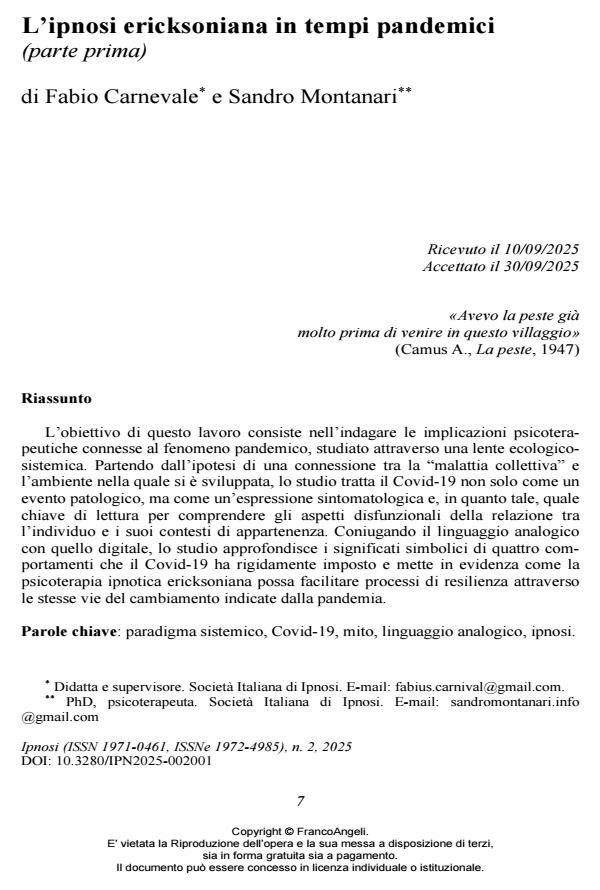
Below, you can see the article first page
If you want to buy this article in PDF format, you can do it, following the instructions to buy download credits
FrancoAngeli is member of Publishers International Linking Association, Inc (PILA), a not-for-profit association which run the CrossRef service enabling links to and from online scholarly content.
The aim of this work is to investigate the psychotherapeutic implications of the pandemic phenomenon through an ecological-systems lens. Starting from the hypothesis of a connection between the “collective illness” and the environment in which it emerged, the study considers Covid-19 not merely as a pathological event, but also as a symptomatic expression offering insight into the dysfunctional dynamics between individuals and their contexts of belonging. By integrating analogical and digital modes of language, the study explores the symbolic meanings of four behaviours rigidly imposed by the pandemic and examines how Ericksonian hypnotherapy can foster resilience by leveraging the same pathways of change that the pandemic itself brought to light.
Keywords: systemic paradigm, Covid-19, myth, analogical language, hypnosis.
- Bateson G. (1984). Mente e natura. Milano: Adelphi.
- Capra F. (1972). La danza di Shiva: “La visione Hindu della materia alla luce della fisica moderna”. Main Currents in Modern Thought, 28(5): 180-191.
- Capra F. (1989). Il Tao della Fisica. Milano: Adelphi.
- Gray W., Duhl F.J., Rizzo N.D. (1969). Introduction. In: Gray W., Duhl F.J., Rizzo N.D., eds., General Systems theory and psychiatry. Boston: Little, Brown and Company.
- Harlow H.F. (1958). The nature of love. American Psychologist, 13: 673-685.
- Heidegger M. (2005). Essere e tempo. Milano: Longanesi.
- Hillman J. (2000). La forza del carattere. Milano: Gli Adelphi.
- Hillman J., Ventura M. (2005). Cent’anni di psicanalisi e il mondo va sempre peggio. Milano: Rizzoli.
- Holmes E.C., Goldstein S.A., Rasmussen A.L. (2021). The origins of SARS-CoV-2: A critical review. Cell, 184 (19): 4848-4856.
- Jung C.G. (2020). Ricordi, sogni, riflessioni. Milano: Bur Rizzoli.
- Lacan J. (1978). Lacan in Italia: 1953-1978. Milano: La Salamandra.
- Levinàs E. (2010). Violenza del volto. Brescia: Morcelliana.
- Lorenz E.N. (1972). Predictability: does the flap of a butterfly’s wings in Brazil set off a Tornado in Texas? American Association for the Advancement of Science, Paper presented at the 139th meeting of the American Association for the Advancement of Science, Washington, D.C.
- Loriedo C., Picardi A. (2022). Dalla teoria generale dei sistemi alla teoria dell’attaccamento. Roma: Franco Angeli.
- Lovelock J. (2021). Gaia. Nuove idee sull’ecologia. Milano: Bollati Boringhieri.
- Lovelock J. (2009). The vanishing face of Gaia. New York: Basic Books.
- Marya R., Patel R. (2022). Infiammazione. Medicina, conflitto e disuguaglianza. Milano: Feltrinelli.
- Montanari S. (2022). “Quattro portali della trance nel tempo della pandemia”. XVI Congresso Nazionale della Società Italiana di Ipnosi Sharing Emotions: La condivisione delle emozioni in ipnosi e nella relazione ipnotica ericksoniana, 4 novembre 2022.
- Phillips R. (2013). The Sacred Hour: Uninterrupted Skin-to-Skin Contact Immediately After Birth. Newborn & Infant Nursing Reviews, 13: 67-72.
- Russell K., Weaver B., Vogel R.L. (2015). Misura centrale neuroprotettiva 2: collaborazione con gli effetti familiari di un dispositivo di simulazione parentale ponderato profumato per i genitori su neonati prematuri in terapia intensiva neonatale. Recensioni infermieristiche per neonati e bambini, 15(3): 97-103.
- Sparzani A. (2016). Jung e Pauli. Il carteggio originale: l’incontro tra Psiche e Materia. Bergamo: Moretti & Vitali.
- Whitaker C.A. (1990). Considerazioni notturne di un terapeuta della famiglia. Roma: Astrolabio.
- Widmann C. 2012). Simbolo o sintomo: due diverse interpretazioni dei contenuti inconsci. Roma: Ma.gi.
- Worobey M., Levy J.I., Serrano L.M. (2022). The Huanan Seafood Wholesale Market in Wuhan was the early epicenter of the COVID-19 pandemic. Science, 377: 951-959.
- WWF (2020). Pandemia, l’effetto boomerang della distruzione degli ecosistemi. Tutelare la salute umana conservando la biodiversità. Roma: WWF Italia Onlus.
Fabio Carnevale, Sandro Montanari, L’ipnosi ericksoniana in tempi pandemici (parte prima) in "IPNOSI" 2/2025, pp 7-17, DOI: 10.3280/IPN2025-002001