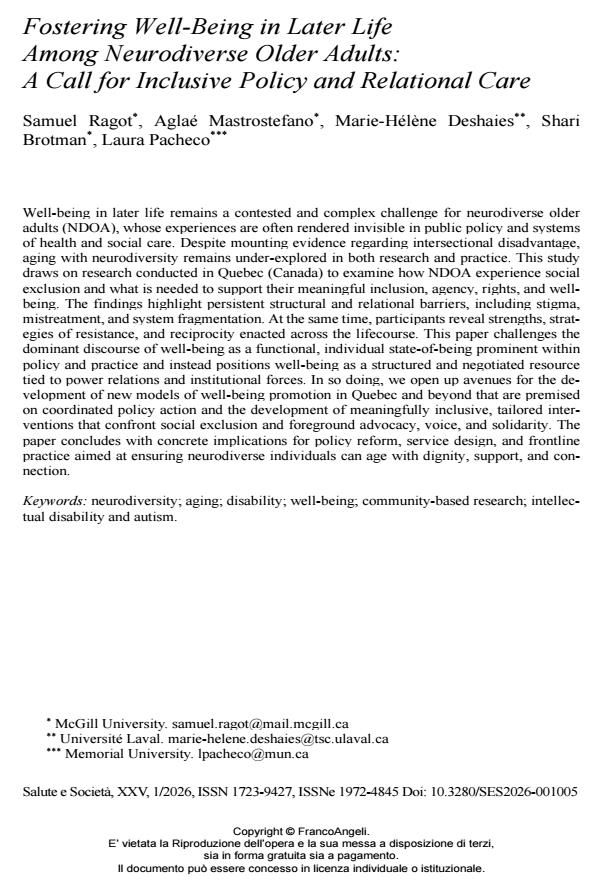
Fostering Well-Being in Later Life Among Neurodiverse Older Adults: A Call for Inclusive Policy and Relational Care

Journal title SALUTE E SOCIETÀ
Author/s Samuel Ragot, Aglaé Mastrostefano, Marie-Hélène Deshaies, Shari Brotman, Laura Pacheco
Publishing Year 2026 Issue 2026/1
Language English Pages 26 P. 59-84 File size 798 KB
DOI 10.3280/SES2026-001005
DOI is like a bar code for intellectual property: to have more infomation click here

Below, you can see the article first page

If you want to buy this article in PDF format, you can do it, following the instructions to buy download credits
Article preview

FrancoAngeli is member of Publishers International Linking Association, Inc (PILA), a not-for-profit association which run the CrossRef service enabling links to and from online scholarly content.

Well-being in later life remains a contested and complex challenge for neurodiverse older adults (NDOA), whose experiences are often rendered invisible in public policy and systems of health and social care. Despite mounting evidence regarding intersectional disadvantage, aging with neurodiversity remains under-explored in both research and practice. This study draws on research conducted in Quebec (Canada) to examine how NDOA experience social exclusion and what is needed to support their meaningful inclusion, agency, rights, and well-being. The findings highlight persistent structural and relational barriers, including stigma, mistreatment, and system fragmentation. At the same time, participants reveal strengths, strategies of resistance, and reciprocity enacted across the lifecourse. This paper challenges the dominant discourse of well-being as a functional, individual state-of-being prominent within policy and practice and instead positions well-being as a structured and negotiated resource tied to power relations and institutional forces. In so doing, we open up avenues for the development of new models of well-being promotion in Quebec and beyond that are premised on coordinated policy action and the development of meaningfully inclusive, tailored interventions that confront social exclusion and foreground advocacy, voice, and solidarity. The paper concludes with concrete implications for policy reform, service design, and frontline practice aimed at ensuring neurodiverse individuals can age with dignity, support, and connection.

Keywords: neurodiversity; aging; disability; well-being; community-based research; intellectual disability and autism.

  1. Akintayo-Usman N.O. (2021). Fragmentation of care: a major challenge for older people living with multimorbidity. Geriatrics, Gerontology & Aging, 15: 1-4.
  2. Alzheimer Society of Canada, ARCH Disability Law Centre, Canadian Association for Community Living, Canadian Mental Health Association, Council of Canadians with Disabilities, et al. (2017). Meeting Canada’s obligations to Affordable Housing and Supports for People with Disabilities to Live Independently in the Community. Available at: https://inclusioncanada.ca/wp-content/uploads/2018/05/Canada-Right-to-Housing-for-Persons-with-Disabilities-May-15-2017.pdf
  3. Antonovsky A. (1994). A sociological critique of the “well being” movement. Advances, 10(3): 6-12.
  4. Aubrecht,K., Kelly C., Rice C. (2021). The Aging-Disability Nexus. University of British Columbia Press.
  5. Billette V., Lavoie J.-P., Séguin A.-M., Van Pevenage I. (2012). Réflexions sur l’exclusion et l’inclusion sociale en lien avec le vieillissement. L’importance des enjeux de reconnaissance et de redistribution. Frontières, 25(1): 10-30.
  6. Braun V., Clarke V. (2019). Reflecting on reflexive thematic analysis. Qualitative Research in Sport, Exercise and Health, 11(4): 589-597. DOI: 10.1080/2159676X.2019.162880
  7. Breidenbach J. (2020). Addressing the Critiques of Well-Being. Stanford Social Innovation Review. DOI: 10.48558/2S1F-YD8
  8. Brotman S., Ferrer I., Koehn S. (2020). Situating the life story narratives of aging immigrants within a structural context: The intersectional life course perspective as research praxis. Qualitative Research, 20(4): 465-484. DOI: 10.1177/146879411988074
  9. Brotman S., Pacheco L., Deshaies M.H., Mastrostefano A., Demers C. (2026). Moving beyond ‘inclusion’ and towards ‘transformation’: Intersectional life story narrative research on aging and neurodiversity. International Review of Qualitative Research, OnlineFirst. DOI: 10.1177/1940844726141692
  10. Brotman S., Ragot S., Deshaies M.-H. (2024). The Experiences of social exclusion and inclusion among people aging with neurodiversity and their families. CREGES. Available at: www.creges.ca/en/aging-neurodiversity
  11. Brotman S., Sussman T., Pacheco L., Dickson D., Lach L., Raymond É., Deshaies M.-H., Freitas Z., Milot É. (2021). The Crisis Facing Older People Living with Neurodiversity and Their Aging Family Carers: A Social Work Perspective. Journal of Gerontological Social Work, 64(5): 547-556. DOI: 10.1080/01634372.2021.192053
  12. Campbell M. (2024). Families, Disability, and Wellbeing in Canada [Issue brief]. The Vanier Institute of the Family.
  13. Chapman R. (2020). Neurodiversity, disability, wellbeing. In Rosqvist H.B., Chown N., Stenning A., eds., Neurodiversity studies: A new critical paradigm (pp. 57-72). Taylor & Francis Group.
  14. Clarfield A.M., Bergman H., Kane R. (2001). Fragmentation of Care for Frail Older People – an International Problem. Experience from Three Countries: Israel, Canada, and the United States. Journal of the American Geriatrics Society, 49(12): 1714-1721.
  15. Cleaver S., Ouellette-Kuntz H., Sakar A. (2010). Participation in intellectual disability research: A review of 20 years of studies. Journal of Intellectual Disability Research, 54(3): 187-193.
  16. Curnow E., Rutherford M., Maciver D., Johnston L., Prior S., Boilson M., Shah P., Jenkins N., Meff T. (2023). Mental health in autistic adults: A rapid review of prevalence of psychiatric disorders and umbrella review of the effectiveness of interventions within a neurodiversity informed perspective. PLOS ONE, 18(7): e0288275.
  17. Dannefer D., Uhlenberg P., Foner A., Abeles R.P. (2005). On the shoulders of a giant: The Legacy of Matilda White Riley for gerontology. The Journals of Gerontology: Series B. J Psychological Sciences and Social Sciences, 60(6): S296-S304.
  18. Dickson D., Brotman S. (2022). Enacting Power at the Decision-Making Table: Foregrounding the Voices of People with Intellectual and Developmental Disabilities in the Policy Process through Engagement with Families in Relational Self-Advocacy. Journal on Developmental Disabilities, 27(2).
  19. Dolan E., Lane J., Hillis G., Delanty N. (2021). Changing trends in life expectancy in intellectual disability over time. Available at: https://repository.rcsi.com/articles/journal_contribution/Changing_trends_in_life_expectancy_in_intellectual_disability_over_time/14414999/1
  20. Doucet A., Mauthner N.S. (2008). What can be known and how? Narrated subjects and the Listening Guide. Qualitative Research, 8(3): 399-409. DOI: 10.1177/146879410609363
  21. Fast J., Duncan K.A., Keating N.C., Kim C. (2024). Valuing the Contributions of Family Caregivers to the Care Economy. Journal of Family and Economic Issues, 45(1): 236-249.
  22. Ferrer I., Grenier A., Brotman S., Koehn S. (2017). Understanding the experiences of racialized older people through an intersectional life course perspective. Journal of Aging Studies, 41: 10-17.
  23. Fritsch K., Monaghan J., van der Meulen E. (2022). Disability injustice: confronting criminalization in Canada. UBC Press. DOI: 10.59962/978077486714
  24. Gilleard C. (2025). Revisiting the social construction of old age. Ageing & Society, 45: 500-513. DOI: 10.1017/S0144686X2300057
  25. Grenier A. (2020). Rereading frailty through a lens of precarity: an explication of politics and the human condition of vulnerability. In Grenier A., Phillipson C., Settersten R.A., eds., Precarity and Ageing: Understanding Insecurity and Risk in Later Life (pp. 69-90). Policy Press.
  26. Grenier A., Guberman N. (2009). Creating and sustaining disadvantage: The relevance of a social exclusion framework. Health & Social Care in the Community, 17(2): 116-124.
  27. Grenier A., Phillipson C. (2018). Precarious aging: Insecurity and risk in late life. Hastings Center Report, 48(5): S15-S18.
  28. Grenier A., Phillipson C., Laliberte Rudman D., Hatzifilalithis S., Kobayashi K., Marier P. (2017). Precarity in late life: Understanding new forms of risk and insecurity. Journal of Aging Studies, 43: 9-14.
  29. Halperin S., Heath O. (2020). Political Research: Methods and Practical Skills. Oxford University Press.
  30. Hughes-McCormack L.A., Rydzewska E., Henderson A., MacIntyre C., Rintoul J., Cooper S.-A. (2017). Prevalence of mental health conditions and relationship with general health in a whole-country population of people with intellectual disabilities compared with the general population. BJPsych Open, 3(5): 243-248.
  31. Hwang Y.I.J., Foley K.R., Troller J.N. (2017). Aging well on the autism spectrum: The perspectives of autistic adults and carers. International Psychogeriatrics, 29(12): 2033-2046. DOI: 10.1017/S104161021700152
  32. Institut de la statistique du Québec (2022). Les personnes proches aidantes au Québec en 2018. Available at: https://statistique.quebec.ca/fr/produit/publication/personnes-proches-aidantes-quebec-2018
  33. Jones-Cobb B., Turner N. (2025). Examining Valued Social Participation of Disabled Older Adults Through the Frameworks of Critical Gerontology and Critical Disability Studies. The Gerontologist, 65(4).
  34. Katz S., Calasanti T. (2014). Critical perspectives on successful aging: Does it “appeal more than it illuminates”?. The Gerontologist, 55(1): 26-33.
  35. Komenda-Schned S., Landskron S.J., Moritz P., Braunstein N., Hochmeister J., Riegler K., Saugspier R., Hillenkamp L., Lueger-Schuster B., Salvador-Carulla L., Zeilinger E.L. (2025). Good mental health for people with intellectual disabilities: A participatory focus group study. International Journal for Equity in Health, 24(1): 1-12.
  36. Leahy A. (2021). Disability and Ageing: Towards a Critical Perspective. Bristol University Press.
  37. Martinson M., Berridge C. (2014). Successful Aging and Its Discontents: A Systematic Review of the Social Gerontology Literature. The Gerontologist, 55(1): 58-69.
  38. McCall L. (2005). The Complexity of Intersectionality. Signs: Journal of Women in Culture and Society, 30(3): 1771-1800. DOI: 10.1086/42680
  39. McKenzie K., Milton M., Smith G., Ouellette-Kuntz H. (2016). Systematic Review of the Prevalence and Incidence of Intellectual Disabilities: Current Trends and Issues. Current Developmental Disorders Reports, 3(2): 104-115.
  40. McLennan H., Aberdein R., Saggers B., Gillet-Swan J. (2025). Thirty years on from Sinclair: A scoping review of neurodiversity definitions and conceptualisations in empirical research. Review Journal of Autism and Developmental Disorders.
  41. Milot E., Couvrette R., Marthouret B., Caouette M., Beauchamp J. (2024). Points de vue d’adultes vieillissants ayant une déficience intellectuelle a l’égard de leur participation sociale. Canadian Journal on Aging, 44(1): 1-9. DOI: 10.1017/S071498082400013
  42. Ministère de la Santé et des Services sociaux (2012). Politique et plan d’action – Vieillir et vivre ensemble – Chez soi, dans sa communauté, au Québec. Ministère de la Santé et des Services sociaux. Available at: https://publications.msss.gouv.qc.ca/msss/fichiers/ainee/F-5234-MSSS.pdf
  43. Ministère de la Santé et des Services sociaux (2024). La fierté de vieillir – Plan d’action gouvernemental 2024-2029. Ministère de la Santé et des Services sociaux. Available at: https://publications.msss.gouv.qc.ca/msss/fichiers/2024/24-830-02W.pdf
  44. Moody H.R., Sasser J.R. (2020). Aging: Concepts and controversies. SAGE Publications.
  45. Newton A., Flinn A., Downs J., Richmond L. (2025). Rethinking self-identification in neurodivergent communities: Barriers, harms, and the need for change. Frontiers in Child and Adolescent Psychiatry, 13.
  46. Pacheco L., McConnell D. (2017). Love and resistance of mothers with intellectual disability from ethnocultural communities in Canada. Journal of Applied Research in Intellectual Disabilities: JARID, 30(3): 501-510.
  47. Phillipson C. (2013). Ageing. Cambridge, UK: Polity Press.
  48. Public Health Agency of Canada (2018). Key Health Inequalities in Canada (Nos. HP35-109/2018E-1-PDF; p. 437). Public Health Agency of Canada. Available at: https://www.canada.ca/content/dam/phac-aspc/documents/services/publications/science-research/key-health-inequalities-canada-national-portrait-executive-summary/key_health_inequalities_full_report-eng.pdf
  49. Putnam M., Stark S.L. (2025). Bridging the Accountability Gap Between Aging and Disability Research. The Gerontologist, 65(6).
  50. Ragot S. (2024a). Nombre de personnes par tranches d’âge ayant reçu des services en déficience intellectuelle et autisme – 2022-2023. Available at: https://datawrapper.dwcdn.net/z2kqb/
  51. Ragot S. (2024b). Programme de revenu de base – Type de diagnostic des prestataires. Available at: https://datawrapper.dwcdn.net/Qgzqm/
  52. Ragot S. (2024c). The New Québec Basic Income Program: A Useful Set of Policy Directions for the Canadian Disability Benefit. Osgoode Hall Law Journal, 61(2): 653-596. DOI: 10.60082/2817-5069.402
  53. Raphael D. (2020). Poverty in Canada: Implications for health and quality of life (Third edition). Canadian Scholars Press.
  54. Salvatori P., Tremblay M., Sandys J., Marcaccio D. (1998). Aging with an intellectual disability: A Review of Canadian literature. Canadian Journal on Aging, 17(3): 249-271. DOI: 10.1017/S071498080001019
  55. Santinele Martino A., Fudge Schormans A. (2018). When Good Intentions Backfire: University Research Ethics Review and the Intimate Lives of People Labeled with Intellectual Disabilities. Forum Qualitative Sozialforschung / Forum: Qualitative Social Research, 19(3): 18.
  56. Seltzer M.M., Floyd F., Song J., Greenberg J., Hong J. (2011). Midlife and Aging Parents of Adults With Intellectual and Developmental Disabilities: Impacts of Lifelong Parenting. American Journal on Intellectual and Developmental Disabilities, 116(6): 479-499. DOI: 10.1352/1944-7558-116.6.47
  57. Sins Invalid (2019). Skin, tooth, and bone: The basis of movement is our people (2nd ed.). Available at: https://docdrop.org/download_annotation_doc/Sins-Invalid---Skin-Tooth-+-Bone-1--6pbqk.pdf
  58. Statistique Canada (2024). Profil démographique, d’emploi et de revenu des personnes ayant une incapacité âgées de 15 ans et plus au Canada, 2022. May 28. Available at: https://www150.statcan.gc.ca/n1/pub/89-654-x/89-654-x2024001-fra.htm
  59. Statistiques Canada (2023). Caractéristiques de l’activité sur le marché du travail des personnes ayant une incapacité et sans incapacité en 2022: Résultats de l’Enquête sur la population active. August 30. Available at: https://www150.statcan.gc.ca/n1/daily-quotidien/230830/dq230830a-fra.htm
  60. Stokes J.E., Waldron D.A., Stam E.J. (2025). Loneliness Among Adults Aging With Intellectual and Developmental Disabilities: The Importance of Living Situation. The Gerontologist, 65(4).
  61. Talantseva O.I., Romanova R.S., Shurdova E.M., Dolgorukova T.A., Sologub P.S., Titova O.S., Kleeva D.F., Grigorenko E.L. (2023). The global prevalence of autism spectrum disorder: A three-level meta-analysis. Frontiers in Psychiatry, 14.
  62. Trip H., Whitehead L., Crowe M., Mirfin-Veitch B., Daffue C. (2019). Aging With Intellectual Disabilities in Families: Navigating Ever-Changing Seas-A Theoretical Model. Qualitative Health Research, 29(11): 1595-1610. DOI: 10.1177/104973231984534
  63. van Heumen L., Heller T., van den Helder C. (2025). Social Relations of Older Adults With Intellectual Disabilities From a Life Course Perspective. The Gerontologist, 65(5).
  64. Viner H.E., Yuill N., Costa A.P., Radford H., Kornadt A.E. (2024). A qualitative interview study on quality of life and ageing experiences of autistic adults. Communications Psychology, 2(1).
  65. Walker N. (2014). Neurodiversity: Some basic terms and definitions. Neurocosmopolitainism. Available at: https://neuroqueer.com/neurodiversity-terms-and-definitions/ [accessed January 10, 2026].
  66. Walker R., Hutchinson C. (2018). Planning for the future among older parents of adult offspring with intellectual disability living at home and in the community: A systematic review of qualitative studies. Journal of Intellectual & Developmental Disability, 43(4): 453-462. DOI: 10.3109/13668250.2017.131082
  67. Wall K. (2017). Le faible revenu chez les personnes ayant une incapacité au Canada (75-006-X; p. 17). Available at: https://www150.statcan.gc.ca/n1/fr/pub/75-006-x/2017001/article/54854-fra.pdf?st=hPhX2eHY
  68. Wark S. (2024). Ageing with an intellectual disability. In The Palgrave Encyclopedia of Disability (pp. 1-13). Palgrave Macmillan.
  69. Winker G., Degele N. (2011). Intersectionality as multi-level analysis: Dealing with social inequality. European Journal of Women’s Studies, 18(1): 51-66. DOI: 10.1177/135050681038608
  70. Wiseman F.K., Al-Janabi T., Hardy J., Karmiloff-Smith A., Nizetic D., Tybulewicz V.L.J., Fisher E.M.C., Strydom A. (2015). A genetic cause of Alzheimer disease: Mechanistic insights from Down syndrome. Nature Reviews Neuroscience, 16(9): 564-574.
  71. Wray D., Badets J., Keating N., Fast J. (2023). L’économie des soins au Canada: Un cadre conceptuel. Statistique Canada (November). Available at: https://www150.statcan.gc.ca/n1/fr/pub/89-652-x/89-652-x2023002-fra.pdf?st=v-I5tJTX
  72. Zhang N., Ke F., Barrett A., Kim C., Xu J. (2025). Assessing Rural Care Ecosystems for Individuals With Neurodiversity: A Systematic Literature Review. Review of Educational Research, Online First. DOI: 10.3102/0034654325137545

Samuel Ragot, Aglaé Mastrostefano, Marie-Hélène Deshaies, Shari Brotman, Laura Pacheco, Fostering Well-Being in Later Life Among Neurodiverse Older Adults: A Call for Inclusive Policy and Relational Care in "SALUTE E SOCIETÀ" 1/2026, pp 59-84, DOI: 10.3280/SES2026-001005