Observing and describing bonds
Journal title SETTING
Author/s Gianluca Carlini
Publishing Year 2026 Issue 2025/49
Language Italian Pages 9 P. 53-61 File size 48 KB
DOI 10.3280/SET2025-049004
DOI is like a bar code for intellectual property: to have more infomation
click here
Below, you can see the article first page
If you want to buy this article in PDF format, you can do it, following the instructions to buy download credits
FrancoAngeli is member of Publishers International Linking Association, Inc (PILA), a not-for-profit association which run the CrossRef service enabling links to and from online scholarly content.
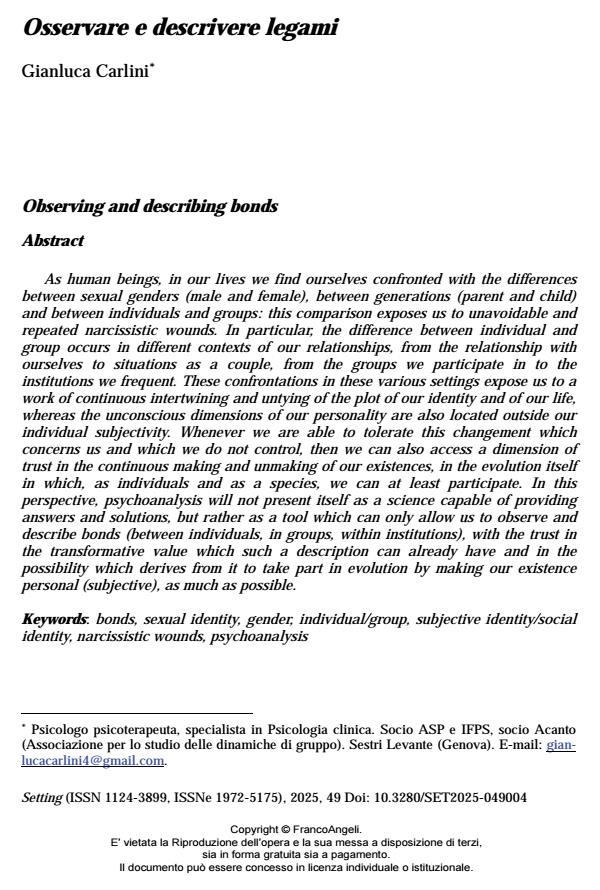
As human beings, in our lives we find ourselves confronted with the differences between sexual genders (male and female), between generations (parent and child) and between individuals and groups: this comparison exposes us to unavoidable and repeated narcissistic wounds. In particular, the difference between individual and group occurs in different contexts of our relationships, from the relationship with ourselves to situations as a couple, from the groups we participate in to the institutions we frequent. These confrontations in these various settings expose us to a work of continuous intertwining and untying of the plot of our identity and of our life, whereas the unconscious dimensions of our personality are also located outside our individual subjectivity. Whenever we are able to tolerate this changement which concerns us and which we do not control, then we can also access a dimension of trust in the continuous making and unmaking of our existences, in the evolution itself in which, as individuals and as a species, we can at least participate. In this perspective, psychoanalysis will not present itself as a science capable of providing answers and solutions, but rather as a tool which can only allow us to observe and describe bonds (between individuals, in groups, within institutions), with the trust in the transformative value which such a description can already have and in the possibility which derives from it to take part in evolution by making our existence personal (subjective), as much as possible.
Keywords: bonds, sexual identity, gender, individual/group, subjective identity/social identity, narcissistic wounds, psychoanalysis
- Ambrosiano L., Gaburri E. (2013). Pensare con Freud. Milano: Raffaello Cortina.
- Bion W. R. (1989). Seminari clinici. Milano: Raffaello Cortina.
- Bleger (1967). Simbiosi e ambiguità. Armando Editore (2010).
- Bolognini S. (2022). Freud e il mondo che cambia. Enrico Damiani Editore.
- Carlini G. (2016). Fragilità. Percorsi scientifici e luoghi psicoanalitici. Educazione sentimentale.
- Ferruta A. (2022). A proposito della terza grande differenza “individuo-gruppo”. 100 anni dopo “Psicologia delle masse e analisi dell’Io”. Rivista di Psicoanalisi, LXVIII(1).
- Kaës R. (2005). Il disagio del mondo moderno e la sofferenza del nostro tempo. Psiche, 2.
- Kaës R. (2015). L’estensione della psicoanalisi. Per una metapsicologia del terzo tipo. Milano: FrancoAngeli.
- Ogden T. (2013). Rivista di Psicoanalisi.
- Saraò G. (2024). Relazione a un Convegno del Centro Milanese di Psicoanalisi.
- Thanopulos S. (2023). Rivista di Psicoanalisi, 2.
Gianluca Carlini, Osservare e descrivere legami in "SETTING" 49/2025, pp 53-61, DOI: 10.3280/SET2025-049004