Psychic retreats and political refugees
Journal title SETTING
Author/s Federico Brundo
Publishing Year 2026 Issue 2025/49
Language Italian Pages 13 P. 89-101 File size 113 KB
DOI 10.3280/SET2025-049008
DOI is like a bar code for intellectual property: to have more infomation
click here
Below, you can see the article first page
If you want to buy this article in PDF format, you can do it, following the instructions to buy download credits
FrancoAngeli is member of Publishers International Linking Association, Inc (PILA), a not-for-profit association which run the CrossRef service enabling links to and from online scholarly content.
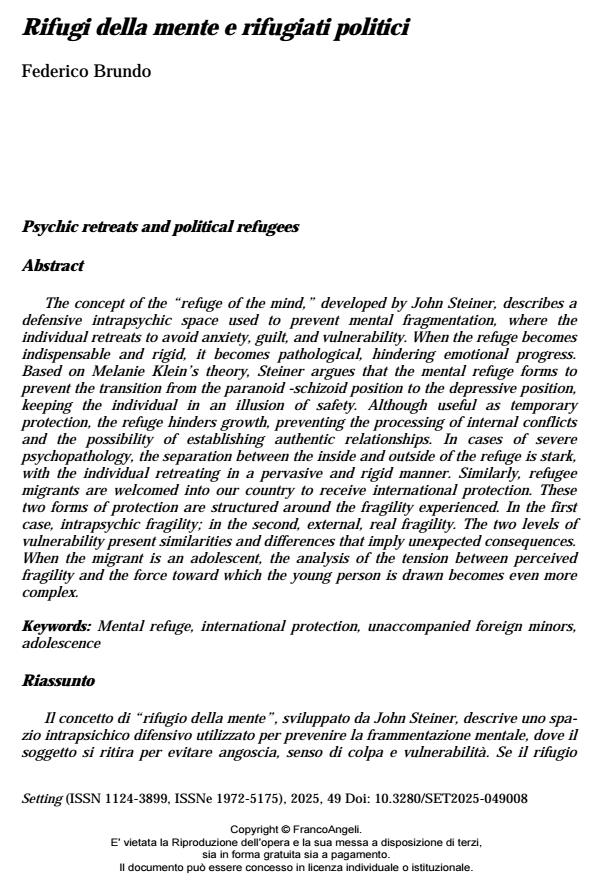
The concept of the “refuge of the mind,” developed by John Steiner, describes a defensive intrapsychic space used to prevent mental fragmentation, where the individual retreats to avoid anxiety, guilt, and vulnerability. When the refuge becomes indispensable and rigid, it becomes pathological, hindering emotional progress. Based on Melanie Klein’s theory, Steiner argues that the mental refuge forms to prevent the transition from the paranoid -schizoid position to the depressive position, keeping the individual in an illusion of safety. Although useful as temporary protection, the refuge hinders growth, preventing the processing of internal conflicts and the possibility of establishing authentic relationships. In cases of severe psychopathology, the separation between the inside and outside of the refuge is stark, with the individual retreating in a pervasive and rigid manner. Similarly, refugee migrants are welcomed into our country to receive international protection. These two forms of protection are structured around the fragility experienced. In the first case, intrapsychic fragility; in the second, external, real fragility. The two levels of vulnerability present similarities and differences that imply unexpected consequences. When the migrant is an adolescent, the analysis of the tension between perceived fragility and the force toward which the young person is drawn becomes even more complex.
Keywords: Mental refuge, international protection, unaccompanied foreign minors, adolescence
Federico Brundo, Rifugi della mente e rifugiati politici in "SETTING" 49/2025, pp 89-101, DOI: 10.3280/SET2025-049008