The current state of European social dialogue: developments and challenges

Journal title GIORNALE DI DIRITTO DEL LAVORO E DI RELAZIONI INDUSTRIALI
Author/s Fausta Guarriello
Publishing Year 2026 Issue 2025/188
Language English Pages 17 P. 825-841 File size 231 KB
DOI 10.3280/GDL2025-188016
DOI is like a bar code for intellectual property: to have more infomation click here
Article preview

FrancoAngeli is member of Publishers International Linking Association, Inc (PILA), a not-for-profit association which run the CrossRef service enabling links to and from online scholarly content.

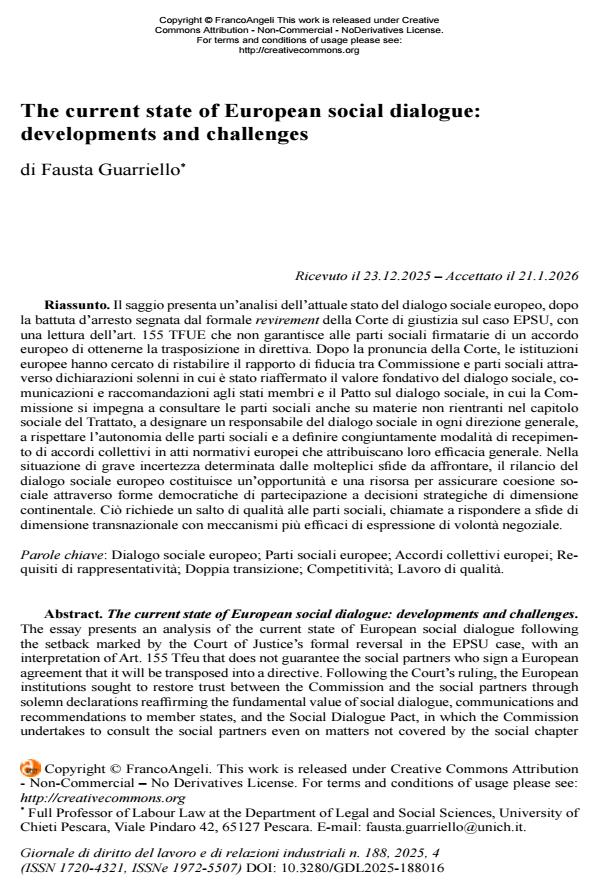
Il saggio presenta un’analisi dell’attuale stato del dialogo sociale europeo, dopo la battuta d’arresto segnata dal formale revirement della Corte di giustizia sul caso EPSU, con una lettura dell’art. 155 TFUE che non garantisce alle parti sociali firmatarie di un accordo europeo di ottenerne la trasposizione in direttiva. Dopo la pronuncia della Corte, le istituzioni europee hanno cercato di ristabilire il rapporto di fiducia tra Commissione e parti sociali attraverso dichiarazioni solenni in cui è stato riaffermato il valore fondativo del dialogo sociale, comunicazioni e raccomandazioni agli stati membri e il Patto sul dialogo sociale, in cui la Commissione si impegna a consultare le parti sociali anche su materie non rientranti nel capitolo sociale del Trattato, a designare un responsabile del dialogo sociale in ogni direzione generale, a rispettare l’autonomia delle parti sociali e a definire congiuntamente modalità di recepimento di accordi collettivi in atti normativi europei che attribuiscano loro efficacia generale. Nella situazione di grave incertezza determinata dalle molteplici sfide da affrontare, il rilancio del dialogo sociale europeo costituisce un’opportunità e una risorsa per assicurare coesione sociale attraverso forme democratiche di partecipazione a decisioni strategiche di dimensione continentale. Ciò richiede un salto di qualità alle parti sociali, chiamate a rispondere a sfide di dimensione transnazionale con meccanismi più efficaci di espressione di volontà negoziale.

Keywords: European social dialogue; European social partners; European collective agreements; Representativeness requirements; Twin transition; Competitiveness; Quality Job

  1. Alaimo A. (2020). Che fine ha fatto la contrattazione collettiva europea? LD, 3: 495 ss.
  2. Ales E., Delfino M. (2022). The European social dialogue under siege? DLM, 1.
  3. Beukers T., de Witte B., Kilpatrick C. (eds.) (2017). Constitutional Change Through EuroCrisis Law. Cambridge: Cambridge University Press.
  4. Borelli S., Dorssemont F. (eds.) (2020). European social dialogue in the Court of Justice. An Amicus curiae workshop on the EPSU case. WP CSDLE “Massimo D’Antona”, Collective volumes n. 10.
  5. Carré P., Steiert M. (2022). Social Europe without Social Dialogue: Decision of the Court of Justice of the European Union in C928/19 P European Federation of Public Service Unions. ECLR, 18: 315 ss.
  6. Ciampani A., Gabaglio E. (2010). L’Europa sociale e la Confederazione Europea dei Sindacati. Bologna: il Mulino.
  7. Degryse C. (2024). What if? A socioenvironmental agenda in a “security Europe”? Foresight Brief, 11, Etui.
  8. Didry C., Mias A. (2005). Le Moment Delors. Les syndicats au coeur de l’Europe sociale. Bruxelles: Peter Lang.
  9. Dorssemont F. (2020). La non promozione del dialogo sociale europeo: osservazioni sul caso EPSU. LD: 519 ss.
  10. Dorssemont F. (2022). Some observations on the Epsu case: a bad judgment for democracy subsidiarity alias a textbook example of not promoting the European Social Dialogue. In: Hartzén A.C., Iossa A., Karageorgiou E. (eds.), Law, Solidarity and the Limits of Social Europe. Constitutional Tensions for EU Integration. CheltenhamNorthampton: Edward Elgar Publishing, 43ss.
  11. Dorssemont F. (2025). The EU Social Dialogue revisited. ELLJ.
  12. Dorssemont F., Lorcher K., Schmitt M. (2019). On the Duty to Implement European Framework Agreements: Lessons to be Learned from the Hairdressers Case. ILJ, 4, 48: 571 ss.
  13. Draghi M. (2024). The future of European competitiveness. Luxembourg: Publications Office of the European Union.
  14. Eurofound (2023). Representativeness of the social partners in European crossindustry social dialogue. Sectoral social dialogue series. Dublin.
  15. Glassner V., Keune M., Marginson P. (2011). Collective bargaining in a time of crisis: developments in the private sector in Europe. Transfer, 17: 303 ss.
  16. Guarriello F. (1992). Ordinamento comunitario e autonomia collettiva. Il dialogo sociale. Milano: FrancoAngeli.
  17. Guarriello F. (1999). Il ruolo delle parti sociali nella produzione e nella attuazione del diritto comunitario. EDP, 1: 243 ss.
  18. Guarriello F. (2017). Legge e contrattazione collettiva in Europa: verso nuovi equilibri? DLRI, 1: 97 ss.
  19. Guarriello F. (2021). La concertazione: prospettive eurounitarie. DLRI, 4: 703 ss.
  20. Guarriello F., Lo Faro A., Zoppoli L., Bavaro V., Izzi D. (2020). La sentenza EPSU c. Commissione europea, ovvero: il dialogo sociale europeo messo sotto sorveglianza. RGL, 2: 331 ss.
  21. ILO (2019). Work for a brighter future. Geneva: ILO.
  22. Keune M. (2015). Less governance capacity and more inequality: the effectsof the assault on collective bargaining in the EU. In: Van Gyes G., Schulten T. (eds.), Wage bargaining under the New Economic Governance. Brussels: Etui, 283 ss.
  23. Keune M. (2025). EU Lawmaking by European unions and employers: a vision unfulfilled. Forthcoming.
  24. Keune M., Pochet P. (2023). The revival of Social Europe: is this time different? Transfer, 29: 173 ss.
  25. Kilpatrick C. (2018). Social Europe via EMU: Sovereign Debt, the European Semester and the European Pillar of Social Rights. DLRI: 737 ss.
  26. Kilpatrick C. (2019). L’Europa della crisi si rivolge all’OIL: come è cambiata la mobilitazione sui diritti sociali e del lavoro. RGL, 1: 147 ss.
  27. Kilpatrick C. (2023). The roaring ’20 for Social Europe. The European Pillar of Social Rights and burgeoning EU legislation. Transfer, 29.
  28. Kilpatrick C., Steiert M. (2024). A little learning is a dangerous thing: AG Emiliou on the Adequate Minimum Wages Directive. DLRI, 4: 437 ss.; EUI Working paper, 2025, 2.
  29. Kilpatrick C., Steiert M., Cellini J. (2025). The social partners and EU Treaty making: revisiting Maastricht through the archives. EUI Working paper, 1.
  30. Lafuente S., Degryse C., Parker J., Vitols S. (2025). Democracy at work and sustainable competitiveness: recent developments, challenges and risks. In: Piasna A., Theodoropoulou S., Vanhercke B. (eds.), Benchmarking Working Europe 2025. Brussels: EtuiETUC, 151 ss.
  31. Lapeyre J. (2017). Le dialogue social européen. Histoire d’une innovation sociale (1985 2003). Bruxelles: Etui.
  32. Leonardi S. (2016). L’impatto della nuova governance europea sulla contrattazione collettiva. QRS, 1: 147 ss.
  33. Letta E. (2024). Much more than a market. Available at: www.consilium.europa.eu/media/ ny3j24sm/muchmorethanamarketreportbyenricoletta.pdf.
  34. Lo Faro A. (1999). Funzioni e finzioni della contrattazione collettiva comunitaria. Milano: Giuffrè.
  35. Lo Faro A. (2018). Articles 154 and Article 155 Tfeu. In: Ales E., Bell M., Deinert O., RobinOlivier S. (eds.), International and European Labour law. A Commentary. Oxford: NomosHart, 165 ss.
  36. LyonCaen A., Jeammaud A. (2021). La négociacion collective estelle apte à créer le droit social de l’Union Européenne? In: Cruz Villalòn J., GonzálezPosada Martínez E., Molero Marañón M.L. (eds.), La negociaciòn colectiva como instituciòn central del sistema de relaciones laborales. Estudios en homenaje al profesor Fernando Valdès DalRé. Albacete: Bomarzo, 37 ss.
  37. Marginson P. (2016). La contrattazione coordinata in Europa: da un’erosione incrementale a un attacco frontale? QRS, 1: 75 ss.
  38. Marginson P., Keune M., Bohle D. (2016). Negoziare gli effetti dell’incertezza? In discussione la capacità di governance della contrattazione collettiva. QRS, 1: 103 ss.
  39. Nahles A. (2021). Report on strengthening EU social dialogue. Luxembourg: Publications Office of the European Union.
  40. Pedersini R., Leonardi S. (2025). The European Union and industrial relations: between divergence and convergence. Forthcoming.
  41. Rainone S. (2020). After the “Hairdressing agreement”, the EPSU case: can the Commission control the EU social dialogue? Etui Research Paper – Policy Brief, 15.
  42. Rainone S. (2022). EPSU v. European Commission: EU Social Dialogue: Valuable But Only When Appropriate? ILRCL, 8, 1: 17 ss.
  43. Sciarra S. (1990). La libertà sindacale nell’Europa sociale. DLRI, 3: 653 ss.
  44. Sciarra S. (1996). Collective Agreements in the Hierarchy of European Community sources. In: Davies P., LyonCaen A., Sciarra S., Simitis S. (eds.), European Community Labour Law: Principles and Perspectives. Liber Amicorum Lord Wedderburn of Charlton. Oxford: Oxford University Press, 189 ss.
  45. Tricart J.P. (2019). Legislative implementation of European social partner agreements: challenges and debates. Etui Working Paper, 9, 1 ss.
  46. Van Malleghem P.A. (2020). Alcune considerazioni sulla sentenza EPSU nella prospettiva del diritto costituzionale dell’Unione europea. DLM, 3: 557 ss.
  47. Veneziani B. (2011). L’art. 152 del Trattato di Lisbona: quale futuro per i social partners?
  48. RGL, 1: 243 ss.
  49. Villani U. (2012). In tema di dialogo sociale e di sussidiarietà nel Trattato di Lisbona. In: Aa.Vv., Liber Amicorum. Spunti di diritto del lavoro in dialogo con Bruno Veneziani. Bari: Cacucci, 327 ss.

Fausta Guarriello, The current state of European social dialogue: developments and challenges in "GIORNALE DI DIRITTO DEL LAVORO E DI RELAZIONI INDUSTRIALI " 188/2025, pp 825-841, DOI: 10.3280/GDL2025-188016