One Health in action: educational approaches for a multisectoral paradigm
Journal title SALUTE E SOCIETÀ
Author/s Simona Seravesi
Publishing Year 2026 Issue 2026/2
Language English Pages 10 P. 134-143 File size 391 KB
DOI 10.3280/SES2026-002013
DOI is like a bar code for intellectual property: to have more infomation
click here
Below, you can see the article first page
If you want to buy this article in PDF format, you can do it, following the instructions to buy download credits
FrancoAngeli is member of Publishers International Linking Association, Inc (PILA), a not-for-profit association which run the CrossRef service enabling links to and from online scholarly content.
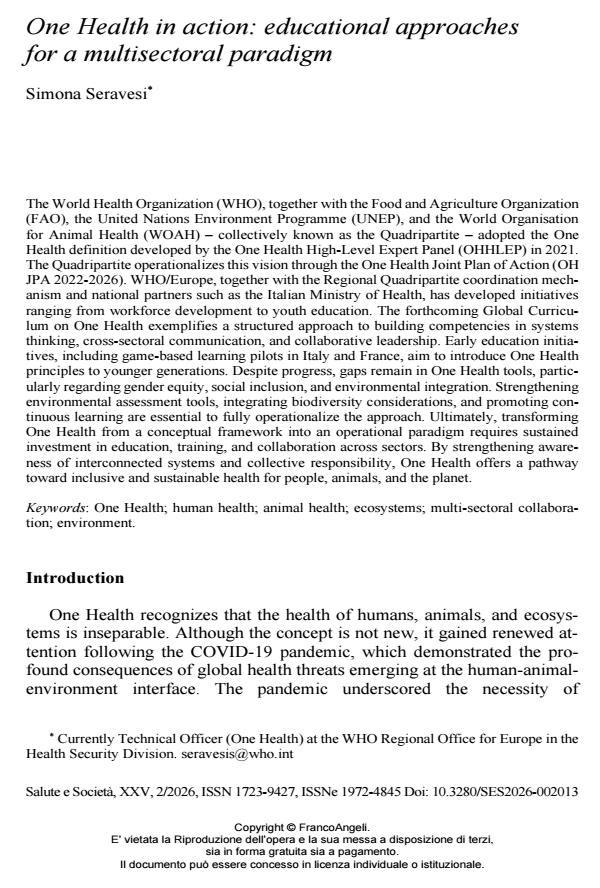
The World Health Organization (WHO), together with the Food and Agriculture Organization (FAO), the United Nations Environment Programme (UNEP), and the World Organisation for Animal Health (WOAH)—collectively known as the Quadripartite—adopted the One Health definition developed by the One Health High-Level Expert Panel (OHHLEP) in 2021. The Quadripartite operationalizes this vision through the One Health Joint Plan of Action (OH JPA 2022–2026). WHO/Europe, together with the Regional Quadripartite coordination mechanism and national partners such as the Italian Ministry of Health, has developed initiatives ranging from workforce development to youth education. The forthcoming Global Curriculum on One Health exemplifies a structured approach to building competencies in systems thinking, cross-sectoral communication, and collaborative leadership. Early education initiatives, including game-based learning pilots in Italy and France, aim to introduce One Health principles to younger generations. Despite progress, gaps remain in One Health tools, particularly regarding gender equity, social inclusion, and environmental integration. Strengthening environmental assessment tools, integrating biodiversity considerations, and promoting continuous learning are essential to fully operationalize the approach. Ultimately, transforming One Health from a conceptual framework into an operational paradigm requires sustained investment in education, training, and collaboration across sectors. By strengthening awareness of interconnected systems and collective responsibility, One Health offers a pathway toward inclusive and sustainable health for people, animals, and the planet.
Keywords: One Health; human health; animal health; ecosystems; multi-sectoral collaboration.
- Behravesh, C. B., Charron, D. F., Liew, A. et al. (2024). An integrated inventory of One Health tools: Mapping and analysis of globally available tools to advance One Health. CABI One Health, 3: 1.
- Convention on Biological Diversity (2023). National Biodiversity Strategies and Action Plans (NBSAPs). Available at: https://www.cbd.int/nbsap (30/01/2026)
- FAO, UNEP, WHO, WOAH (2022). One Health Joint Plan of Action (20222026). Working together for the health of humans, animals, plants and the environment. Rome. Available at: https://www.who.int/publications/i/item/9789240059139 (15/04/2026)
- Francesco (2015). Laudato si’: Lettera enciclica sulla cura della casa comune. Roma: Libreria Editrice Vaticana.
- IPBES (2019). Global assessment report on biodiversity and ecosystem services of the Intergovernmental SciencePolicy Platform on Biodiversity and Ecosystem Services (IPBES). In: Brondizio E.S., Settele J., Díaz S., Ngo H.T., eds., Global Assessment Report on Biodiversity and Ecosystem Services. Bonn, Germany: IPBES secretariat.
- Mettenleiter T.C., Markotter W., Charron D.F., Adisasmito W.B. et al. (2023). The one health highlevel expert panel (OHHLEP). One Health Outlook, 5(1): 18.
- OHHLEP (2023). OHHLEP Inventory of One Health Tools and Resources. Available at: https://www.who.int/publications/m/item/ohhlepinventoryofonehealthtools (15/02/2026)
- WHO (2014). International Health Regulations (IHR) Monitoring & Evaluation Framework. Available at: https://www.who.int/emergencies/operations/internationalhealthregulationsmonitoringevaluationframework (15/01/2026)
- WHO, FAO, OIE (2020). Tripartite Zoonoses Guide: Operational tools and approaches for zoonotic diseases. Available at: https://www.who.int/initiatives/tripartitezoonosisguide (06/02/2026)
- WHO, FAO, OIE (2021). Tripartite and UNEP support OHHLEP's definition of “One Health”. Available at: https://www.who.int/news/item/01122021tripartiteandunepsupportohhlepsdefinitionofonehealth (04/2/2026)
- WHO, FAO, UNEP, WOAH (2023). A Guide to Implementing the One Health Joint Plan of Action at National Level. Available at: https://www.who.int/publications/i/item/9789240082069 (20/02/2026)
- WHO, FAO, WOAH (2022). Tripartite Zoonoses Guide (TZG). Multisectoral, One Health, Coordinating Mechanism Operational Tool (MCM OT). Available at: https://www.who.int/initiatives/tripartitezoonosisguide/multisectoralcoordinationmechanismoperationaltool (06/02/2026)
- WHO, OIE, FAO (2020). Joint Risk Assessment Operational Tool (JRA OT): An Operational Tool of the Tripartite Zoonoses Guide. Available at: https://www.fao.org/documents/card/en/c/cb1520en/ (31/01/2026)
- WHO, WOAH, FAO (2017). National Bridging Workshops (NBW) Program. Available at: https://www.who.int/activities/bridginghumanandanimalhealthsectors (31/01/2026)
- WOAH (2019). OIE Tool for the Evaluation of Performance of Veterinary Services, Seventh Edition. Available at: https://www.woah.org/fileadmin/Home/eng/Support_to_OIE_Members/docs/pdf/2019_PVS_Tool_FINAL.pdf (05/02/2026)
Simona Seravesi, One Health in action: educational approaches for a multisectoral paradigm in "SALUTE E SOCIETÀ" 2/2026, pp 134-143, DOI: 10.3280/SES2026-002013