Toward a reorganization of community-based care services. A scenario analysis

Journal title PSICOLOGIA DI COMUNITA’
Author/s Claudia Venuleo, Terri Mannarini
Publishing Year 2026 Issue 2024/2
Language Italian Pages 19 P. 22-40 File size 124 KB
DOI 10.3280/PSC2024-002003
DOI is like a bar code for intellectual property: to have more infomation click here

Below, you can see the article first page

If you want to buy this article in PDF format, you can do it, following the instructions to buy download credits
Article preview

FrancoAngeli is member of Publishers International Linking Association, Inc (PILA), a not-for-profit association which run the CrossRef service enabling links to and from online scholarly content.

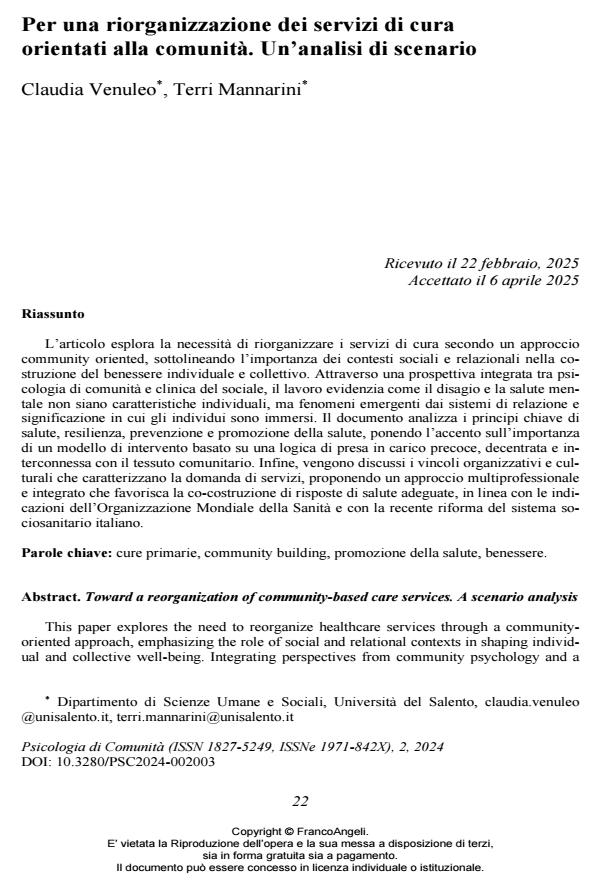
This paper explores the need to reorganize healthcare services through a community-oriented approach, emphasizing the role of social and relational contexts in shaping individual and collective well-being. Integrating perspectives from community psychology and a socio-semiotic-cultural clinical approach, the study highlights how mental health and distress are not individual traits, but emergent properties of relational and meaning-making systems. It examines key principles such as health, resilience, prevention, and health promotion, and advocates for an intervention model based on early, decentralized, and community-integrated care. It also discusses organizational and cultural constraints that affect demand for services, and proposes a multidisciplinary and integrated approach that promotes the co-construction of appropriate health responses. This perspective is in line with the recommendations of the World Health Organization and recent reforms in the Italian social and health system.

Keywords: primary healthcare, community building, health promotion, wellbeing.

  1. Adams, J. (2013). Medicalization and the market economy: Constructing cosmetic surgery as consumable health care. Sociological Spectrum, 33(4): 374-389. DOI: 10.1080/02732173.2013.73289
  2. Ahmad, F., Hudak, P. L., Bercovitz, K., Hollenberg, E., & Levinson, W. (2006). Are physicians ready for patients with Internet-based health information? Journal of Medical Internet Research, 8(3), e535.
  3. Attema, A. E., Brouwer, W. B., & l’Haridon, O. (2013). Prospect theory in the health domain: A quantitative assessment. Journal of Health Economics, 32, 1057–1065.
  4. Bauman, Z. (2007). Liquid times: Living in an age of uncertainty. Polity Press.
  5. Bloch, P., Toft, U., Reinbach, H. C., Clausen, L. T., Mikkelsen, B. E., Poulsen, K., & Jensen, B. B. (2014). Revitalizing the setting approach–Supersettings for sustainable impact in community health promotion. International Journal of Behavioral Nutrition and Physical Activity, 11, 1-15.
  6. Bonanno, G. A., Westphal, M., & Mancini, A. D. (2011). Resilience to loss and potential trauma. Annual review of Clinical Psychology, 7(1), 511-535.
  7. Bronfenbrenner, U. (1979). The ecology of human development: Experiments by nature and design. Harvard University Press.
  8. Bronfenbrenner, U., & Morris, P. A. (2006). The bioecological model of human development. In R. M. Lerner & W. Damon (Eds.). Handbook of Child Psychology, Vol. 1: Theoretical Models of Human Development (pp. 793–828). 6th ed. Wiley.
  9. Brownstein J. S., Freifeld C. C., & Madoff L. C. (2009). Digital disease detection–harnessing the web for public health surveillance. New England Journal of Medicine, 360(21), 2153-2157.
  10. Campbell, C., & Burgess, R. (2012). The role of communities in advancing the goals of the Movement for Global Mental Health. Transcultural psychiatry, 49(3-4), 379-395. DOI: 10.1177/1363461512454643
  11. Cardinali, P., Olcese, M., Antichi, L., & Migliorini, L. (2024). Cumulative trauma and perceived community resilience: A serial mediation model. Journal of Community Psychology, 52(1): 276–288. DOI: 10.1002/JCOP.2309
  12. Carli, R., Paniccia, R., Caputo, A., Dolcetti, F., Finore, E., & Giovagnoli, F. (2016). The relationship between health care users’ demand and the health care system’s response: A research on change observed in the health care system, in the hospital and in the territory. Rivista di Psicologia Clinica, 1, 7-44.
  13. Carter, E. D., & Cordero, M. L. (2022). Salir Adelante: Social capital and resilience during the Covid-19 pandemic in Argentina. Health and Place, 77, 102870. DOI: 10.1016/J.HEALTHPLACE.2022.10287
  14. de Jong-Gierveld, J., Van Tilburg, T. G., & Dykstra, P. A. (2018). New ways of theorizing and conducting research in the field of loneliness and social isolation. In A.L. Vangelisti & D. Perlman (Eds.). The Cambridge handbook of personal relationships (pp. 391-404). Cambridge University Press.
  15. DiClemente, R. J., Crosby, R. A., & Kegler, M. C. (2009). Emerging theories in health promotion practice and research (2nd ed.). Jossey-Bass.
  16. ENPAP (2023). Progetto “Vivere Meglio” Risultati preliminari per la valutazione dell’efficacia dei percorsi di trattamento psicologico e psicoterapeutico per ansia e depressione del Progetto “Vivere Meglio”. Testo disponibile al sito: https://www.enpap.it/doc/borse_lavoro/ReportVivereMeglio_maggio2023.pdf (20 Settembre 2024).
  17. Foulkes, S. H. (2003). Mind. Group Analysis, 36(3): 315-321. DOI: 10.1177/0533316403036300
  18. Fusar-Poli, P., Estradé, A., Esposito, C. M., Rosfort, R., Basadonne, I., Mancini, M., ... & Maj, M. (2024). The lived experience of mental disorders in adolescents: a bottom-up review co-designed, co-conducted and co-written by experts by experience and academics. World Psychiatry, 23(2), 191-208.
  19. Gottlieb, G. (2007). Probabilistic epigenesis. Developmental Science, 10(1): 1–11.
  20. Hall, C. E., Wehling, H., Stansfield, J., South, J., Brooks, S. K., Greenberg, N., Amlôt, R., & Weston, D. (2023). Examining the role of community resilience and social capital on mental health in public health emergency and disaster response: a scoping review. BMC Public Health, 23(1). DOI: 10.1186/S12889-023-17242-
  21. Health Organization (1984). Glossary of terms used in the” Health for All” series, no. 1-8. WHO. Testo disponibile al sito https://iris.who.int/bitstream/handle/10665/39565/ 9241800097.pdf?sequence=1 (20 Settembre 2024)
  22. Hillen, M. A., Gutheil, C. M., Strout, T. D., Smets, E. M. A., & Han, P. K. J. (2017). Tolerance of uncertainty: conceptual analysis, integrative model, and implications for healthcare. Social Science and Medicine, 180, 62–75.
  23. INC NON Profit Lab in collaborazione con AstraRicerche (2023). L’era del disagio. Testo disponibile al sito: https://www.inc-comunicazione.it/wp-content/uploads/2023/10/ERA-DEL-DISAGIO-2023.pdf (30 Ottobre 2024)
  24. Inglehart, R. F., & Norris, P. (2016). Trump, Brexit, and the rise of populism: Economic have-nots and cultural backlash. HKS Working, Paper No.: RWP16-026.
  25. Kaës, R. (2012). Le malêtre. Dunod (trad. it.: Il malessere. Borla, 2014).
  26. Kakhramonovich, T. P. (2022). Epidemiology of Pysichiatric Disorders. Texas Journal of Medical Science, 12, 102-105.
  27. Kalisch, R., Cramer, A. O. J., Binder, H., Fritz, J., & Leertouwer, I, …. & Van Harmelen, A. L. (2019). Deconstructing and reconstructing resilience: A dynamic network approach. Perspectives on Psychological Science, 14(5), 765–77. DOI: 10.1177/1745691619855637
  28. Kienzler, H., Massazza, A., Kuykendall, R., Tamimi, N., Hammoudeh, W., & Giacaman, R. (2024). Uncertainty and Mental Health: A Qualitative Scoping Review. SSM. Qualitative Research in Health, 7, Article 100521.
  29. Kristanti, D., Edison, E., Yunanto, M. K., Alfiandri, A., Utari, D. S., Samnuzulsari, T., Akbar, D., Suyito, S., Solina, E., & Yudiatmaja, W. E. (2021). Strengthening social capital of urban community during COVID-19 disaster. E3S Web of Conferences, 331. DOI: 10.1051/E3SCONF/20213310101
  30. Lazarus, S., Seedat, M., & Naidoo, T. (2017). Community building: Challenges of constructing community. In M. Bond, I. Serrano-Garci´a, C. B. Keys, & M. Shinn, APA handbook of community psychology: Vol. 2. Methods for community research and action for diverse groups and issues (pp. 215–234). American Psychological Association.
  31. Liu, J. J. W., Reed, M., & Girard, T. A. (2017). Advancing resilience: An integrative multi-system model of resilience. Personality and Individual Differences, 111, 111–18.
  32. Mannarini, T., & Salvatore, S. (2020). The politicization of otherness and the privatization of the enemy: Cultural hindrances and assets for active citizenship. Human Affairs, 30, 86-95.
  33. Massazza, A., Kienzler, H., Al-Mitwalli, S., Tamimi, N., & Giacaman, R. (2023) The association between uncertainty and mental health: a scoping review of the quantitative literature. Journal of Mental Health, 32(2), 480-491. DOI: 10.1080/09638237.2021.202262
  34. Masten, A. S., Lucke, C. M., Nelson, K. M., & Stallworthy, I. C. (2021). Resilience in development and psychopathology: Multisystem perspectives. Annual Review of Clinical Psychology, 17, 521-549.
  35. Masten, A. S. (2016). Resilience in developing systems: the promise of integrated approaches. European Journal of Developmental Psychology, 13, 297–312. DOI: 10.1080/17405629.2016.114734
  36. Masten, A. S. (2018). Resilience theory and research on children and families: past, present, and promise. Journal of Family Theory & Review, 10(1), 12–31.
  37. McKinlay, J. B., & Marceau, L. D. (2002). The end of the golden age of doctoring. International Journal of Health Services, 32(2), 379-416. DOI: 10.2190/JL1D-21BG-PK2N-J0K
  38. Ministero della Salute (2020). Piano Nazionale della Prevenzione (PNP) 2020-2025. Testo disponibile al sito: https://www.salute.gov.it/imgs/C_17_pubblicazioni_2955_allegato.pdf (20 Settembre 2024)
  39. Ministero della Salute (2022). Rapporto salute mentale. Analisi dei dati del Sistema Informativo per la Salute Mentale (SISM) - Anno 2022. Testo disponibile al sito: https://www.salute .gov.it/imgs/C_17_pubblicazioni_3369_allegato.pdf (20 Settembre 2024)
  40. Ministero della Salute (2022). Rapporto salute mentale. Analisi dei dati del Sistema Informativo per la Salute Mentale (SISM). Testo disponibile al sito: https://www.salute. gov.it/imgs/C_17_pubblicazioni_3369_allegato.pdf (30 Ottobre 2024)
  41. Moitra, M., Santomauro, D., Collins, P. Y., Vos, T., Whiteford, H., Saxena, S., & Ferrari, A. J. (2022). The global gap in treatment coverage for major depressive disorder in 84 countries from 2000–2019: A systematic review and Bayesian meta-regression analysis. PLoS Medicine, 19(2), e1003901.
  42. Moretta, T., & Buodo, G. (2020). Problematic Internet use and loneliness: How complex is the relationship? A short literature review. Current Addiction Reports, 7(2), 125-136.
  43. Mpofu, E., Baghbanian, A., Bickenbach, J. E., & Brooks, J. (2015). Community-oriented health services: History, framework, nature, and significance. In E. Mpofu (Ed.). Community-oriented health services: Practices across disciplines (pp. 1–15). Springer Publishing Company.
  44. Mushtaq, R., Shoib, S., Shah, T., & Mushtaq, S. (2014). Relationship between loneliness, psychiatric disorders and physical health? A review on the psychological aspects of loneliness. Journal of clinical and diagnostic research: JCDR, 8(9), WE01-WE04. DOI: 10.7860/JCDR/2014/10077.482
  45. Organisation for Economic Cooperation and Development (OCSE) (2021). A New Benchmark for Mental Health Systems: Tackling the Social and Economic Costs of Mental Ill-Health. OECD Publishing.
  46. Perach, R., Fernandes-Jesus, M., Miranda, D., Mao, G., Ntontis, E., Cocking, C., McTague, M., Semlyen, J., & Drury, J. (2023). Can group-based strategies increase community resilience? Longitudinal predictors of sustained participation in Covid-19 mutual aid and community support groups. Journal of Applied Social Psychology, 53(11), 1059–1075. https:// doi.org/10.1111/JASP.12995
  47. Phillimore, J., & Cheung, S. Y. (2021). The violence of uncertainty: Empirical evidence on how asylum waiting time undermines refugee health. Social Science & Medicine, 282, 114154.
  48. Prewitt Diaz, J. O. (2023). Activating community resilience through community capitals after covid-19. In J. O. Prewitt Diaz (Ed.). Mental Health and Psychosocial Support during the COVID-19 Response: An Overview (pp. 15–22). Apple Academic Press.
  49. Rochira, A., Marinaci, T., De Simone, E., Mannarini, T., Ciavolino, E., Verbena, S., & Pasca, P. (2023). The interplay of community resilience potential, trust in the future and social well-being. Journal of Community and Applied Social Psychology, 33, 1455–1473.
  50. Rochira, A., De Simone, E., & Mannarini, T. (2022). Community resilience and continuous challenges: A qualitative analysis of the functioning of communities in the aftermath of persistent and ordinary stressors. Journal of Community Psychology, 51: 1106–1123.
  51. Rochira, A., Mannarini, T., Fini, V., & Salvatore, S. (2019). Symbolic universes, semiotic capital and health. A semiotic cultural psychological analysis of the vaccination hesitancy phenomenon in Italy. In Symbolic Universes in Time of (Post) Crisis (pp. 215-233). Cham: Springer International Publishing.
  52. Ross, C. E., Mirowsky, J., & Pribesh, S. (2001). Powerlessness and the amplification of threat: Neighborhood disadvantage, disorder, and mistrust. American Sociological Review, 66(4), 568–591. DOI: 10.2307/308892
  53. Salvatore, S., Freda, M. F., Ligorio, B., Iannaccone, A., Rubino, F. & Scotto di Carlo, M. (2003). Socioconstructivism and Theory of the unconscious. A gaze over a Research Horizon. European Journal of School Psychology, 1(1), 9-36.
  54. Salvatore, S., Mannarini, T., Avdi, E., Battaglia, F., Cremaschi, M., Fini, V., ... & Veltri, G. A. (2019). Globalization, demand of sense and enemization of the other: A psychocultural analysis of European societies’ sociopolitical crisis. Culture & Psychology, 25(3), 345-374. DOI: 10.1177/1354067X1877905
  55. Salvatore, S., & Palma, L. (2024). Per dare risposte efficaci al disagio psicologico serve un ampliamento di scala degli interventi. Quotidiano Sanità Puglia, 5 gennaio 2024: Available online at: https://www.quotidianosanita.it/puglia/articolo.php?articolo_id=116589 (accessed September 2023).
  56. Salvatore, S., Palmieri, A., Pergola, F., & Andrisano, R. (2019). Trasformazioni sociali, affettivizzazione della sfera pubblica e ricerca di senso. Education Sciences & Society, 10(2), 206-255.
  57. Salvatore, S., Picione, R. D. L., Bochicchio, V., Mannino, G., Langher, V., Pergola, F., ... & Venuleo, C. (2021). The affectivization of the public sphere: the contribution of psychoanalysis in understanding and counteracting the current crisis scenarios. International Journal of Psychoanalysis and Education: Subject, Action & Society, 1(1), 3-30. DOI: 10.32111/SAS.2021.1.1.2
  58. Salvatore, S., Valsiner, J., & Veltri, G. A. (2019). The theoretical and methodological framework. semiotic cultural psychology, symbolic universes and lines of semiotic forces. In S. Salvatore, V. Fini, T. Mannarini, J. Valsiner, & G. A. Veltri (Eds.). Symbolic Universes in Time of (Post)Crisis. The Future of European Societies (pp. 5-49). Springer.
  59. Santinello, M., Canale, N., & Prati, G. (2021). Prevenzione. In C. Arcidiacono, N. De Piccoli, T. Mannarini, & E. Marta (2021). Psicologia di comunità. 1. Prospettive e concetti chiave (pp. 169-182). Franco Angeli.
  60. Sapien Labs (2024, March 4). The mental state of the world in 2023: A perspective on internet-enabled populations. Global Mind Project. Available online at: https://sapienlabs. org/wp-content/uploads/2024/03/4th-Annual-Mental-State-of-the-World-Report.pdf (accessed October 2024)
  61. Sodi, T., Han, B., & Singh, P. (2021). Special issue on psychology of uncertainty and vulnerabilities: COVID-19 pandemic related crisis. Psychological studies, 1-4. https://doi. org/10.1007/s12646-021-00623-w
  62. Tan, S. S. L., & Goonawardene, N. (2017). Internet health information seeking and the patient-physician relationship: a systematic review. Journal of medical Internet research, 19(1), e5729.
  63. Venezia, A., Mossi, P., Venuleo, C., Savarese, G., & Salvatore, S. (2019). Representations of physician’s role and their impact on compliance. Psicologia della Salute, 2, 100-121.
  64. Venuleo, C., & Guacci, C., (2014). Lo psicologo di base entro il servizio sanitario. Un caso studio sull’immagine della funzione psicologica e del servizio integrato espressa da pediatri e medici di base. Psicologia della Salute, 1, 73-97.
  65. Venuleo, C., Marinaci, T., Savarese, G., & Venezia, A. (2023). Images of the Patient–Physician Relationship Questionnaire (IPPRQ): An Instrument for Analyzing the Way Patients Make Sense of the Relationship with the Physician. In Methods and Instruments in the Study of Meaning-Making (pp. 169-195). Springer International Publishing.
  66. Venuleo, C., Rollo, S., Marinaci, T., & Calogiuri, S. (2016). Towards a cultural understanding of addictive behaviours. The image of the social environment among problem gamblers, drinkers, internet users and smokers. Addiction Research & Theory, 24(4), 274-287. DOI: 10.3109/16066359.2015.112625
  67. Vinson, A. H. (2016). ‘Constrained collaboration’: Patient empowerment discourse as resource for countervailing power. Sociology of Health & Illness, 38(8), 1364-1378. DOI: 10.1111/1467-9566.1248
  68. World Health Organization (1946). Constitution of the world health organization. Available online at: https://apps.who.int/gb/gov/assets/constitution-en.pdf (accessed September 2023).
  69. World Health Organization (1986). Ottawa Charter for Health Promotion. Copenhagen: WHO.
  70. World Health Organization (2021). Mental Health ATLAS 2020. Available online at: https://www.who.int/publications/i/item/9789240036703 (accessed September 2023).
  71. World Health Organization (2022a). World mental health report: Transforming mental health for all. Available online at: https://iris.who.int/bitstream/handle/10665/356119/ 9789240049338-eng.pdf?sequence=1&isAllowed=y (accessed September 2023).
  72. World Health Organization (2022b) Mental Health and COVID-19: Early evidence of the pandemic’s impact: Scientific brief, 2 March 2022. Available online at: https://www. who.int/publications-detail-redirect/WHO-2019-nCoV-Sci_Brief-Mental_health-2022.1 (accessed September 2023).
  73. Wu, D., Yu, L., Yang, T., Cottrell, R., Peng, S., Guo, W., & Jiang, S. (2020). The impacts of uncertainty stress on mental disorders of Chinese college students: Evidence from a nationwide study. Frontiers in Psychology, 11, 243.

Claudia Venuleo, Terri Mannarini, Per una riorganizzazione dei servizi di cura orientati alla comunità. Un’analisi di scenario in "PSICOLOGIA DI COMUNITA’" 2/2024, pp 22-40, DOI: 10.3280/PSC2024-002003