Social Impact as a Criterion for Evaluating Collective Performance: The Role of Ideal-motive Entities and Third Sector Reform

Journal title QUADERNI DI ECONOMIA DEL LAVORO
Author/s Azio Barani
Publishing Year 2026 Issue 2022/116
Language Italian Pages 35 P. 113-147 File size 534 KB
DOI 10.3280/QUA2022-116007
DOI is like a bar code for intellectual property: to have more infomation click here

Below, you can see the article first page

If you want to buy this article in PDF format, you can do it, following the instructions to buy download credits
Article preview

FrancoAngeli is member of Publishers International Linking Association, Inc (PILA), a not-for-profit association which run the CrossRef service enabling links to and from online scholarly content.

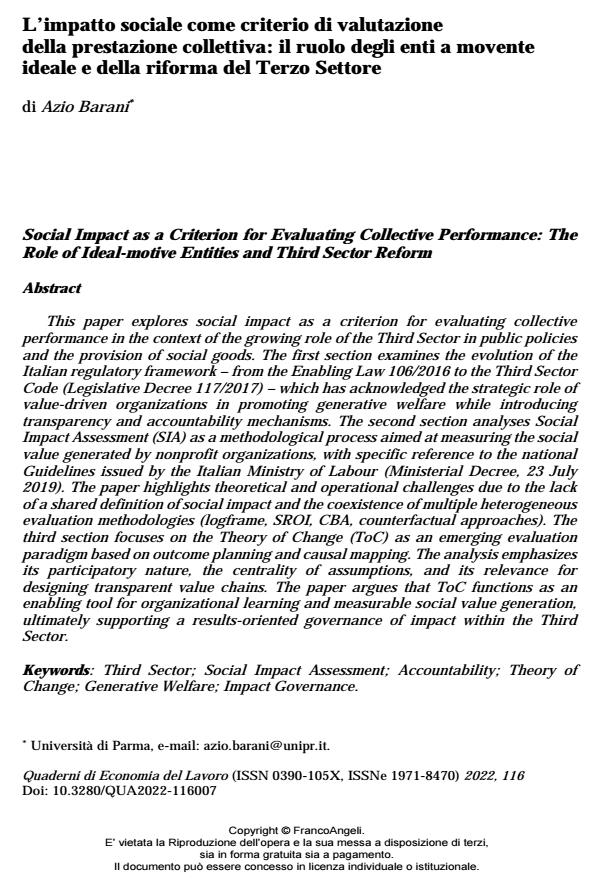
This paper explores social impact as a criterion for evaluating collective performance in the context of the growing role of the Third Sector in public policies and the provision of social goods. The first section examines the evolution of the Italian regulatory framework – from the Enabling Law 106/2016 to the Third Sector Code (Legislative Decree 117/2017) – which has acknowledged the strategic role of value-driven organizations in promoting generative welfare while introducing transparency and accountability mechanisms. The second section analyses Social Impact Assessment (SIA) as a methodological process aimed at measuring the social value generated by nonprofit organizations, with specific reference to the national Guidelines issued by the Italian Ministry of Labour (Ministerial Decree, 23 July 2019). The paper highlights theoretical and operational challenges due to the lack of a shared definition of social impact and the coexistence of multiple heterogeneous evaluation methodologies (logframe, SROI, CBA, counterfactual approaches). The third section focuses on the Theory of Change (ToC) as an emerging evaluation paradigm based on outcome planning and causal mapping. The analysis emphasizes its participatory nature, the centrality of assumptions, and its relevance for designing transparent value chains. The paper argues that ToC functions as an enabling tool for organizational learning and measurable social value generation, ultimately supporting a results-oriented governance of impact within the Third Sector.

Keywords: Third Sector; Social Impact Assessment; Accountability; Theory of Change; Generative Welfare; Impact Governance.

  1. Oswick C., Fleming P., Hanlon G. (2011). From borrowing to blending: Rethinking the processes of organizational theory building. Academy of Management Review.
  2. Anheier H.K., Seibel W. (1990). The Third Sector: Comparative Studies of Nonprofit Organizations. New York: de Gruyter.
  3. Barbetta G.P., a cura di (1997). The nonprofit sector in Italy. Manchester University Press.
  4. Baker T., Nelson R.E. (2005). Creating Something from Nothing: Resource Construction through. Entrepreneurial Bricolage. Administrative Science Quarterly. Sage.
  5. Borgomeo C. (2020). Ripartire da un nuovo paradigma: la centralità del Terzo Settore. In: I nuovi scenari economici di fronte alla sfida del COVID-19 – Il ruolo dell’economia sociale in Italia e nel Mezzogiorno. SRM Centro Studi/Banca Intesa San Paolo.
  6. Brest P., Katz S., Peeler H., Stangler D. (2012). A decade of outcome-oriented philanthropy. Stanford Social Innovation Review.
  7. Capasso S., Cozzolino A., Musella M. (2020). Il Terzo Settore prima, durante e dopo la crisi pandemica. Alcune linee interpretative. In: I nuovi scenari economici di fronte alla sfida del COVID-19 – Il ruolo dell’economia sociale in Italia e nel Mezzogiorno. SRM Centro Studi/Banca Intesa San Paolo.
  8. Carstensen M.B. (2011). Paradigm man vs. the bricoleur: bricolage as an alternative vision of agency in ideational change. European Political Science Review.
  9. Castello S., a cura di (2017). Manuale operativo per la Theory of Change. Linee Guida per gestire un workshop partecipativo di Teoria del Cambiamento e porre le basi per valutazione dell’impatto sociale. Centro Studi Lang.
  10. Elevati C., Almagro Carrobles N., Bozzio G., Rossi Romanelli C., Bastia F., Trentin M., (2019). Progettare con la Teoria del Cambiamento. Una guida per il mondo della cooperazione internazionale. ChangeLab.
  11. Choi N., Majumdar S. (2014). Social entrepreneurship as an essentially contested concept: Opening a new avenue for systematic future research. Journal of Business Venturing.
  12. Clark C., Rosenzweig W., Long D., Olsen S. (2004). Double bottom line project report: assessing social im-pact in double bottom line ventures. Columbia Business School.
  13. Clark H. (2012). Theory of Change Basics. A primer on theory of change. ActKnowledge.
  14. Colonese E. (2006). Ruolo del Facilitatore nei progetti di trasformazione. -- Testo disponibile al sito: http://www.colonese.it/00-Manuali_Pubblicatii/11-RuoloFacilitator_v1.pdf.
  15. Colonese E. (2006). Ruolo del facilitatore nei progetti di trasformazione. WWW.Colonese.it. “Facilitazione Gruppi” dal sito: https://www.alberodellavita.bo.it/facilitazione-gruppi/ (visitato il 20 novembre, 2022).
  16. DECRETO LEGISLATIVO 3 luglio 2017, n. 112 dal sito gazzettaufficiale.it -- https://www.gazzettaufficiale.it/eli/id/2017/07/19/17G00124/sg.
  17. DECRETO 23 luglio 2019, dal sito gazzettaufficiale.it -- https://www.gazzettaufficiale.it/atto/serie_generale/caricaDettaglioAtto/originario?atto.dataPubblicazioneGazzetta=2019-09-12&atto.codiceRedazionale=19A05601&elenco30giorni=false.
  18. Di Domenico M.L., Haugh H., Tracey P. (2010). Social bricolage: Theorizing social value creation in social enterprises. Entrepreneurship Theory and Practice.
  19. Ebrahim A., Rangan V.K. (2014). What impact?. A framework for measuring the scale & scope of social performance. California Management Review.
  20. Ebrahim A., Battilana J., Mair J. (2014). The Governance of Social Enterprises: Mission drift and accountability challenges in hybrid organizations. Research in Organisational Behavior. Amsterdam: Elsevier.
  21. Elevati C., Almagro Carrobles N., Bozzio G., Rossi Romanelli C., Bastia F., Trentin M. (2019). Progettare con la Teoria del Cambiamento. Una guida per il mondo della cooperazione internazionale. ChangeLab.
  22. Emerson J., Wachowicz J., Chun S. (1998). Social Return on Investment: Exploring Aspects of Value Creation in the Nonprofit Sector. The Roberts Enterprise Development Fund.
  23. Emerson J. (2003). The blended value proposition: Integrating social and financial returns. California Management Review.
  24. Epstein M.J., Yuthas K. (2014). Measuring and Improving Social Impacts: A Guide for Non-profits Companies and Impact Investors. BK Business.
  25. Harries E., Hodgson L., Noble J. (2014). Creating your Theory of Change NPC’s practical guide. thinknpc.org.
  26. “I numeri del non profit” dal sito -- https://www.cantiereterzosettore.it/i-numeri-del-non-profit/ (visitato il 20 novembre, 2022).
  27. LEGGE 8 novembre 2000, n. 328 dal sito gazzettaufficiale.it -- https://www.gazzettaufficiale.it/eli/id/2000/11/13/000G0369/sg.
  28. LEGGE 6 giugno 2016, n. 106 dal sito gazzettaufficiale.it -- https://www.gazzettaufficiale.it/eli/id/2016/06/18/16G00118/sg.
  29. Lévi-Strauss C. (1962). Savage mind. University of Chicago Press.
  30. Lester M., Salamon H., Anheier K. (1997). Defining the Nonprofit sector: a Cross-national Analysis. Manchester University Press.
  31. Mair J., Marti I. (2009). Entrepreneurship in and around institutional voids: A case study from Bangladesh. Journal of Business Venturing.
  32. McLoughlin J., Kaminski J., Sodagar B., Khan S., Harris R., Arnaudo G., Mc Brearty S. (2009). A strategic approach to social impact measurement of social enterprises: The SIMPLE Methodology. Social Enterprise Journal.
  33. Millar R., Hall K. (2013). Social return on investment (SROI) and performance measurement: The opportunities and barriers for social enterprises in health and social care. Public Management Review.
  34. Molecke G., Pinkse J. (2019). Accountability for social impact: A bricolage perspective on impact measurement in social enterprises. Journal of Business Venturing.
  35. Nicholls A. (2009). ‘We do good things, don’t we?’: ‘Blended Value Accounting’. Social Entrepreneurship, Accounting, Organizations and Society, 34: 755-769.
  36. Nicholls A. (2015). Synthetic Grid: A critical framework to inform the development of social innovation metric. CRESSI Working Papers no. 14/2015.
  37. Perrini F., Vurro C. (2013). La valutazione degli impatti sociali. Approcci e strumenti applicative. Milano: Egea.
  38. Roche C.J. (1999). Impact assessment for development agencies: Learning to value change. Oxford Oxfam.
  39. Rossi Romanelli C., Elevati C., Gerovasi E., Bastia F., Bozzia G., Cappello M., Trentin M., Palmerini P., Franzoso S. (2017). La Theory of Change per la cooperazione internazionale. -- www.info-cooperazione.it.
  40. “Stakeholder” dal sito: -- https://www.glossariomarketing.it/significato/stakeholder/ (visitato il 20 novembre 2022).
  41. Servizio di Valutazione al PSR (2019). La teoria del cambiamento del Piano di Sviluppo Rurale della Sardegna 2014-2020. I risultati di un esercizio di condivisione. Regione Autonoma della Sardegna.
  42. Taplin D.H., Clark H. (2012). Theory of Change Basics: A Primer on Theory of Change. ActKnowledge. Testo disponibile al sito: -- https://www.theoryofchange.org/wpcontent/uploads/toco_library/pdf/ToCBasics.pdf.
  43. “Theory of Change” dal sito inside.ewu.edu: -- https://inside.ewu.edu/ogrd/pre-award/proposal-development/writing-resources/theory-of-change/ (visitato il 20 novembre 2022).
  44. “Theory of change: progettare il cambiamento” dal sito ong2zero.org: -- https://www.ong2zero.org/blog/thoery-change-governare-cambiamento/ (visitato il 20 novembre 2022).
  45. “TOC Background” dal sito theoryofchange.org: -- https://www.theoryofchange.org/what-is-theory-of-change/toc-background/ (visitato il 20 novembre 2022).
  46. “TOC Origins” dal sito theoryofchange.org: -- https://www.theoryofchange.org/what-is-theory-of-change/toc-background/toc-origins/ (visitato il 20 novembre 2022).
  47. Venturi P. (2019). La valutazione d’impatto sociale come pratica trasformativa. Forlì: Aiccon.
  48. Zamagni S., Venturi P., Rago S. (2018). Valutare l’impatto sociale. La questione della misurazione nelle imprese sociali. Rivista Impresa Sociale, 6(12), 2015.

Azio Barani, L’impatto sociale come criterio di valutazione della prestazione collettiva: il ruolo degli enti a movente ideale e della riforma del Terzo Settore in "QUADERNI DI ECONOMIA DEL LAVORO" 116/2022, pp 113-147, DOI: 10.3280/QUA2022-116007