Labour, Organizational Performance and Information Systems

Journal title QUADERNI DI ECONOMIA DEL LAVORO
Author/s Azio Barani
Publishing Year 2026 Issue 2022/116
Language Italian Pages 22 P. 215-236 File size 102 KB
DOI 10.3280/QUA2022-116009
DOI is like a bar code for intellectual property: to have more infomation click here

Below, you can see the article first page

If you want to buy this article in PDF format, you can do it, following the instructions to buy download credits
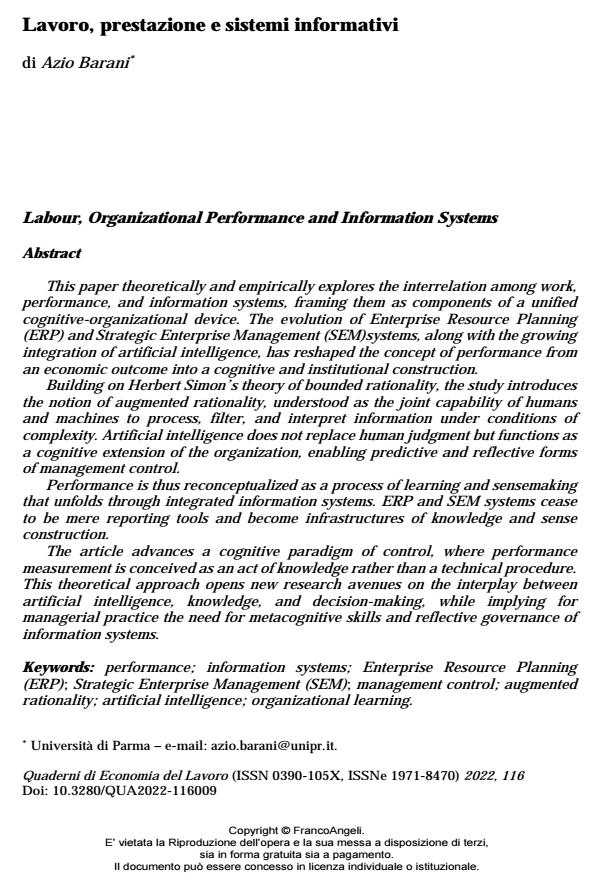
Article preview

FrancoAngeli is member of Publishers International Linking Association, Inc (PILA), a not-for-profit association which run the CrossRef service enabling links to and from online scholarly content.

This paper theoretically and empirically explores the interrelation among work, performance, and information systems, framing them as components of a unified cognitive-organizational device. The evolution of Enterprise Resource Planning (ERP) and Strategic Enterprise Management (SEM)systems, along with the growing integration of artificial intelligence, has reshaped the concept of performance from an economic outcome into a cognitive and institutional construction. Building on Herbert Simon’s theory of bounded rationality, the study introduces the notion of augmented rationality, understood as the joint capability of humans and machines to process, filter, and interpret information under conditions of complexity. Artificial intelligence does not replace human judgment but functions as a cognitive extension of the organization, enabling predictive and reflective forms of management control. Performance is thus reconceptualized as a process of learning and sensemaking that unfolds through integrated information systems. ERP and SEM systems cease to be mere reporting tools and become infrastructures of knowledge and sense construction. The article advances a cognitive paradigm of control, where performance measurement is conceived as an act of knowledge rather than a technical procedure. This theoretical approach opens new research avenues on the interplay between artificial intelligence, knowledge, and decision-making, while implying for managerial practice the need for metacognitive skills and reflective governance of information systems.

Keywords: performance; information systems; Enterprise Resource Planning (ERP); Strategic Enterprise Management (SEM); management control; augmented rationality; artificial intelligence; organizational learning.

  1. Ahrens T. e Chapman C.S. (2018). Management accounting as practice. In: The Routledge Companion to Accounting Communication, pp. 31-47. London: Routledge.
  2. Alavi M. e Leidner D.E. (2001). Knowledge management and knowledge management systems: Conceptual foundations and research issues. MIS Quarterly, 25(1): 107-136.
  3. Alvesson M. e Kärreman D. (2001). Odd couple: Making sense of the curious concept of knowledge management. Journal of Management Studies, 38(7): 995-1018.
  4. Anthony R.N., Govindarajan V. e Dearden J. (2014). Management control systems, 13° ed. New York: McGraw-Hill Education.
  5. Argyris C. (1991). Teaching smart people how to learn. Harvard Business Review, 69(3): 99-109.
  6. Argyris C. e Schön D.A. (1978). Organizational learning: A theory of action perspective. Reading, MA: Addison-Wesley.
  7. Ashby W.R. (1956). An introduction to cybernetics. London: Chapman & Hall.
  8. Bakator M., Ðordevic D., Cockalo D. e Nikolic M. (2019). Industry 4.0 and business process management: Theoretical framework. Strategic Management, 24(3): 22-31.
  9. Beer D. (2018). The data gaze: Capitalism, power and perception. London: SAGE.
  10. Beer S. (1972). Brain of the firm. London: Allen Lane.
  11. Borghini S. e Cillo P. (2020). Artificial intelligence and organizational cognition: A research agenda. Sinergie Italian Journal of Management, 38(2): 11-27.
  12. Brusa L. (2000). Sistemi manageriali di programmazione e controllo. Milano: Giuffrè.
  13. Brynjolfsson E. e McAfee A. (2017). Machine, platform, crowd: Harnessing our digital future. New York: W.W. Norton.
  14. Burrell J. (2016). How the machine “thinks”: Understanding opacity in machine learning algorithms. Big Data & Society, 3(1): 1-12.
  15. Camussone P.F. (1990). Il sistema informativo: Finalità, ruolo e metodologia di realizzazione. Milano: ETAS.
  16. Crossan M.M., Lane H.W. e White R.E. (1999). An organizational learning framework: From intuition to institution. Academy of Management Review, 24(3): 522-537.
  17. Cyert R.M. e March J.G. (1963). A behavioral theory of the firm. Englewood Cliffs, NJ: Prentice Hall.
  18. Daft R.L. e Lengel R.H. (1986). Organizational information requirements, media richness and structural design. Management Science, 32(5): 554-571.
  19. Daunoriene A., Ramanauskaite J., Kazimieras S.J., Staniskiene E. e Stankeviciute Ž. (2022). Transformation of business organization towards sustainability. Cham: Springer.
  20. Devaraj S. e Kohli R. (2003). Performance impacts of information technology: Is actual usage the missing link? Management Science, 49(3): 273-289.
  21. El Sawy O.A. e Pavlou P.A. (2008). IT-enabled business capabilities for turbulent environments. MIS Quarterly Executive, 7(3): 139-150.
  22. Floridi L. e Taddeo M. (2016). What is data ethics? Philosophical Transactions of the Royal Society A: Mathematical, Physical and Engineering Sciences, 374(2083): 1-5.
  23. Grant R.M. (1996). Toward a knowledge-based theory of the firm. Strategic Management Journal, 17(S2): 109-122.
  24. Hopwood A.G. (1976). Accounting and human behavior. Englewood Cliffs, NJ: Prentice Hall.
  25. Jorfi S., Nor K.M. e Najafabadi M.O. (2017). The impact of IT flexibility on strategic alignment and applications implementation. Journal of Enterprise Information Management, 30(4): 678-701.
  26. Kahneman D. (2011). Thinking, fast and slow. New York: Farrar, Straus and Giroux.
  27. Kaplan R.S. e Norton D.P. (1996). Using the balanced scorecard as a strategic management system. Harvard Business Review, 74(1): 75-85.
  28. Lazzari S. (2019). Activity-based costing e creazione di valore. Contabilità e Cultura Aziendale, 19(1): 35-56.
  29. Leonardi P.M. (2018). Digital materiality? How artifacts without matter, matter. Information and Organization, 28(1): 59-65.
  30. Lipe M.G. e Salterio S.E. (2000). The balanced scorecard: Judgmental effects of common and unique performance measures. The Accounting Review, 75(3): 283-298.
  31. Luhmann N. (1990). Essays on self-reference. New York: Columbia University Press.
  32. Luftman J., Ly R. e Zadeh H.S. (2017). IT alignment: Twenty years later. Journal of Information Technology, 32(2): 98-118.
  33. March J.G. (1994). A primer on decision making: How decisions happen. New York: Free Press.
  34. Marzona A. e Pighin M. (2005). Sistemi informativi aziendali: Struttura e applicazioni. Milano: Pearson.
  35. Melville N., Kraemer K. e Gurbaxani V. (2004). Information technology and organizational performance: An integrative model of IT business value. MIS Quarterly, 28(2): 283-322.
  36. Merchant K.A., Van der Stede W.A. e Zoni L. (2013). Sistemi di controllo di gestione. Milano: Pearson.
  37. Miller P. e Power M. (2013). Accounting, organizing, and economizing: Connecting accounting research and organization theory. The Academy of Management Annals, 7(1): 557-605.
  38. Neely A., Adams C. e Kennerley M. (2002). The performance prism: The scorecard for measuring and managing business success. London: Prentice Hall.
  39. Nonaka I. e Takeuchi H. (1995). The knowledge-creating company: How Japanese companies create the dynamics of innovation. Oxford: Oxford University Press.
  40. Nowotny H. (2016). The cunning of uncertainty. Cambridge: Polity Press.
  41. Orlikowski W.J. (2007). Sociomaterial practices: Exploring technology at work. Organization Studies, 28(9): 1435-1448.
  42. Orlikowski W.J. e Scott S.V. (2016). Digital work: A research agenda. Organization Studies, 37(12): 1579-1602.
  43. Pigni F., Ravarini A. e Sciuto D. (2009). Sistemi per la gestione dell’informazione. Milano: Apogeo.
  44. Power M. (2004). The risk management of everything. Journal of Management Studies, 41(6): 975-1002.
  45. Russell S. e Norvig P. (2021). Artificial intelligence: A modern approach, 4° ed. London: Pearson.
  46. Scott W.R. (2014). Institutions and organizations: Ideas, interests, and identities, 4° ed. Thousand Oaks, CA: Sage.
  47. Seddon P.B., Calvert C. e Yang S. (2010). A multi-project model of key factors affecting organizational benefits from enterprise systems. MIS Quarterly, 34(2): 305-328.
  48. Shrestha Y.R., Ben-Menahem S.M. e von Krogh G. (2019). Organizational decision-making structures in the age of artificial intelligence. California Management Review, 61(4): 66-83.
  49. Simons R. (1995). Levers of control: How managers use innovative control systems to drive strategic renewal. Boston, MA: Harvard Business School Press.
  50. Simon H.A. (1976). Administrative behavior: A study of decision-making processes in administrative organizations, 3° ed. New York: Free Press.
  51. Soh C. e Sia S.K. (2004). An institutional perspective on sources of ERP package-organization misalignments. Journal of Strategic Information Systems, 13(4): 375-397.
  52. Teece D.J. (2018). Business models and dynamic capabilities. Long Range Planning, 51(1): 40-49.
  53. Teece D.J., Pisano G. e Shuen A. (1997). Dynamic capabilities and strategic management. Strategic Management Journal, 18(7): 509-533.
  54. Weick K.E. (1995). Sensemaking in organizations. Thousand Oaks, CA: SAGE.
  55. Zuboff S. (2019). The age of surveillance capitalism: The fight for a human future at the new frontier of power. New York: PublicAffairs.

Azio Barani, Lavoro, prestazione e sistemi informativi in "QUADERNI DI ECONOMIA DEL LAVORO" 116/2022, pp 215-236, DOI: 10.3280/QUA2022-116009