Marx, Keynes, Technological Progress and Labor: A Backward-looking Perspective on Artificial Intelligence and Time-use
Journal title HISTORY OF ECONOMIC THOUGHT AND POLICY
Author/s Gabriele Guzzi, Eleonora Sanfilippo
Publishing Year 2026 Issue 2026/1
Language English Pages 33 P. 81-113 File size 145 KB
DOI 10.3280/SPE2026-001004
DOI is like a bar code for intellectual property: to have more infomation
click here
Below, you can see the article first page
If you want to buy this article in PDF format, you can do it, following the instructions to buy download credits
FrancoAngeli is member of Publishers International Linking Association, Inc (PILA), a not-for-profit association which run the CrossRef service enabling links to and from online scholarly content.
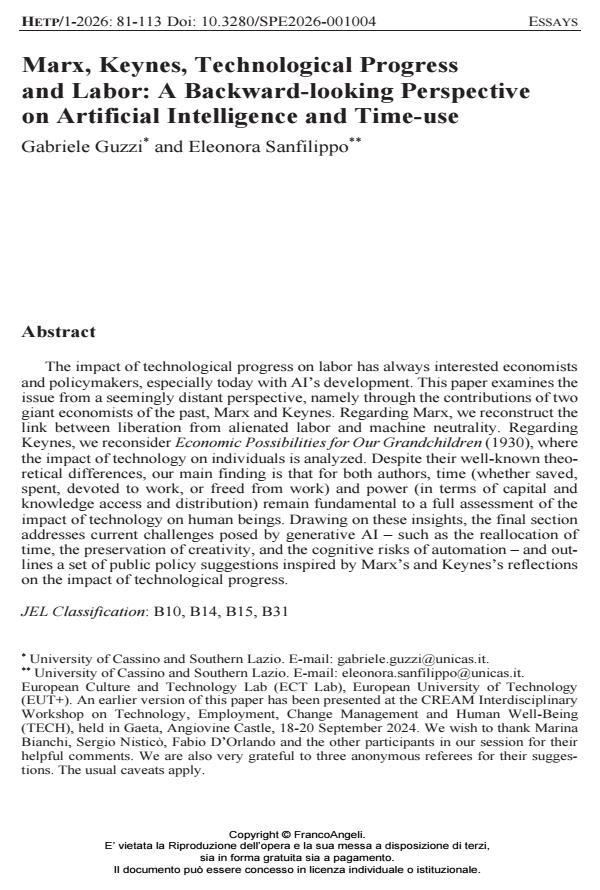
The impact of technological progress on labor has always interested economists and policymakers, especially today with AI’s development. This paper examines the issue from a seemingly distant perspective, namely through the contributions of two giant economists of the past, Marx and Keynes. Regarding Marx, we reconstruct the link between liberation from alienated labor and machine neutrality. Regarding Keynes, we reconsider Economic Possibilities for Our Grandchildren (1930), where the impact of technology on individuals is analyzed. Despite their wellknown theoretical differences, our main finding is that for both authors, time (whether saved, spent, devoted to work, or freed from work) and power (in terms of capital and knowledge access and distribution) remain fundamental to a full assessment of the impact of technology on human beings. Drawing on these insights, the final section addresses current challenges posed by generative AI - such as the reallocation of time, the preservation of creativity, and the cognitive risks of automation - and outlines a set of public policy suggestions inspired by Marx’s and Keynes’s reflections on the impact of technological progress.
Keywords: Marx, Keynes, technology, Artificial Intelligence, time-use
Jel codes: B10, B14, B15, B31
Gabriele Guzzi, Eleonora Sanfilippo, Marx, Keynes, Technological Progress and Labor: A Backward-looking Perspective on Artificial Intelligence and Time-use in "HISTORY OF ECONOMIC THOUGHT AND POLICY" 1/2026, pp 81-113, DOI: 10.3280/SPE2026-001004