The psychopathology of everyday politics: Trump, his apostles, and the fate of the world order
Journal title PSICOTERAPIA E SCIENZE UMANE
Author/s Drew Westen
Publishing Year 2026 Issue 2026/2
Language Italian Pages 30 P. 189-218 File size 408 KB
DOI 10.3280/PU2026-002001
DOI is like a bar code for intellectual property: to have more infomation
click here
Below, you can see the article first page
If you want to buy this article in PDF format, you can do it, following the instructions to buy download credits
FrancoAngeli is member of Publishers International Linking Association, Inc (PILA), a not-for-profit association which run the CrossRef service enabling links to and from online scholarly content.
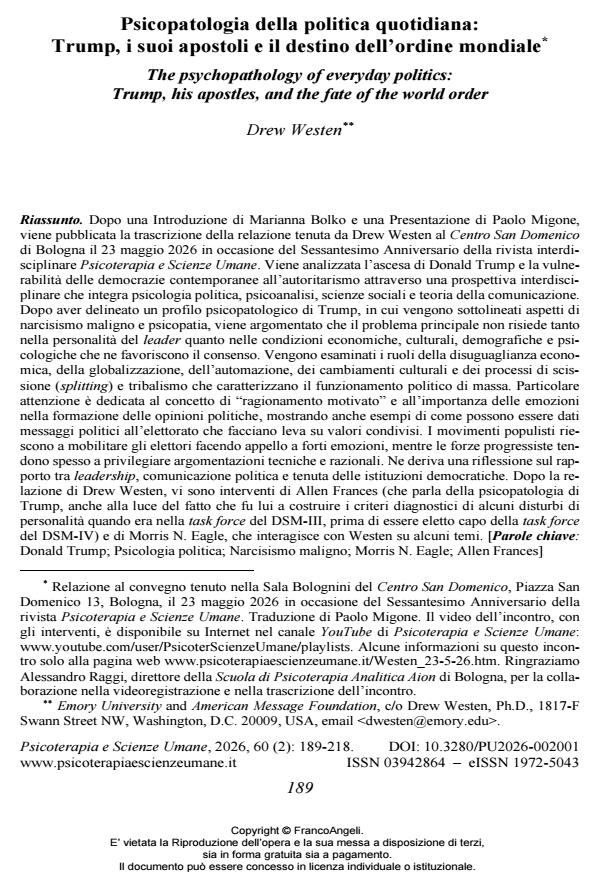
After an Introduction by Marianna Bolko and a Presentation by Paolo Migone, the transcript of Drew Westen’s talk at the Centro San Domenico of Bologna on May 23, 2026, is published; this talk was on the occasion of the Sixtieth Anniversary of the interdisciplinary journal Psicoterapia e Scienze Umane. The rise of Donald Trump in America and the vulnerability of contemporary democracies to authoritarianism are analyzed through an interdisciplinary perspective that integrates political psychology, psychoanalysis, social sciences, and communication theory. After outlining a psychopathological profile of Trump, highlighting aspects of malignant narcissism and psychopathy, it is argued that the main problem lies not so much in the leader’s personality as in the economic, cultural, demographic, and psychological conditions that favor his consensus. The role of economic inequality, globalization, automation, cultural shifts, and the processes of splitting and tribalism that characterize mass political functioning are discussed. Particular attention is paid to the concept of “motivated reasoning” and the importance of emotions in shaping political opinions, also showing examples of how political messages can be conveyed to the electorate by leveraging shared values. Populist movements are able to mobilize voters by appealing to strong emotions, while progressive parties often tend to favor technical and rational arguments. This leads to a reflection on the relationship between leadership, political communication, and the stability of democratic institutions. Following Drew Westen’s presentation, there are interventions from Allen Frances (who discusses Trump’s psychopathology, also in light of the fact that Frances himself developed the diagnostic criteria of some personality disorders when he was on the DSM-III task force, before being elected chief of the DSM-IV task force) and Morris N. Eagle, who interacts with Westen on various topics.
Keywords: Donald Trump, Political psychology, Malignant narcissism, Morris N. Eagle, Allen Frances
Drew Westen, Psicopatologia della politica quotidiana: Trump, i suoi apostoli e il destino dell’ordine mondiale in "PSICOTERAPIA E SCIENZE UMANE" 2/2026, pp 189-218, DOI: 10.3280/PU2026-002001