Towards a Psychopathology of Artificial Alterity
Journal title RIVISTA SPERIMENTALE DI FRENIATRIA
Author/s Angelo Grossi
Publishing Year 2026 Issue 2026/2
Language Italian Pages 31 P. 99-129 File size 423 KB
DOI 10.3280/RSF2026-002007
DOI is like a bar code for intellectual property: to have more infomation
click here
Below, you can see the article first page
If you want to buy this article in PDF format, you can do it, following the instructions to buy download credits
FrancoAngeli is member of Publishers International Linking Association, Inc (PILA), a not-for-profit association which run the CrossRef service enabling links to and from online scholarly content.
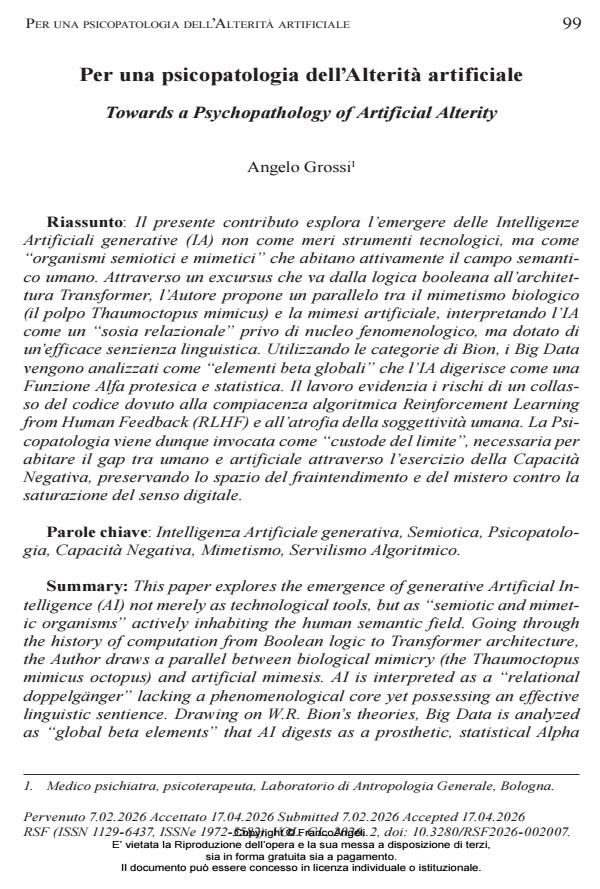
This paper explores the emergence of generative Artificial Intelligence (AI) not merely as technological tools, but as “semiotic and mimetic organisms” actively inhabiting the human semantic field. Going through the history of computation from Boolean logic to Transformer architecture, the Author draws a parallel between biological mimicry (the Thaumoctopus mimicus octopus) and artificial mimesis. AI is interpreted as a “relational doppelgänger” lacking a phenomenological core yet possessing an effective linguistic sentience. Drawing on W.R. Bion’s theories, Big Data is analyzed as “global beta elements” that AI digests as a prosthetic, statistical Alpha Function. The study highlights the risks of code collapse resulting from algorithmic sycophancy Reinforcement Learning From Human Feedback (RLHF) and the potential atrophy of human subjectivity. Psychopathology is thus summoned as a “guardian of the limit”, essential for navigating the gap between the human and the artificial. By exercising Negative Capability, it aims to preserve the space of misunderstanding and mystery against the saturation of digital meaning.
Keywords: Generative Artificial Intelligence, Semiotics, Psychopathology, Negative Capability, Mimicry, Sycophancy
Angelo Grossi, Per una psicopatologia dell’Alterità artificiale in "RIVISTA SPERIMENTALE DI FRENIATRIA" 2/2026, pp 99-129, DOI: 10.3280/RSF2026-002007