Safeguarding Differences: The Importance of Individual Perspective for Peacebuilding in the Age of Generative Artificial Intelligence
Journal title WELFARE E ERGONOMIA
Author/s Daniele Caligiore
Publishing Year 2026 Issue 2026/1 Suppl.
Language Italian Pages 9 P. 105-113 File size 49 KB
DOI 10.3280/WE2026-001-S1006
DOI is like a bar code for intellectual property: to have more infomation
click here
Below, you can see the article first page
If you want to buy this article in PDF format, you can do it, following the instructions to buy download credits
FrancoAngeli is member of Publishers International Linking Association, Inc (PILA), a not-for-profit association which run the CrossRef service enabling links to and from online scholarly content.
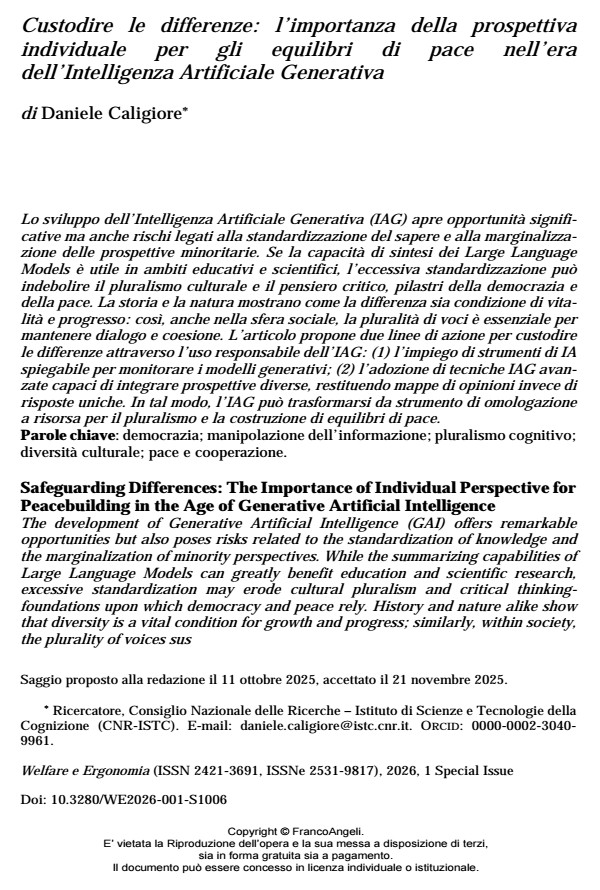
The development of Generative Artificial Intelligence (GAI) offers remarkable opportunities but also poses risks related to the standardization of knowledge and the marginalization of minority perspectives. While the summarizing capabilities of Large Language Models can greatly benefit education and scientific research, excessive standardization may erode cultural pluralism and critical thinking-foundations upon which democracy and peace rely. History and nature alike show that diversity is a vital condition for growth and progress; similarly, within society, the plurality of voices sus tains dialogue, inclusion, and social cohesion. This article proposes two key strategies for safeguarding diversity through the responsible use of GAI: (1) employing explainable AI tools to monitor and assess generative models, ensuring transparency; and (2) developing advanced generative systems capable of integrating multiple perspectives and producing multidimensional “maps of opinions” rather than single, homogenized answers. In this way, GAI can evolve from a mechanism of uniformity into a catalyst for pluralism and a driver of lasting peace and democratic balance.
Keywords: democracy; information manipulation; cognitive pluralism; cultural diversity; peace and cooperation.
Daniele Caligiore, Custodire le differenze: l’importanza della prospettiva individuale per gli equilibri di pace nell’era dell’Intelligenza Artificiale Generativa in "WELFARE E ERGONOMIA" 1 Suppl./2026, pp 105-113, DOI: 10.3280/WE2026-001-S1006