Public food procurement in Italy at the crossroads of school and territory: exploring a dialogue between the global economy and peripheral and rural realities
Journal title SOCIOLOGIA URBANA E RURALE
Author/s Eleonora Veneri
Online First 8/28/2026 Issue 2026/Online First
Language Italian Pages 21 P. 1-21 File size 155 KB
DOI 10.3280/SUR2026-22198
DOI is like a bar code for intellectual property: to have more infomation
click here
Below, you can see the article first page
If you want to buy this article in PDF format, you can do it, following the instructions to buy download credits
FrancoAngeli is member of Publishers International Linking Association, Inc (PILA), a not-for-profit association which run the CrossRef service enabling links to and from online scholarly content.
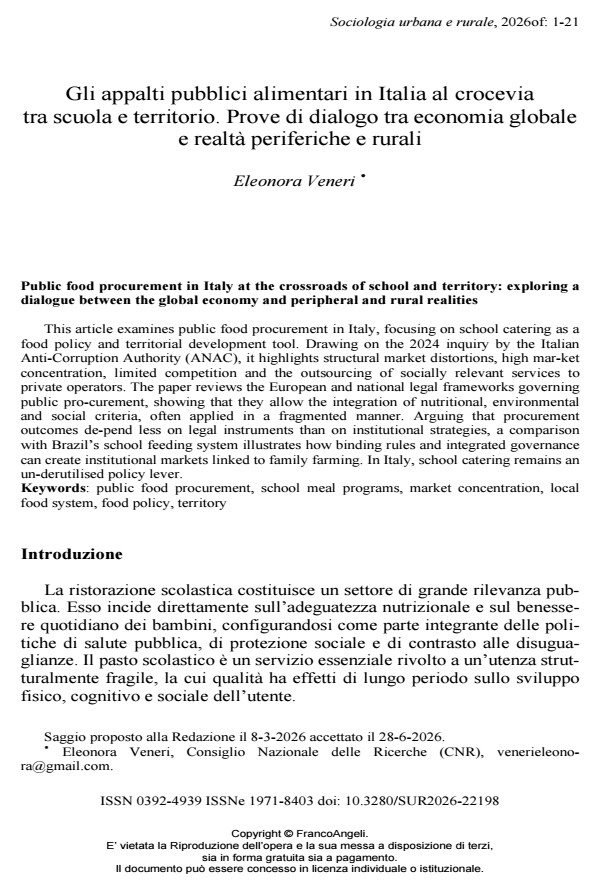
This article examines public food procurement in Italy, focusing on school catering as a food policy and territorial development tool. Drawing on the 2024 inquiry by the Italian Anti-Corruption Authority (ANAC), it highlights structural market distortions, high mar-ket concentration, limited competition and the outsourcing of socially relevant services to private operators. The paper reviews the European and national legal frameworks governing public pro-curement, showing that they allow the integration of nutritional, environmental and social criteria, often applied in a fragmented manner. Arguing that procurement outcomes de-pend less on legal instruments than on institutional strategies, a comparison with Brazil’s school feeding system illustrates how binding rules and integrated governance can create institutional markets linked to family farming. In Italy, school catering remains an un-derutilised policy lever.
Keywords: public food procurement, school meal programs, market concentration, local food system, food policy, territory
Eleonora Veneri, Gli appalti pubblici alimentari in Italia al crocevia tra scuola e territorio. Prove di dialogo tra economia globale e realtà periferiche e rurali in "SOCIOLOGIA URBANA E RURALE" Online First/2026, pp 1-21, DOI: 10.3280/SUR2026-22198