Labour, well-being and organizational communication
Journal title QUADERNI DI ECONOMIA DEL LAVORO
Author/s Azio Barani
Publishing Year 2026 Issue 2023/117
Language Italian Pages 36 P. 41-76 File size 265 KB
DOI 10.3280/QUA2023-117003
DOI is like a bar code for intellectual property: to have more infomation
click here
Below, you can see the article first page
If you want to buy this article in PDF format, you can do it, following the instructions to buy download credits
FrancoAngeli is member of Publishers International Linking Association, Inc (PILA), a not-for-profit association which run the CrossRef service enabling links to and from online scholarly content.
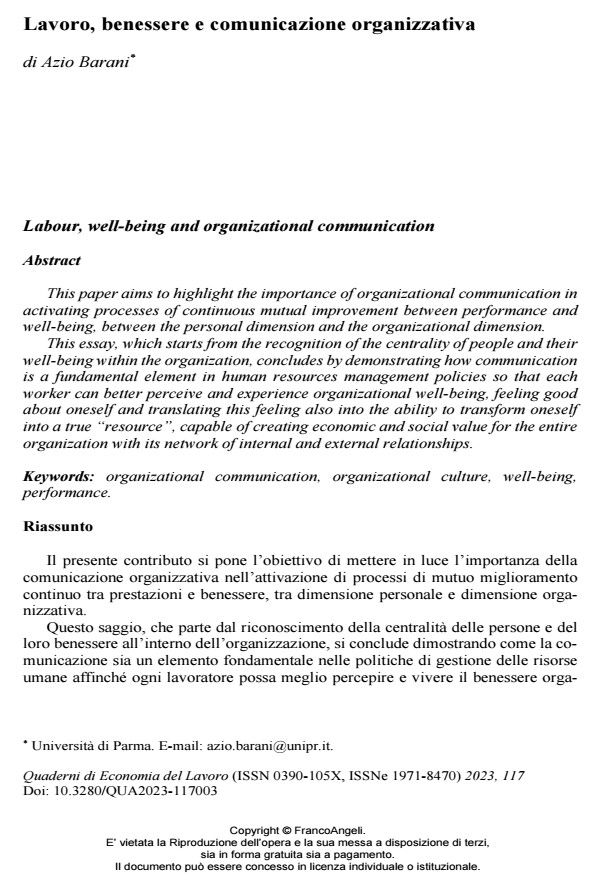
This paper aims to highlight the importance of organizational communication in activating processes of continuous mutual improvement between performance and well-being, between the personal dimension and the organizational dimension. This essay, which starts from the recognition of the centrality of people and their well-being within the organization, concludes by demonstrating how communication is a fundamental element in human resources management policies so that each worker can better perceive and experience organizational well-being, feeling good about oneself and translating this feeling also into the ability to transform oneself into a true “resource”, capable of creating economic and social value for the entire organization with its network of internal and external relationships.
Keywords: organizational communication, organizational culture, well-being, performance.
- Acemoglu D., Restrepo P. (2020). Robots and jobs: Evidence from US labor markets. Journal of Political Economy, 128(6): 2188-2244.
- Acemoglu D., Lelarge C. e Restrepo P. (2020, maggio). Competing with robots: Firm-level evidence from France. In AEA Papers and Proceedings, vol. 110, pp. 383-88.
- Autor D.H., Levy F., Murnane R.J. (2003). The skill content of recent technological change: An empirical exploration. The Quarterly journal of economics, 118(4): 1279-1333.
- Barbieri L., Mussida C., Piva M., Vivarelli M. (2019). Testing the employment impact of automation, robots and ai: a survey and some methodological issues. IZA Discussion Papers 12612. Institute of Labor Economics (IZA).
- Barone M., Fontana A. (2005). Prospettive per la Comunicazione Interna e il Benessere Organizzativo. Appartenere, integrarsi e comunicare nell’organizzazione che cambia. Milano: FrancoAngeli.
- Beer M. (2020). Fit to Compete: Why Honest Conversations About Your Company’s Capabilities Are the Key to a Winning Strategy. Boston: Harvard Business Review Press.
- Dauth W., Findeisen S., Suedekum J., Woessner N. (2018). Adjusting to robots: Worker-level evidence. Opportunity and Inclusive Growth Institute Working Papers 13. Federal Reserve Bank of Minneapolis.
- De Vincentis M. (2020). La comunicazione interna. Come creare valore nelle organizzazioni: strategia, strumenti e modelli gestionali. Pavia: CDG Edizioni.
- Degli Antoni G., a cura di (2021a). Fiducia e lavoro: una prospettiva multidisciplinare. Quaderni di Economia del Lavoro, 113. Milano: FrancoAngeli.
- Degli Antoni G. (2021b). Lavoro, fiducia e motivazioni intrinseche. In: Degli Antoni G., a cura di, Fiducia e lavoro: una prospettiva multidisciplinare. Quaderni di Economia del Lavoro, 113. Milano: FrancoAngeli.
- Depolo M. (1988). Entrare nelle organizzazioni. Psicologia della socializzazione organizzativa. Bologna: il Mulino.
- Dottori D. (2021). Robots and employment: evidence from Italy. Economia Politica, 1-57.
- Faber M. (2020). Robots and reshoring: Evidence from Mexican labor markets. Journal of International Economics, 127, 103384.
- Gentili A., Compagnucci F., Gallegati M., Valentini E. (2020). Are machines stealing our jobs? Cambridge Journal of Regions, Economy and Society, 13:153-173.
- Graetz G., Michaels G. (2018). Robots at work. Review of Economics and Statistics, 100(5): 753-768.
- Groysberg B., Slind M. (2012). Leadership Is a Conversation. Harvard Business Review, 90: 76-84, 144.
- Invernizzi E. (2000). La comunicazione organizzativa: teorie, modelli e metodi. Milano: Giuffrè.
- Klenert D., Fernandez-Macias E., Antón Pérez J.I. (2020). Do robots really destroy jobs? Evidence from Europe, n. 01. JRC Working Papers Series on Labour, Education and Technology.
- Kreitner R., Kinicki A. (2015). Comportamento organizzativo. Milano: Apogeo.
- Kuusisto M. (2017). Organizational effects of digitalization: A literature review. International journal of organization theory and behaviour, 20(3): 341-362.
- Lu Y., Pan T. (2019). The Effect of Employee Participation in Enterprise Social Media on Their Job Performance. IEEE Access, 7, 137528-137542.
- Martin J., Siehl C. (1983). Organizational culture and counterculture: An uneasy symbiosis. Organizational Dynamics, 12(2): 52-64.
- Matošková J. (2020). Communication tools as drivers of employees’ knowledge sharing: evidence from the Czech Republic. Problems and Perspectives in Management.
- Meda D. (2016). The future of work: the meaning and value of work in Europe. ILO Research Paper, n. 18.
- Nobel C. (2012). The Power of Conversational Leadership. Harvard Business School, 23 luglio.
- Palazzoli Selvini M. (1983). Sul fronte dell’organizzazione. Milano: Feltrinelli.
- Pastore A., Vernuccio M. (2008). Impresa e comunicazione, Principi e strumenti per il management. Milano: Apogeo.
- Poletti F. (2020). Tempo di IoP Intranet of People. Palermo: Dario Flaccovio Editore.
- Schein E. (1985). Organizational Culture and Leadership, University of Illinois at Urbana-Champaign’s Academy for Entrepreneurial Leadership Historical Research Reference in Entrepreneurship.
- Schwabe H., Castellacci F. (2020). Automation, workers’skills and job satisfaction. Plos one, 15(11), e0242929.
- Volterrani A. (2014). La comunicazione organizzativa come narrazione collettiva. Roma: Università di Roma Tor Vergata.
- Colletti G. (2019). La comunicazione in azienda diventa diffusa. Ecco gli strumenti a disposizione. Il Sole 24 ore, 30 luglio.
- Rick T. (2013). The importance of organizational alignment. -- Testo disponibile al sito: https://www.torbenrick.eu/blog/strategy/the-importance-of-organizational-alignment/.
- Santoni A. (2019). Cercare l’affinità con l’azienda in cui si lavora. -- Testo disponibile al sito: https://www.zerounoweb.it/cio-innovation/agostino-santoni-ad-cisco-italia-cercare-laffinita-con-lazienda-in-cui-si-lavora/, 3 luglio.
- Bellé N., Cantarelli P., Giacomelli G., Nuti S. (2019). Rapporto di indagine di clima organizzativo. Rapporto promosso dalla Regione Veneto e realizzata con il supporto tecnico-scientifico del Laboratorio Management e Sanità, Istituto di Management, della Scuola Superiore Sant’Anna di Pisa.
- Mazzei A. (2006). La comunicazione interna per l’impresa orientata al capitale intellettuale e al capitale sociale. Congresso Internazionale “Marketing Trends” Ecole Supérieure de Commerce de Paris ESCP-EAP, 26 gennaio.
- Nelli R. (2017). Gli approcci strategici alla comunicazione interna nelle grandi imprese operanti in Italia. Uno studio di ricerca promosso da ASCAI e realizzato dall’Università Cattolica di Milano, ottobre.
Azio Barani, Lavoro, benessere e comunicazione organizzativa in "QUADERNI DI ECONOMIA DEL LAVORO" 117/2023, pp 41-76, DOI: 10.3280/QUA2023-117003