Consumption choices and workers’ well-being
Journal title QUADERNI DI ECONOMIA DEL LAVORO
Author/s Giacomo Degli Antoni
Publishing Year 2026 Issue 2023/117
Language Italian Pages 14 P. 77-90 File size 83 KB
DOI 10.3280/QUA2023-117004
DOI is like a bar code for intellectual property: to have more infomation
click here
Below, you can see the article first page
If you want to buy this article in PDF format, you can do it, following the instructions to buy download credits
FrancoAngeli is member of Publishers International Linking Association, Inc (PILA), a not-for-profit association which run the CrossRef service enabling links to and from online scholarly content.
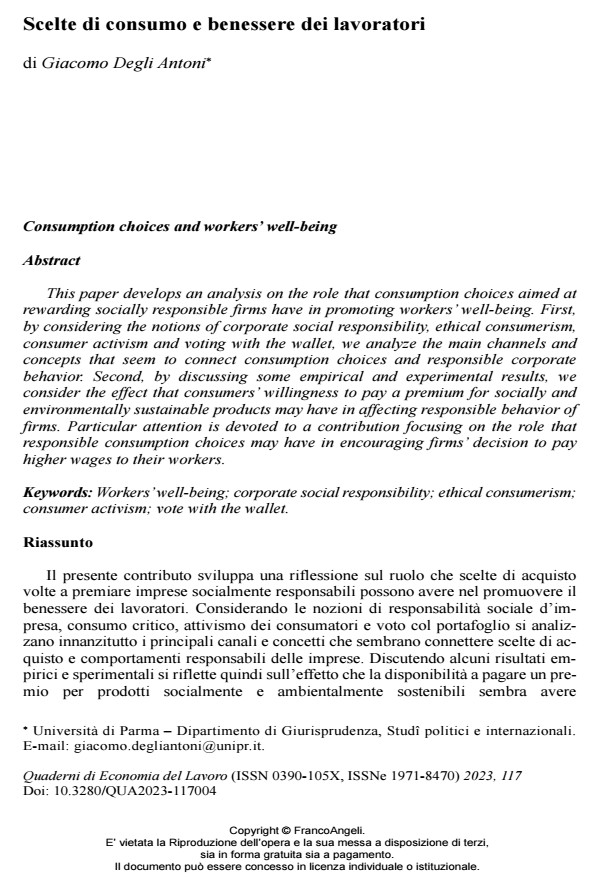
This paper develops an analysis on the role that consumption choices aimed at rewarding socially responsible firms have in promoting workers’ well-being. First, by considering the notions of corporate social responsibility, ethical consumerism, consumer activism and voting with the wallet, we analyze the main channels and concepts that seem to connect consumption choices and responsible corporate behavior. Second, by discussing some empirical and experimental results, we consider the effect that consumers’ willingness to pay a premium for socially and environmentally sustainable products may have in affecting responsible behavior of firms. Particular attention is devoted to a contribution focusing on the role that responsible consumption choices may have in encouraging firms’ decision to pay higher wages to their workers.
Keywords: Workers’ well-being; corporate social responsibility; ethical consumerism; consumer activism; vote with the wallet.
- Anderson L.R., Mellor J.M. e Milyo J. (2004). Social capital and contributions in a public-goods experiment. American Economic Review, 94(2): 373-376.
- Bartling B., Weber R.A. e Yao L. (2014). Do markets erode social responsibility? The Quarterly Journal of Economics, 130(1): 219-266.
- Berle A. e Means G. (1932). The modern corporation and private property. New York: Commerce Clearing House. (Trad. it.: Società per azione e proprietà privata. Torino: Einaudi, 1966).
- Baron D.P. (2007). Corporate social responsibility and social entrepreneurship. Journal of Economics & Management Strategy, 16(3): 683-717.
- Baron D.P. (2001). Private politics, corporate social responsibility, and integrated strategy. Journal of Economics & Management Strategy, 10: 7-45.
- Baron D.P. (2009). A positive theory of moral management, social pressure, and corporate social performance. Journal of Economics & Management Strategy, 18: 7-43.
- Baron D.P. e Diermeier D. (2007). Strategic activism and nonmarket strategy. Journal of Economics & Management Strategy, 16: 599-634.
- Becchetti L. (2012). Voting with the wallet. International Review of Economics, 59: 245-268.
- Becchetti L., Pelligra V. e Salustri F. (2018). The impact of redistribution mechanisms in the vote with the wallet game: experimental results. Social Choice and Welfare, 51: 595-619.
- Bertrand M. e Mullainathan S. (2001). Do people mean what they say? Implications for subjective survey data. American Economic Review, 91(2): 67-72.
- Claudy M.C., Peterson M. e O’Driscoll A. (2013). Understanding the attitude-behavior gap for renewable energy systems using behavioral reasoning theory. Journal of Macromarketing, 33(4): 273-287.
- Degli Antoni G. e Vagliasindi A.P. (2023). Qualità della vita lavorativa e benessere soggettivo. Quaderni di Economia del Lavoro, 117.
- Degli Antoni G. e Sacconi L. (2009). Responsabilità sociale d’impresa. In: Bruni L. e Zamagni S., a cura di, Dizionario di Economia Civile, pp. 660-676. Roma: Città Nuova Editrice.
- Degli Antoni G. e Sacconi L. (2013). Social responsibility, activism and boycotting in a firm-stakeholders network of games with players’ conformist preferences. The Journal of Socio-Economics, 45: 216-226.
- Degli Antoni G. e Faillo M. (2022). Ethical consumerism and wage levels: Evidence from an experimental market. Business Ethics, the Environment & Responsibility, 31(3): 875-887.
- Doane D. (2001). Taking flight: The rapid growth of ethical consumerism: The ethical purchasing index 2001. New Economics Foundation.
- Donaldson T. e Preston L. (1995). The Stakeholder Theory of the Corporation: Concepts, Evidence, and Implications. Academy of Management Review, 20, 1: 65-91.
- Freeman R.E. (1984). Strategic Management: A Stakeholder Approach. Boston: Pitman.
- Frey B.S. (1997). Not just for the money, vol. 748, p. 204. Cheltenham: Edward Elgar.
- Frey B.S. e Jegen R. (2001). Motivation crowding theory. Journal of economic surveys, 15(5): 589-611.
- Friedman M. (1962). Capitalism and freedom. Friedman. University of Chicago.
- Friedman M. (1970). A Friedman doctrine - The Social Responsibility of Business Is to Increase Its Profits. The New York Times Magazine, 13 settembre.
- Glaeser E.L., Laibson D.I., Scheinkman J.A. e Soutter C.L. (2000). Measuring trust. Quarterly Journal of Economics, 115(3): 811-846.
- Grossman S. e Hart O. (1986). The Costs and Benefit of Ownership: A Theory of Vertical and Lateral Integration. Journal of Political Economy, 94: 691-719.
- Jones E. (2017). Bridging the gap between ethical consumers and corporate social responsibility: An international comparison of consumer-oriented CSR rating systems. Corporate Citizenship, 65: 30-55.
- Kuhn K.U. e Uler N. (2019). Behavioral sources of the demand for carbon offsets: An experimental study. Experimental Economics, 22(3): 676-704.
- Rode J., Hogarth R.M. e Le Menestrel M. (2008). Ethical differentiation and market behavior: An experimental approach. Journal of Economic Behavior and Organization, 66(2): 265-280.
- Sacconi L. (2005). Guida critica alla responsabilità sociale e al governo di impresa. Roma: Bancaria editrice.
- Sacconi L. (2006). A social contract account for CSR as an extended model of corporate governance (I): Rational bargaining and justification. Journal of business ethics, 68: 259-281.
- Sacconi L. (2007). A social contract account for CSR as an extended model of corporate governance (II): Compliance, reputation and reciprocity. Journal of business ethics, 75: 77-96.
- Schäufele I. e Janssen M. (2021). How and why does the attitude-behavior gap differ between product categories of sustainable food? Analysis of organic food purchases based on household panel data. Frontiers in Psychology, 12: 1-13.
- Teraji S. (2009). A model of corporate social performance: social satisfaction and moral conduct. Journal of Socio-Economics, 38: 926-934.
- Vasileiou E. e Georgantzís N. (2015). An experiment on energy-saving competition with socially responsible consumers: Opening the black box. Journal of Behavioral and Experimental Economics, 58: 1-10.
- Williamson O. (1975). Market and Hierarchies. Los Angeles, CA: The Free Press.
Giacomo Degli Antoni, Scelte di consumo e benessere dei lavoratori in "QUADERNI DI ECONOMIA DEL LAVORO" 117/2023, pp 77-90, DOI: 10.3280/QUA2023-117004