Analytic training and training analysis
Journal title PSICOTERAPIA E SCIENZE UMANE
Author/s Michael Balint
Publishing Year 2026 Issue 2026/3
Language Italian Pages 12 P. 417-428 File size 272 KB
DOI 10.3280/PU2026-003005
DOI is like a bar code for intellectual property: to have more infomation
click here
Below, you can see the article first page
If you want to buy this article in PDF format, you can do it, following the instructions to buy download credits
FrancoAngeli is member of Publishers International Linking Association, Inc (PILA), a not-for-profit association which run the CrossRef service enabling links to and from online scholarly content.
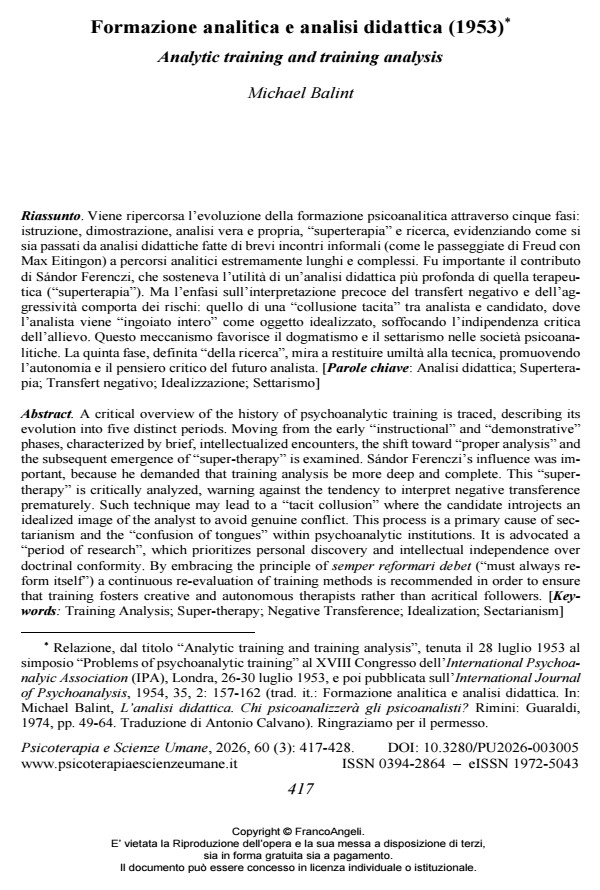
A critical overview of the history of psychoanalytic training is traced, describing its evolution into five distinct periods. Moving from the early “instructional” and “demonstrative” phases, characterized by brief, intellectualized encounters, the shift toward “proper analysis” and the subsequent emergence of “supertherapy” is examined. Sándor Ferenczi’s influence was important, because he demanded that training analysis be more deep and complete. This “supertherapy” is critically analyzed, warning against the tendency to interpret negative transference prematurely. Such technique may lead to a “tacit collusion” where the candidate introjects an idealized image of the analyst to avoid genuine conflict. This process is a primary cause of sectarianism and the “confusion of tongues” within psychoanalytic institutions. It is advocated a “period of research”, which prioritizes personal discovery and intellectual independence over doctrinal conformity. By embracing the principle of semper reformari debet (“must always reform itself”) a continuous reevaluation of training methods is recommended in order to ensure that training fosters creative and autonomous therapists rather than acritical followers.
Keywords: Training Analysis; Supertherapy; Negative Transference; Idealization; Sectarianism
- Balint M. (1947). On the psychoanalytic training system. International Journal of Psychoanalysis, 1948, 29, 2: 163173 (trad. it.: Il sistema didattico in psicoanalisi. In: L’analisi didattica. Chi psicoanalizzerà gli psicoanalisti? Rimini: Guaraldi, 1974, pp. 1747. Anche in: Psicoterapia e Scienze Umane, 2026, 60, 3: 373392. DOI: 10.3280/PU2026003003)
- Balint M. (1949). On the termination of analysis. International Journal of Psychoanalysis, 1950, 31, 4: 196199 (trad. it.: La conclusione dell’analisi. In: L’amore primario. Rimini: Guaraldi, 1973, pp. 279288; Milano: Raffaello Cortina, 1991, pp. 201207).
- Ferenczi S. (1928a). Das Problem der Beendigung der Analysen. Internationale Zeitschrift für Psychoanalyse, 14, 1: 110 (trad. inglese: The problem of the termination of the analysis. In: Balint M., editor, Final Contributions to the Problems and Methods of Psychoanalysis. London: Hogarth, 1955, pp. 7786; trad. it.: Il problema della conclusione delle analisi. In: Opere, Vol. III: 19191933. Milano: Raffaello Cortina, 1992, pp. 353361).
- Ferenczi S. (1928b). Die Elastizität der psychoanalytischen Technik. Internationale Zeitschrift für Psychoanalyse, 14, 2: 197209 (trad. inglese: The elasticity of psychoanalytic technique. In: Balint M., editor, Final Contributions to the Problems and Methods of Psychoanalysis. London: Hogarth, 1955, pp. 87101; trad. it.: L’elasticità della tecnica psicoanalitica. In: Opere, Vol. III: 19191933. Milano: Raffaello Cortina, 1992, pp. 363375).
- Freud S. & Ferenczi S. (190814). Lettere. Milano: Raffaello Cortina, 1993, Vol. I: 19081914. Freud S. (1920). Al di là del principio di piacere. Opere, 9: 189249. Torino: Boringhieri, 1977. Freud S. (1937). Analisi terminabile e interminabile. Opere, 11: 497535. Torino: Boringhieri, 1979.
Michael Balint, Formazione analitica e analisi didattica (1953) in "PSICOTERAPIA E SCIENZE UMANE" 3/2026, pp 417-428, DOI: 10.3280/PU2026-003005