Preventing and countering ICT-related harms and addictive behaviours among children and adolescents. An agenda for families, schools and institutions
Journal title PRISMA Economia - Società - Lavoro
Author/s Nicola Matteucci, Lisa Albertani, Lorella Albertani
Publishing Year 2026 Issue 2026/1
Language Italian Pages 25 P. 104-128 File size 196 KB
DOI 10.3280/PRI2026-001009
DOI is like a bar code for intellectual property: to have more infomation
click here
Below, you can see the article first page
If you want to buy this article in PDF format, you can do it, following the instructions to buy download credits
FrancoAngeli is member of Publishers International Linking Association, Inc (PILA), a not-for-profit association which run the CrossRef service enabling links to and from online scholarly content.
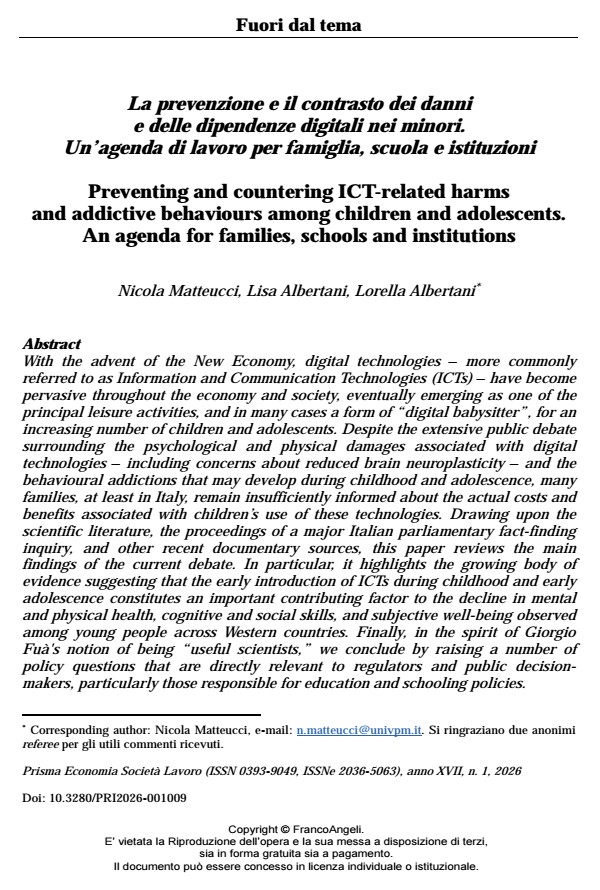
With the advent of the New Economy, digital technologies ‒ more commonly referred to as Information and Communication Technologies (ICTs) ‒ have become pervasive throughout the economy and society, eventually emerging as one of the principal leisure activities, and in many cases a form of “digital babysitter”, for an increasing number of children and adolescents. Despite the extensive public debate surrounding the psychological and physical damages associated with digital technologies ‒ including concerns about reduced brain neuroplasticity ‒ and the behavioural addictions that may develop during childhood and adolescence, many families, at least in Italy, remain insufficiently informed about the actual costs and benefits associated with children’s use of these technologies. Drawing upon the scientific literature, the proceedings of a major Italian parliamentary fact-finding inquiry, and other recent documentary sources, this paper reviews the main findings of the current debate. In particular, it highlights the growing body of evidence suggesting that the early introduction of ICTs during childhood and early adolescence constitutes an important contributing factor to the decline in mental and physical health, cognitive and social skills, and subjective well-being observed among young people across Western countries. Finally, in the spirit of Giorgio Fuà's notion of being “useful scientists,” we conclude by raising a number of policy questions that are directly relevant to regulators and public decision-makers, particularly those responsible for education and schooling policies.
Keywords: ICT, social media, psychophysical damage, behavioral addictions, school, regulation
- Albertani L., Matteucci N. (2024), “Minori digitali, tra sfide ed emergenze. Una proposta educativa (e regolatoria)”, Adolescenze, 2, -- disponibile su: https://www.fondazionevarenna.it/wp-content/uploads/2025/10/Fascicolo-Adolescenze-2-2024_rev_def2.pdf.
- Babor T., Casswell S., Graham K., Huckle T., Livingston M., Osterberg E., Rehm J., Room R., Rossow I., Sornpaisarn B. (2023), Alcohol: No Ordinary Commodity: Research and public policy. 3 edizione. Oxford University Press: Oxford.
- Barra F. (2026), Il no che vorrei dirti: Smartphone, chat e social. Guida pratica per genitori smarriti. Giunti: Firenze.
- Biella D., Pistono D. (2025), XVI Atlante dell’Infanzia (a rischio) in Italia 2025 – Senza Filtri -Voci di Adolescenze, 14 novembre 2025, -- disponibile su: https://s3-www.savethechildren.it/public/allegati/xvi-atlante-dellinfanzia-rischio-senza-filtri_0.pdf.
- Botting N., Del Rosario C., Flynn J., Reimers S., Davies C., Gonzalez-Gomez N., ... & Henry L. A. (2026), “Developmental outcomes in 4-year-old children born in the first COVID-19 lockdown in England: preliminary findings from the Born In COVID Year–Core Lockdown Effects (BICYCLE) study”. Archives of Disease in Childhood, 0, pp. 1-9.
- Bozdag E., Van Den Hoven J. (2015), “Breaking the filter bubble: democracy and design”. Ethics and information technology, 17(4), pp. 249-265.
- Bresnahan T. (2010). “General purpose technologies”, in: Handbook of the Economics of Innovation, 2, pp. 761-791.
- Bruni L., Stanca L. (2008), “Watching alone: relational goods, television and happiness”, Journal of Economic Behavior & Organization, 65(3-4), pp. 506-528
- Bruni L., Porta P.L. (Eds.) (2016), Handbook of research methods and applications in happiness and quality of life. Edward Elgar Publishing.
- Capellani G. (2018), Crescere nell’era digitale, Edilibri srl: Monotipia Cremonese (CR).
- Ciarchi A. (2025), “Crescere nel mondo reale: l’infanzia deve essere “analogica””, in: Quadernone di Via Clericetti, settembre, Rudolf Steiner Cooperativa Sociale ar.l. Onlus: Milano
- Daloisio V. (2023), “I filtri sui social e l’effetto “influencer” – Corsa dei minori dal chirurgo estetico”, Avvenire, 4 febbraio, -- disponibile su: https://www.sicpre.it/wp-content/uploads/2023/02/avvenire-chirurgia-e-social.pdf.
- Dang A. (2023), “Real-world evidence: a primer”. Pharmaceutical medicine, 37(1), pp. 25-36.
- De Biase L. (2003), Edeologia: critica del fondamentalismo digitale. Laterza: Bari.
- De Looze M., Van Dorsselaer S.A.F.M., Stevens G.W., Boniel-Nissim M., Vieno A., Van den Eijnden R. J. (2019), “The decline in adolescent substance use across Europe and North America in the early twenty-first century: A result of the digital revolution?”. International journal of public health, 64(2), pp. 229-240
- Elli C. (2025), “Cosa significa educare oggi?”, in: il Quadernone di Via Clericetti, settembre, Rudolf Steiner Cooperativa Sociale ar.l. Onlus: Milano.
- Faleni P. (2025), “Caldo…freddo: un dialogo per immagini”, in: il Quadernone di Via Clericetti, settembre, Rudolf Steiner Cooperativa Sociale ar.l. Onlus: Milano.
- Forsström S. et al. (2025), The impact of digital technologies on students’ learning: Results from a literature review, OECD Education Working Papers, No. 335, OECD Publishing, Paris,
- Gabanelli M., Tortora F. (2022), “Smartphone e social ai figli, i capi del web li vietano. I motivi”, 22 giugno, Corriere della Sera, -- disponibile su: www.corriere.it.
- Gui M., Gerosa, T. (2019), “Strumenti per apprendere o oggetti di apprendimento? Una rilettura critica della digitalizzazione nella scuola italiana”. Scuola democratica, 10(3), pp. 481-501.
- Gui B., Sugden R. (2005), “Why interpersonal relations matter for economics”, in: Gui, B., Sugden, R., (eds.), Economics and Social Interaction: Accounting for Interpersonal Relations, Cambridge University Press: Cambridge.
- Haidt J. (2024), La generazione ansiosa. Come i social hanno rovinato i nostri figli, Mondadori per Rizzoli: Milano, Bologna.
- Haidt J., Rausch, Z. (2026), “Social media is harming adolescents at a scale large enough to cause changes at the population level”, in: World Happiness Report 2026, capitolo 3, -- disponibile su: https://www.worldhappiness.report/ed/2026/social-media-is-harming-adolescents-at-a-scale-large-enough-to-cause-changes-at-the-population-level/.
- Huang P., Chan S.Y, Zhou K.X., Chuah J., Arellano Manahan A.M., Law E.C.N., Shorey S., Zhou H.J., Fortier M.V., Chang Y., Meaney M.J., Tan A.P. (2026), “Neurobehavioural links from infant screen time to anxiety”, The Lancet, 123, p. 9.
- Kahneman D. (2011), Thinking, Fast and Slow. Allen Lane and Penguin Books: New York.
- Kerr B., Garimella A., Pillarisetti L., Charlly N., Sullivan K., Moreno M.A. (2025), “Associations between social media use and anxiety among adolescents: A systematic review study”. Journal of Adolescent Health, 76(1), pp. 18-28.
- König K. (1957), I primi tre anni del bambino, (ed. 2022), Edizioni Educazione Waldorf: Zoppè di San Vendemiano (TV).
- Leonardi B. (2026), “Registro elettronico e ansia da notifiche”, Focus Scuola, -- disponibile su: https://www.focus-scuola.it/registro-elettronico-e-ansia-da-notifiche/.
- Longagnani S., Righi D. (2024), “La scuola cibernetica” in: Frezza E. (a cura di), Per una scuola che torni ad essere scuola. Il Cerchio: Rimini
- Maffei L. (2019), Resoconto della 7a Commissione Permanente del Senato della Repubblica, 2 ottobre 2019.
- Marino A. (2019), Resoconto della 7a Commissione Permanente del Senato della Repubblica, 24 ottobre 2019.
- Martzog P., Stoeger H., Suggate S. (2019), “Relations between Preschool Children’s Fine Motor Skills and General Cognitive Abilities”. Journal of Cognition and Development, 20(4), pp. 443-465.
- Matteucci N. (2022), “Il boom italiano del gioco d’azzardo: mercato, istituzioni e politiche”. Stato e mercato, 42(2), pp. 327-361
- Meta Internal Research (2020), Appearance-Based Social Comparison Study, dicembre, -- disponibile su: https://metasinternalresearch.org/.
- Min G., Yue J., Zhang Y., Yan J., Zhang D., Yu K., Li H. (2026), “Longitudinal association between problematic social media use and school refusal among adolescents: a random intercept cross-lagged panel model”. Frontiers in Psychology, 17, 1801922.
- Nicolosi, A. M. (2024), “Il modello di direzione scolastica in Italia”. Educación y Futuro: Revista de investigación aplicada y experiencias educativas, (50), pp. 67-89.
- Orazi F., Sofritti F., Lucantoni D. (2024), “Mental well-being of children and adolescents during COVID-19: Evidence from the Italian context and possible future developments”. Frontiers in Sociology, 9, 1387030.
- Patzlaff R. (2024), Lo sviluppo del linguaggio del bambino in epoca digitale – I tesori nascosti della parola parlata, Edizioni Arcobaleno: Milano.
- Presta V., Guarnieri A., Laurenti F., Mazzei F., Arcari M.L., Mirandola P., Vitale M., Yong Hua Chia M., Condello G., Gobbi G. (2024), “The Impact of Digital Devices on Children’s Health: A Sistematic Literature Review”, Journal of Functional Morphology and Kinesiology, 9(4), 236.
- Pugno M. (2023), È tempo di riconoscere i danni procurati ai giovani dai social media, 29 gennaio, -- disponibile su: https://eticaeconomia.it/e-tempo-di-riconoscere-i-danni-procurati-ai-giovani-dai-social-media/.
- Redazionale (2022), Bambino Gesù: 1 caso al giorno negli ultimi due anni tra tentativi e ideazioni di suicidio tra i giovanissimi [Comunicato stampa]. (2022, 9 settembre). Ospedale pediatrico Bambino Gesù, Roma. -- Disponibile su: https://img.ospedalebambinogesu.it/images/2022/09/09/122517536-5ac19b38-7c8e-49b1-8c46-2eb003efbd0b.pdf.
- Riva G. (2025), Io, noi, loro. Le relazioni nell’era dei social e dell’IA, il Mulino: Bologna.
- Rogers E. (2003), Diffusion of innovations. New York: The Free Press.
- Rotondi V., Stanca L., Miriam T. (2017), “Connecting alone: Smartphone use, quality of social interactions and well-being”. Journal of Economic Psychology, 63, pp. 17-26.
- Satapathy P., Khatib M.N., Balaraman A.K., Kaur M., Srivastava M., Barwal A., ... & Samal, S.K. (2025), “Burden of gaming disorder among adolescents: A systemic review and meta-analysis”. Public health in practice, 9, 100565.
- Shiller, R.J. (2015), Irrational exuberance. 3 Ed. Princeton University Press: Princeton.
- Spitzer M. (2012), Demenza digitale. Come la nuova tecnologia ci rende stupidi (ed. 2024), Corbaccio: Milano.
- Spitzer M. (2019), Resoconto della 7a Commissione Permanente del Senato della Repubblica, 11 giugno 2019.
- Steiner R. (1907), Educazione del bambino e preparazione degli educatori, (ed. 2022), Editrice Antroposofica Milano: Milano.
- Società Italiana di Pediatria – Commissione Dipendenze Digitali (2025), Il bambino digitale – Schede tecniche SIP.
- Venturelli A. (2019), Resoconto della 7a Commissione Permanente del Senato della Repubblica, 27 novembre 2019.
- Wolf K., Schmitz J. (2024), “Scoping review: longitudinal effects of the COVID-19 pandemic on child and adolescent mental health”, European child & adolescent psychiatry, 33(5), pp. 1257-1312.
- World Health Organization (2015), Public health implications of excessive use of the internet, computers, smartphones and similar electronic devices: Meeting report, Main Meeting Hall, Foundation for Promotion of Cancer Research, National Cancer Research Centre, Tokyo, Japan, 27-29 August 2014. World Health Organization.
- Zong Z., Zhang Y., Qiao J. et al. (2024), “The association between screen time exposure and myopia in children and adolescents: a meta-analysis”, BMC Public Health, 24, 1625
- Zuboff S. (2019), Il capitalismo della sorveglianza. Il futuro dell’umanità nell’era dei nuovi poteri (ed. 2025), Luiss University Press: Roma.
Nicola Matteucci, Lisa Albertani, Lorella Albertani, La prevenzione e il contrasto dei danni e delle dipendenze digitali nei minori. Un’agenda di lavoro per famiglia, scuola e istituzioni in "PRISMA Economia - Società - Lavoro" 1/2026, pp 104-128, DOI: 10.3280/PRI2026-001009