The relational request in obsessive–phobic behavior: the symptom as an opportunity for exploration and care
Journal title TERAPIA FAMILIARE
Author/s Chiara Molini
Publishing Year 2026 Issue 2026/141
Language Italian Pages 20 P. 55-74 File size 141 KB
DOI 10.3280/TF2026-141004
DOI is like a bar code for intellectual property: to have more infomation
click here
Below, you can see the article first page
If you want to buy this article in PDF format, you can do it, following the instructions to buy download credits
FrancoAngeli is member of Publishers International Linking Association, Inc (PILA), a not-for-profit association which run the CrossRef service enabling links to and from online scholarly content.
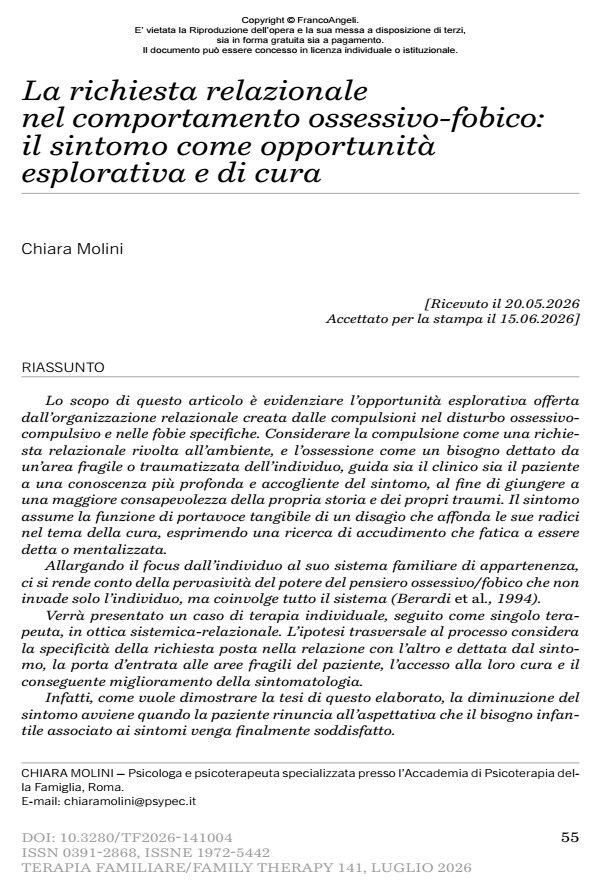
The aim of this article is to highlight the exploratory opportunity offered by the relational organization created by compulsions in obsessivecompulsive disorder and specific phobias. Considering compulsion as a relational request that the individual directs toward their environment, and obsession as a need arising from a fragile or traumatized area of the individual, guides both the clinician and the patient toward a deeper and more compassionate understanding of the symptom, in order to achieve greater awareness of one’s personal history and traumas. The symptom takes on the function of a tangible spokesperson for a form of distress rooted in the theme of care, expressing a search for nurturance that cannot be verbalized or mentalized. By broadening the focus from the individual to the family system, one becomes aware of the invasiveness and pervasiveness of the power of obsessive/phobic thinking, which invades not only the individual but involves the entire system (Berardi et al., 1994). A case of individual therapy, conducted by a single therapist within a systemicrelational framework, will be presented. The hypothesis underlying the therapeutic process considers the specific nature of the request emerging within the relationship with the other, and shaped by the symptom, as the gateway to the patient’s vulnerable areas, enabling access to their care and the consequent improvement of the symptomatology. Indeed, as this paper aims to demonstrate, the symptom decreases when the patient relinquishes the expectation that the infantile need associated with the symptoms will finally be satisfied.
Keywords: obsessive–phobic symptoms, insecure attachment, nurturance, relational request, relational organization of symptoms, primary affective needs
Chiara Molini, La richiesta relazionale nel comportamento ossessivo-fobico: il sintomo come opportunità esplorativa e di cura in "TERAPIA FAMILIARE" 141/2026, pp 55-74, DOI: 10.3280/TF2026-141004