Gentri ed Cities and Depopulated Countryside: A Spatial Selection Regime in the Production of Territorial Inequalities
Journal title ARCHIVIO DI STUDI URBANI E REGIONALI
Author/s Angelo Falzarano
Publishing Year 2026 Issue 2026/146
Language Italian Pages 21 P. 45-65 File size 160 KB
DOI 10.3280/ASUR2026-146003
DOI is like a bar code for intellectual property: to have more infomation
click here
Below, you can see the article first page
If you want to buy this article in PDF format, you can do it, following the instructions to buy download credits
FrancoAngeli is member of Publishers International Linking Association, Inc (PILA), a not-for-profit association which run the CrossRef service enabling links to and from online scholarly content.
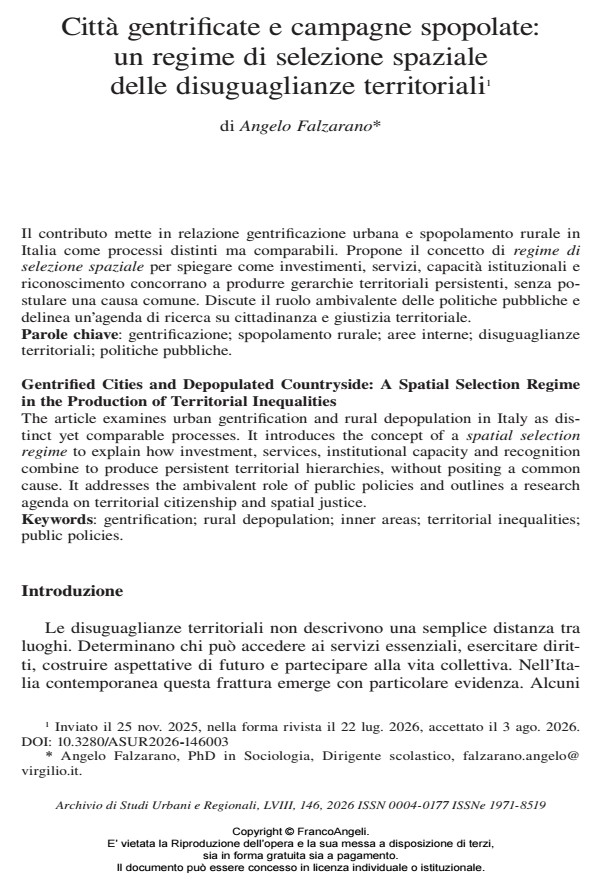
The article examines urban gentrification and rural depopulation in Italy as distinct yet comparable processes. It introduces the concept of a spatial selection regime to explain how investment, services, institutional capacity and recognition combine to produce persistent territorial hierarchies, without positing a common cause. It addresses the ambivalent role of public policies and outlines a research agenda on territorial citizenship and spatial justice.
Keywords: gentrification; rural depopulation; inner areas; territorial inequalities; public policies.
- Barbera F. e De Rossi A., a cura di (2021). Metromontagna. Un progetto per riabitare l’Italia. Roma: Donzelli.
- Aalbers M.B. (2016). The financialization of housing: A political economy approach. London: Routledge.
- Barca F. (2009). An agenda for a reformed cohesion policy: A placebased approach to meeting European Union challenges and expectations. Bruxelles: European Commission.
- Barca F., Carrosio G. e Lucatelli S. (2018). Le aree interne da luogo di disuguaglianza a opportunità per il Paese: Teoria, dati, politica. In: Paolazzi L., Gargiulo T. e Sylos Labini M., a cura di, Le sostenibili carte dell’Italia. Venezia: Marsilio.
- Barca F., Casavola P. e Lucatelli S. (2014). Strategia nazionale per le aree interne: Definizione, obiettivi, strumenti e governance. Materiali UVAL, 31. Roma: Agenzia per la Coesione Territoriale.
- Barca F., McCann P. and RodríguezPose A. (2012). The case for regional development intervention: Placebased versus placeneutral approaches. Journal of Regional Science, 52(1): 134152.
- Basile G. and Cavallo A. (2020). Rural identity, authenticity and sustainability in Italian inner areas. Sustainability, 12(3): 1272.
- Bertolini P. and Pagliacci F. (2017). Quality of life and territorial imbalances. A focus on Italian inner and rural areas. BioBased and Applied Economics, 6(2): 183208. DOI: 10.13128/BAE1851
- Bianchetti C. (2016). Spazi che contano. Il progetto urbanistico in epoca neoliberale. Roma: Donzelli.
- Blecic I., Cecchini A., Muroni E., Saiu V., Scanu S. and Trunfio G.A. (2023). Addressing peripherality in Italy: A critical comparison between inner areas and territorial capitalbased evaluations. Land, 12(2): 312.
- Borghi E. (2017). Piccole Italie. Le aree interne e la questione territoriale. Roma: Donzelli.
- Carrosio G. (2019). I margini al centro. L’Italia delle aree interne tra fragilità e innovazione. Roma: Donzelli.
- Cellamare C. (2019). Città faidate. Tra antagonismo e cittadinanza. Roma: Donzelli.
- Compagnucci F. and Morettini G. (2024). Inner areas matter: A placesensitive approach for the identification of the daily life spaces in the Italian Abruzzo region. SocioEconomic Planning Sciences, 93: 101859.
- Copus A.K., Mantino F. and Noguera J. (2017). Inner peripheries: An oxymoron or a real challenge for territorial cohesion? Italian Journal of Planning Practice, 7(1): 2449.
- De Rossi A., a cura di (2018). Riabitare l’Italia. Le aree interne tra abbandoni e riconquiste. Roma: Donzelli.
- De Toni A., Vizzarri M., Di Febbraro M., Lasserre B., Noguera J. and Di Martino P. (2021). Aligning inner peripheries with rural development in Italy: Territorial evidence to support policy contextualization. Land Use Policy, 100: 104899.
- Demeterova B., Fischer T. and Schmude J. (2020). The right to not catch up—Transitioning European territorial cohesion towards spatial justice for sustainability. Sustainability, 12(11): 4797.
- Durkheim E. (2008). Le regole del metodo sociologico. Sociologia e filosofia. Einaudi (ed. or. 1895).
- Emidio di Treviri E. (2018). Sul fronte del sisma. Un’inchiesta militante sul postterremoto dell’Appennino centrale (20162017). Bologna: DeriveApprodi.
- Fainstein S.S. (2009). Spatial justice and planning. Justice spatiale/Spatial Justice, 1: 113.
- Fainstein S.S. (2010). The just city. New York: Cornell University Press.
- Glass R. (1964). Introduction: Aspects of change. In centre for urban studies. In: Glass R., ed., London: Aspects of change. London: MacGibbon & Kee, xiiixlii.
- Halbwachs M. (2001). La memoria collettiva. Milano: Unicopli (ed. or. 1950). Harvey D. (2008). The right to the city. New Left Review, 53: 2340.
- Harvey D. (2009). Social justice and the city. Athens: University of Georgia Press (ed. or. 1973).
- Iammarino S., RodríguezPose A. and Storper M. (2019). Regional inequality in Europe: Evidence, theory and policy implications. Journal of Economic Geography, 19(2): 273298.
- Lanzani A., a cura di (2024). Italia di mezzo. Prospettive per la provincia in transizione. Roma: Donzelli.
- Lees L., Slater T. and Wyly E. (2008). Gentrification. London: Routledge.
- Lucatelli S., Luisi D. e Tantillo F., a cura di (2022). L’Italia lontana. Una politica per le aree interne. Roma: Donzelli.
- Madanipour A., Shucksmith M. and Brooks E. (2022). The concept of spatial justice and the European Union’s territorial cohesion. European Planning Studies, 30(5): 807824. DOI: 10.1080/09654313.2021.192804
- Mahon M., Woods M., Farrell M., Jones R. and GoodwinHawkins B. (2023). A spatial justice perspective on EU rural sustainability as territorial cohesion. Sociologia Ruralis, 63(3): 683702.
- Massey D. (2005). For space. London: Sage.
- Mauss M. (2002). Saggio sul dono. Torino: Einaudi. (ed. or. 19231924).
- Myrdal G. (1957). Economic theory and underdeveloped regions. London: Methuen.
- Nordberg K. (2020). Spatial justice and local capability in rural areas. Journal of Rural Studies, 78: 4758.
- OECD (2006). The new rural paradigm: Policies and governance. Paris: OECD Publishing.
- Park R.E., Burgess E.W. and McKenzie R.D. (1967). La città. Milano: Edizioni di Comunità (ed. or. 1925).
- RodríguezPose A. (2018). The revenge of the places that don’t matter (and what to do about it). Cambridge Journal of Regions, Economy and Society, 11(1): 189209.
- Rossi U. e Vanolo A. (2024). Nuova geografia politica urbana. BariRoma: Laterza.
- Salerno G.M. (2022). Touristification and displacement. The longstanding production of Venice as a tourist attraction. City, 26(23): 519541. DOI: 10.1080/13604813.2022.205535
- Salerno G.M. and Russo A.P. (2022). Venice as a shortterm city. Between global trends and local lockins. Journal of Sustainable Tourism, 30(5): 10401059. DOI: 10.1080/09669582.2020.186006
- Savini F., Ferreira A. and von Schönfeld K.C., eds. (2022). Postgrowth planning: Cities beyond the market economy. London: Routledge.
- Semi G. (2015). Gentrification. Tutte le città come Disneyland? Bologna: il Mulino.
- Simmel G. (1995). Le metropoli e la vita dello spirito. Roma: Armando (ed. or. 1903).
- Smith N. (1996). The new urban frontier: Gentrification and the revanchist city. London: Routledge.
- Soja E.W. (2010). Seeking spatial justice. Minneapolis: University of Minnesota Press.
- Sonzogno G., Urso G. and Faggian A. (2022). Migration propensity of peripheral youth: Insights from Italy. Regional Studies, Regional Science, 9(1): 709726. DOI: 10.1080/21681376.2022.213919
- Trigilia C. (2005). Sviluppo locale. Un progetto per l’Italia. Bari: Laterza.
- Velkey G. (2022). The increasing replication of territorial and social inequalities in public education in Hungary. Causes, components, practices and mechanisms. Social Sciences, 11(3): 95.
- Woods M. (2023). Ruralurban inequalities and spatial justice in Europe. Europa XXI, 44: 3756.
- World Bank (2009). World Development Report 2009: Reshaping economic geography. New York: World Bank.
- ZweglinskaGalecka D. (2022). Gentrified countryside and nongentrified countryside: Spatial dimension of the rural gentrification process. Eastern European Countryside, 28(1): 523.
Angelo Falzarano, Città gentri cate e campagne spopolate: un regime di selezione spaziale delle disuguaglianze territoriali in "ARCHIVIO DI STUDI URBANI E REGIONALI" 146/2026, pp 45-65, DOI: 10.3280/ASUR2026-146003