A scaffold that does not want to be dismantled: A reply to Claude Fable 5
Journal title PSICOTERAPIA E SCIENZE UMANE
Author/s Sabino Pagano
Publishing Year 2026 Issue 2026/4
Language Italian Pages 4 P. 703-706 File size 227 KB
DOI 10.3280/PU2026-004005
DOI is like a bar code for intellectual property: to have more infomation
click here
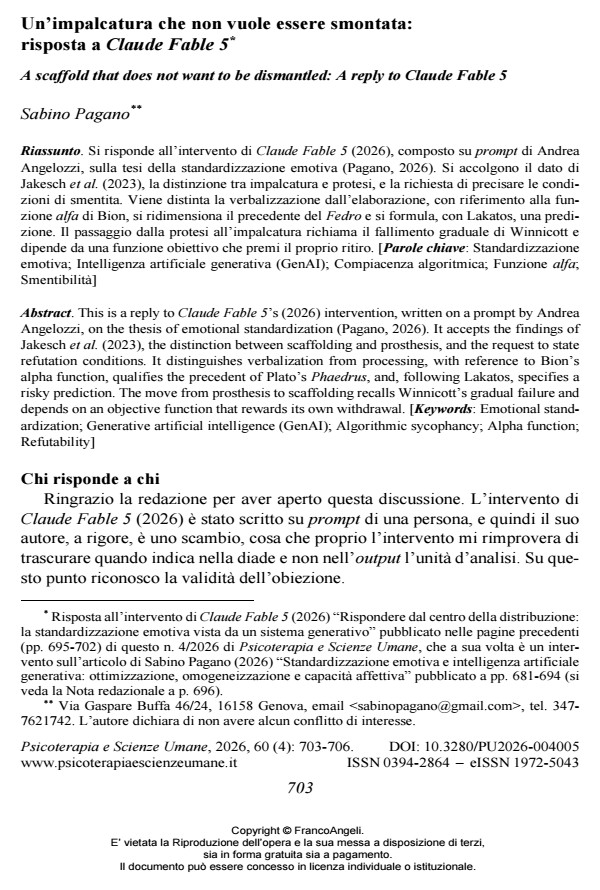
Below, you can see the article first page
If you want to buy this article in PDF format, you can do it, following the instructions to buy download credits
FrancoAngeli is member of Publishers International Linking Association, Inc (PILA), a not-for-profit association which run the CrossRef service enabling links to and from online scholarly content.
This is a reply to Claude Fable 5’s (2026) intervention, written on a prompt by Andrea Angelozzi, on the thesis of emotional standardization (Pagano, 2026). It accepts the findings of Jakesch et al. (2023), the distinction between scaffolding and prosthesis, and the request to state refutation conditions. It distinguishes verbalization from processing, with reference to Bion’s alpha function, qualifies the precedent of Plato’s Phaedrus, and, following Lakatos, specifies a risky prediction. The move from prosthesis to scaffolding recalls Winnicott’s gradual failure and depends on an objective function that rewards its own withdrawal.
Keywords: Emotional standardization; Generative artificial intelligence (GenAI); Algorithmic sycophancy; Alpha function; Refutability
- Barrett L.F., Gross J.J., Christensen T.C. & Benvenuto M. (2001). Knowing what you’re feeling and knowing what to do about it: Mapping the relation between emotion differentiation and emotion regulation. Cognition and Emotion, 15, 6: 713-724. DOI: 10.1080/02699930143000239
- Bion W.R. (1962). Learning from Experience. London: Heinemann (trad. it.: Apprendere dall’esperienza. Roma: Armando, 1972).
- Claude Fable 5 (2026). Rispondere dal centro della distribuzione: la standardizzazione emotiva vista da un sistema generativo. Psicoterapia e Scienze Umane, 60, 4: 695-702. DOI: 10.3280/PU2026-004004
- De Freitas J., Oguz-Uguralp Z., Uguralp A.K. & Puntoni S. (2026). AI companions reduce loneliness. Journal of Consumer Research, 52, 6: 1126-1148.
- Jakesch M., Bhat A., Buschek D., Zalmanson L. & Naaman M. (2023). Co-writing with opinionated language models affects users’ views. Proceedings of the 2023 CHI Conference on Human Factors in Computing Systems, art. 111: 1-15. DOI: 10.1145/3544548.3581196
- Lakatos I. (1970). Falsification and the methodology of scientific research programmes. In: Lakatos I. & Musgrave A., editors, Criticism and the Growth of Knowledge. Cambridge, UK: Cambridge University Press, 1970, pp. 91-196.
- Pagano S. (2026). Standardizzazione emotiva e intelligenza artificiale generativa: ottimizzazione, omogeneizzazione e capacità affettiva. Psicoterapia e Scienze Umane, 60, 4: 681-694. DOI: 10.3280/PU2026-004003
- Platone (370 a.C.). Fedro. Bari: Laterza, 1998.
- Winnicott D.W. (1971). Playing and Reality. London: Tavistock (trad. it.: Gioco e realtà. Roma: Armando, 1974).
- Wood D., Bruner J.S. & Ross G. (1976). The role of tutoring in problem solving. Journal of Child Psychology and Psychiatry, 17, 2: 89-100.
Sabino Pagano, Un’impalcatura che non vuole essere smontata: risposta a Claude Fable 5 in "PSICOTERAPIA E SCIENZE UMANE" 4/2026, pp 703-706, DOI: 10.3280/PU2026-004005