Towards a Sociological Analysis of the Statistical Concept of Early Leaving from Education and Training
Journal title SOCIOLOGIA E RICERCA SOCIALE
Author/s Lorenzo Maraviglia
Publishing Year 2026 Issue 2026/139
Language Italian Pages 24 P. 25-48 File size 280 KB
DOI 10.3280/SR2026-139002
DOI is like a bar code for intellectual property: to have more infomation
click here
Below, you can see the article first page
If you want to buy this article in PDF format, you can do it, following the instructions to buy download credits
FrancoAngeli is member of Publishers International Linking Association, Inc (PILA), a not-for-profit association which run the CrossRef service enabling links to and from online scholarly content.
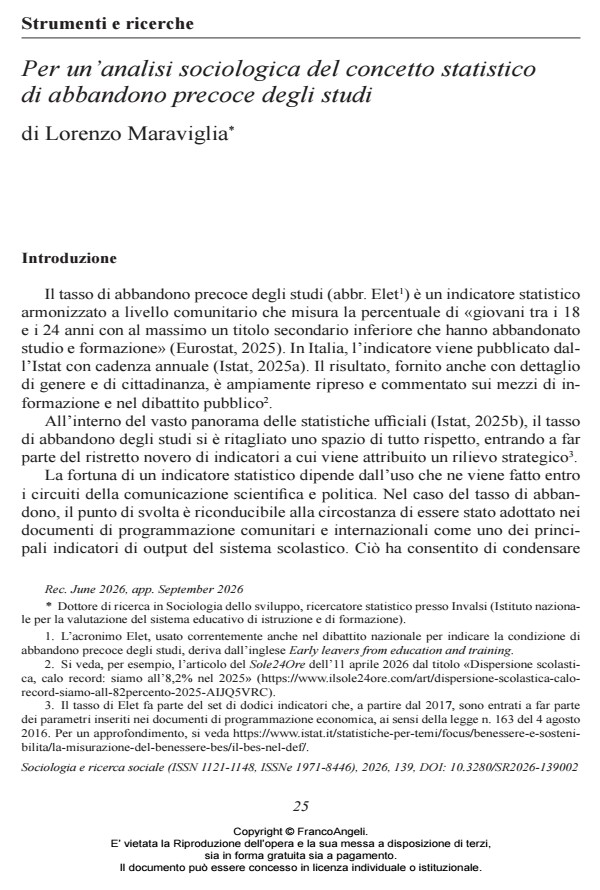
This article provides an analysis of the early leaving from education and training (ELET) rate, understood not merely as a descriptive statistical indicator but as a cognitive and institutional device that contributes to shaping the ways in which early school leaving is classified and governed. Starting from a reflection on the role of statistical indicators in the construction of public problems, the article highlights three sets of tensions concerning, respectively, the temporal mismatch between the occurrence and the measurement of early leaving; the composite nature of the mechanisms through which individuals cease to be classified as ELET; and the instability of certain segments of the observed population.
- Autorità garante per l’infanzia (2022), La dispersione scolastica in Italia: un’analisi multifattoriale, https://www.garanteinfanzia.org/wpcontent/uploads/2025/06/dispersionescolastica2022.pdf.
- G. Ballarino, I. Bison, H. Schadee (2011), «Abbandoni scolastici e stratificazione sociale nell’Italia contemporanea», Stato e mercato, 93, 3, pp. 479518, DOI: 10.1425/35981
- R. Biagioli, M. Baldini, M.G. Proli (2022), «School dropout as an endemic phenomenon: Research on the state of art in Italy and Europe», European Journal of Research on Education and Teaching, 20, 3, https://doi.org/10.7346/feiXX0322_08.
- F. Biondi Dal Monte, S. Frega (a c. di) (2024), Contrastare la dispersione scolastica. Analisi multidisciplinare di un fenomeno complesso, Bologna, il Mulino,
- A. Cacchione (a c. di) (2024), Viaggio nell’istruzione degli adulti in Italia. Caratteri, risultati e prospettive della ricerca, Firenze, Indire, vol. 3.
- G. Cascino (2023), «School dropout/early leaving from education and training: diachronic and comparative analysis of conceptualisation and operational definition in Europe and Italy», Sociology and Social Work Review, 7, 1, pp. 7897, DOI: 10.58179/SSWR7105
- M. Colombo (2010), Dispersione scolastica e politiche per il successo formativo. Dalla ricerca sugli early school leaver alle proposte di innovazione, Trento, Erickson.
- M. Colombo (2015), «Abbandono scolastico in Italia. Un problema serio, molti circoli viziosi e qualche strategia di prevenzione», Scuola democratica, 2, pp. 41124.
- Council of the European Union (2021), Council Resolution on a strategic framework for European cooperation in education and training towards the European Education Area and beyond (20212030) 2021/C 66/01) (conosciuto come EEA 2030).
- A. Desrosières (1998), The Politics of Large Numbers: A History of Statistical Reasoning, Cambridge, Harvard University Press.
- W. Espeland, M. Stevens (1998), «Commensuration as a social process», Annual Review of Sociology, 24, pp. 31343.
- European Commission/Eacea/Eurydice (2023), Structural Indicators for Monitoring Education and Training Systems in Europe – 2023, Eurydice Report, Luxembourg, Publications Office of the European Union.
- Eurostat (2025), Statistics Explained: Early leavers from education and training, https:// ec.europa.eu/eurostat/statisticsexplained/index.php?title=Early_leavers_from_education_ and_training (articolo soggetto ad aggiornamento periodico).
- M. Foucault (1972), L’ordine del discorso, Torino, Einaudi.
- O. Giancola, L. Salmieri (2023), La povertà educativa in Italia. Dati, analisi, politiche, Roma, Carocci.
- O. Giancola, L. Salmieri (a c. di) (2024), Disuguaglianze educative e scelte scolastiche. Teorie, processi e contesti, Milano, FrancoAngeli.
- I. Hacking (1990), The Taming of Chance, Cambridge, Cambridge University Press.
- J. Heckman (2006), «Skill Formation and the Economics of Investing in DisadvantagedChildren», Science, 312, 5782, pp. 19002.
- Inapp (2026), XXIII Rapporto di monitoraggio del sistema di Istruzione e formazione professionale e dei percorsi in duale nella IeFP a.f. 20232024, https://www.inapp.gov.it/eventi/ presentazionedelxxiiirapportodimonitoraggiodelsistemadiistruzioneeformazioneprofessionale.
- Invalsi (2025), Rapporto prove Invalsi 2025, https://www.invalsi.it/wpcontent/uploads/2025/ 10/RapportoproveINVALSI2025.pdf.
- Istat (2006), «La rilevazione sulle forze di lavoro: contenuti, metodologie, organizzazione», Metodi e norme, 32.
- Istat (2011), La produzione di stime mensili dei principali indicatori sul mercato del lavoro, nota metodologica, https://www.istat.it/wpcontent/uploads/2011/01/notametodologica.pdf.
- Istat (2025a), Statistiche report – Livelli di istruzione e ritorni occupazionali. Anno 2024, https:// www.istat.it/comunicatostampa/livellidiistruzioneeritornioccupazionalianno2024/.
- Istat (2025b), Annuario statistico italiano 2025, https://www.istat.it/produzioneeditoriale/ annuariostatisticoitaliano2025/.
- N. Luhmann (1990), Sistemi sociali. Fondamenti di una teoria generale, Bologna, il Mulino.
- Ministero dell’Istruzione e del merito (Mim) – Dgsis – Ufficio di Statistica (2022), Analisi longitudinale sulla dispersione scolastica, aa.ss. 2012/20132021/2022, https://www.mim. gov.it/pubblicazioni//asset_publisher/6Ya1FS4E4QJw/content/analisilongitudinalesulladispersionescolasticaaass2012201320212022.
- Oecd (2025), Education at a Glance 2025 – Oecd Indicators, Paris, Oecd Publishing.
- J. Rohrer (2025), «Thinking ClearlyAboutAge, Period, and Cohort Effects», Advancesin Methods and Practices in Psychological Science, 8, 2, https://doi.org/10.1177/25152459251342750.
- R. Rumberger (2011), Dropping Out: Why Students Drop Out of High School and What Can Be Done About It, Cambridge, Harvard University Press.
- Unesco Institute for Statistics (2012), International Standard Classification of Education: Isced 2011, Montreal, UisUnesco.
- Zolo D. (1986), «Autopoiesi: un paradigma conservatore», Micromega, 1, pp. 12973.
Lorenzo Maraviglia, Per un’analisi sociologica del concetto statistico di abbandono precoce degli studi in "SOCIOLOGIA E RICERCA SOCIALE " 139/2026, pp 25-48, DOI: 10.3280/SR2026-139002