Bullismo e fattori di rischio. Una riflessione sul trattamento cognitivo-evoluzionista

Titolo Rivista PSICOBIETTIVO
Autori/Curatori Eleonora Pietropaoli, Emanuela Cioccolanti, Alessandra Salvini
Anno di pubblicazione 2015 Fascicolo 2015/1
Lingua Italiano Numero pagine 18 P. 17-34 Dimensione file 123 KB
DOI 10.3280/PSOB2015-001002
Il DOI è il codice a barre della proprietà intellettuale: per saperne di più clicca qui

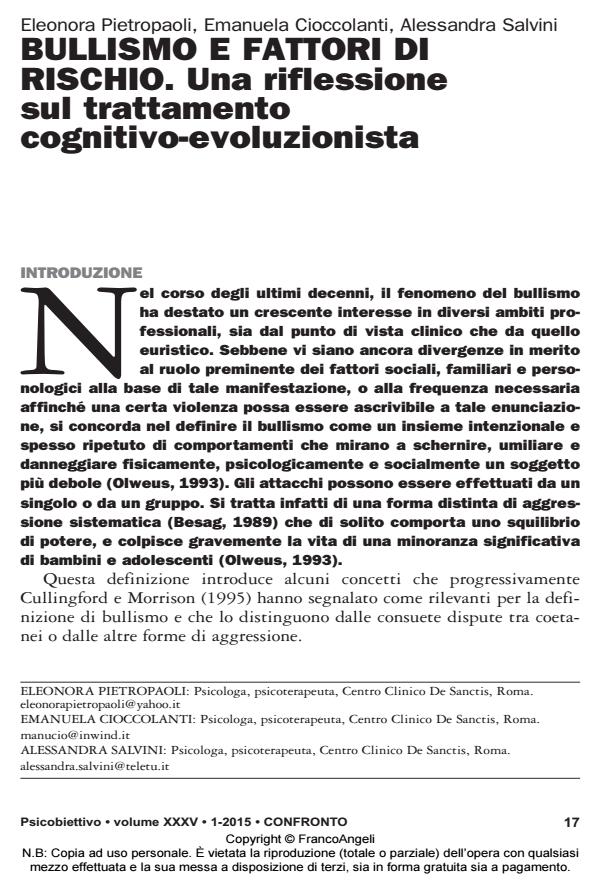
Qui sotto puoi vedere in anteprima la prima pagina di questo articolo.

Se questo articolo ti interessa, lo puoi acquistare (e scaricare in formato pdf) seguendo le facili indicazioni per acquistare il download credit. Acquista Download Credits per scaricare questo Articolo in formato PDF
Anteprima articolo

FrancoAngeli è membro della Publishers International Linking Association, Inc (PILA), associazione indipendente e non profit per facilitare (attraverso i servizi tecnologici implementati da CrossRef.org) l’accesso degli studiosi ai contenuti digitali nelle pubblicazioni professionali e scientifiche.

In questo lavoro gli autori espongono una breve rassegna delle diverse forme e modalità con cui viene esercitato il bullismo, ponendo attenzione ai fattori di rischio quali: lo stile temperamentale e personologico indi viduale, la tipologia familiare e la qualità delle prime relazioni di attaccamento. Dopo aver passato in rassegna le metodiche di tipo preventivo utilizzate in ambito scolastico e comunitario per arginare il fenomeno del bullismo, si è passati ad una riflessione di interesse clinico rispetto alla possibilità di sperimentare interventi di trattamento mirati al miglioramento delle rappresentazioni mentali delle relazioni di attaccamento e alla stabilizzazione della sintomatologia che deriva dagli atti bullistici. L’approccio cognitivo-evoluzionista per una revisione dei modelli operativi interni e il trattamento EMDR nella cura dell’aspetto traumatico dell’esperienza sono ormai in letteratura considerati metodi evidence-based. Tali interventi vengono proposti in associazione e continuità a quelli di prevenzione già attuati nelle scuole.

Parole chiave:Bullismo; fattori di rischio; stile di attaccamento; terapia cognitivo-evoluzionista; trauma; terapia EMDR.

  1. Pisano L., Saturno M.E. (2008) “Le prepotenze che non terminano mai: tipologie, proprietà e aspetti epidemiologici del Cyberbullismo”, Psicologia Contemporanea, 2: 110-121
  2. Pranjic N., Bajraktarevic A. (2010) “Depression and suicide ideation among secondary school adolescents involved in school bullying”, Development Primary Health Care Research & Development, 11, 4: 349-362
  3. Rivers I. (1995) “Mental Health issues among young lesbians and gay men bullied in school”, Health and Social Care in the Community, 3: 380-383. DOI: 10.1111/j.1365-2524.1996.tb00039
  4. Rizzardi M. (2005) Psicologia Sociale dell’Età Evolutiva, AIPAC Edizioni, Pesaro
  5. Roland E., Idsoe T. (2001) “Aggression and Bullying”, Aggressive Behavior, 27: 446-462
  6. Schneider S.K., O’Donnell L., Stueve A., Coulter R.W.S.
  7. (2012) “Cyberbullying, School Bullying, and Psychological Distress: A Regional Census of High School Students”, American Journal of Public Health, 102, 1: 171-177
  8. Shapiro F., Kaslow F., Maxfield L. (2007) Handbook of EMDR and Family Therapy Processes, Wiley, New York
  9. Smith P.K., Myron-Wilson R. (1998) “Parenting and School Bullying”, Clinical Child Psychology and Psychiatry, 3, 3: 405-417. DOI: 10.1177/135910459803300
  10. Smith P.K., Mahdavi J., Carvalho M., Fisher S., Russell S., Tippett N. (2008) “Cyberbullying: its nature and impact in secondary school pupils”, Journal of Child Psychology and Psychiatry, 49: 376-385. DOI: 10.1111/j.1469-7610.2007.01846
  11. Smokowski P.R., Kopasz K.H. (2005) “Bullying in school: an overview of types, effects, family characteristics, and intervention strategies”, Children and Schools, 27,2: 101-109
  12. vanGeel M., Vedder P., Tanilon J. (2014) “Relationship between peer victimization, cyberbullying, and suicide in children and adolescents: A meta-analysis”, JAMA Pediatrics, Advanced Online Publication. DOI: 10.1001/jamapediatrics.2013.414
  13. Walden L.M., Beran T.N. (2010) “Attachment Quality and Bullying Behavior in School-Aged Youth”, Canadian Journal of School Psychology, 25, 1: 5-18
  14. Wigfield A., Lutz S.L., Wagner A.L., Laureal A. (2005) “Early adolescents’ development across the middle school years: Implications for school counselors”, Professional School Counseling, 9: 112-119
  15. Wolke D., Woods S., Stanford K., Schulz H. (2001) “Bullying and victimization of primary school children in England and Germany: prevalence and school factors”, British Journal of Educational Psychology, 92, 4: 676-696
  16. Arseneault L., Walsh E., Trzesniewski K, Newcombe R., Caspi A., Moffitt T.E. (2006) “Bullying victimization uniquely contributes to adjustment problems in young children: a nationally representative cohort study”, Pediatrics, 118, 1: 130-13
  17. Baldry A.C. (1998) “Il bullismo. Un approccio psicosociale”, Carlo Amore, Roma, cit. in Guarino A., Lancellotti R., Serantoni G. (2013) Bullismo. Aspetti giuridici, teorie psicologiche e tecniche di intervento, FrancoAngeli, Milano
  18. Beck J.S. (2011) Cognitive behavior therapy: Basics and beyond, 2nd Ed., Guilford, New York
  19. Berdondini L., Fantacci F. (2003) Using teachers reflections and experience to understand bullying at school and how to deal with it, XIIth European Conference on Developmental Psychology
  20. Besag V.E. (1989) Bullies and Victims in school. A Guide to Understanding and Management, England UK, Open University Press
  21. Bonanno R.A., Hymel S. (2013). “Cyber Bullying and Internalizing Difficulties: Above and Beyond the Impact of Traditional Forms of Bullying”, Journal of Youth and Adolescence, 42 (5): 685-697. DOI: 10.1007/S10964-013-9937-
  22. Boney-McCoy S., Finkelhor D. (2007) “Polyvictimization and trauma in a national longitudinal cohort”, Development and Psychology, 19, 1: 149-166.
  23. DOI: 10.1017/S0954579407070083BrometE.J.,Havenaar,J.M.(2002)“Mentalhealthconsequencesofdisasters”,inSartoriusN.,GaebelW.(eds.),Psychiatryinsociety,Wiley,NewYork,pp.241-26
  24. Buccoliero E., Maggi M. (2005) Bullismo, bullismi. Le prepotenze in adolescenza dall’analisi dei casi agli strumenti d’intervento, FrancoAngeli, Milano
  25. Chan J.H.F (2006) “Systemic Patterns in Bullying and Victimization”, School Psychology International, 27, 3: 352-369
  26. Cullingford C., Morrison J. (1995) “Bullying as a formative influence: The relationship between the experience of school and criminality”, British Educational Research Journal, 21, 5: 547-560
  27. Demaray C.K., Malecki M.K., De Long L.K. (2006) “Support in the lives of aggressive students, their victims and their peers”, in Jimerson S.R., Furlong M.J. (eds.), Handbook of School Violence and School Safety: From Research to Practice, Lawrence Erlbaum Associates, Inc., Mahwah, NJ
  28. Farrell D., Keenan P., Knibbs L. (2014) An interpretative phenomenological analysis of Emdr clinicians experience of bullying, Social Sciences Directory.
  29. Fonagy P., Steele M., Steele H., Target M. (1997) Reflective-Functioning Manual Version 4.1 for Application to Adult Attachment Interview. University College, London.
  30. Fonzi A. (a cura di) (1997) Il bullismo in Italia. Il fenomeno delle prepotenze a scuola dal Piemonte alla Sicilia. Ricerche e prospettive di intervento, Giunti, Firenze
  31. Georgiou S.N. (2008) “Parental style and child bullying and victimization experiences at school”, Social Psychological Education, 11, 3: 213-227
  32. Georgiou S.N., Stavrinides P. (2012). “Social-psychological profiles of early adolescents involved in bullying activities”, International Journal of Criminology and Sociology, 1: 60-68. DOI: 10.1177/014303430809920
  33. Guarino A., Lancellotti R., Serantoni G. (2011) Bullismo. Aspetti giuridici, teorie psicologiche e tecniche di intervento, FrancoAngeli, Milano
  34. Hazler R.J. (1996) Breaking the cicle of violence: intervention for bullying and victimization, Accelerated Development, Taylor & Francis Group
  35. Hinduja S., Patchin J.W. (2010) “Bullying, Cyberbullying, and Suicide”, Archives of Suicide Research, 14, 3. DOI: 10.1080/13811118.2010.49413
  36. Janson G.R., Hazler R.J. (2004) “Trauma reactions of bystanders and victims to repetitive abuse experiences”, Violence and Victims, 19: 239-255
  37. Jones A.H., Bilge-Johnson S., Rabinovitch A.E., Fischel H. (2013) “Self-Reported Peer Victimization and Suicidal Ideation in Adolescent Psychiatric Inpatients: The Mediating Role of Negative Self-Esteem”, Clinical Child Psychology and Psychiatry, 19, 4: 606-616
  38. Juvonen J., Graham S., Schuster M.A. (2003) “Bullying among young adolescents: the Strong, the weak, and the troubled”, Pediatrics, 112, 6, I: 1231-123. DOI: 10.1542/peds.112.6.123
  39. Kokkinos, Constantinos M. (2013) “Bullying and Victimization in Early Adolescence: Associations with Attachment Style and Perceived Parenting”, Journal of School Violence, 12, 2: 174-192 Knous-Westfall H.M., Ehrensaft M.K., Watson MacDonell K., Cohen P. (2012) “Parental Intimate Partner Violence, Parenting Practices and Adolescent Peer Bullying: A Prospective Study”, Journal of Child and Family Studies, 21: 754-766
  40. Kowalski R.M., Limber S.P. (2013) “Psychological, Physical, and Academic Correlates of Cyberbullying”, Journal of Adolescent Health, 53, 1: S13-S20. DOI: 10.1016/j.jadohealth.2012.09.01
  41. Kumpulainen K., Räsänen E., Henttonen I., Almqvist F., Kresanov K., Linna S. L., Moilanen I., Piha J., Puura K., Tamminen T. (1998) “Bullying and Psychiatric symptoms among elementary school age children”, Child abuse & Neglect, 2, 7: 705-717. DOI: 10.1016/S0145-2134(98)00049-
  42. Kumpulainen K., Räsänen E. (2000) “Children involved in bullying at elementary school age: their psychiatric symptoms and deviance in adolescence – an epidemiological sample” Child Abuse and Neglect, 24, 12: 1567-1577. DOI: 10.1016/S0145-2134(00)00210-
  43. Leahy R.L., Holland S.J., McGinn L.K. (2011) Treatment Plans and Interventions for Depression and Anxiety Disorders. Treatment Plans and Interventions for Evidence-Based Psychot, Guilford Pubblications, New York
  44. Linehan M.M. (1993) Cognitive-Behavioral Treatment of Borderline Personality Disorder, Guilford Press, New York
  45. Liotti G., Farina B. (2011) Sviluppi traumatici. Eziopatogenesi della dimensione dissociativa, Raffaello Cortina, Milano
  46. Marzocchi C. (2013) Labirinti traumatici: Il filo dell’EMDR. Trattamento EMDR per la rabbia patologica e l’ostilità, State of Mind. www.stateofmind.it/2013/12/ trattamento-emdr-rabbia-patologica/
  47. Menesini E. (1999) “Relazione tra coetanei in età scolare: processi evolutivi e fattori di rischio. Una rassegna di studi”, Psicologia Clinica Dello Sviluppo, 1: 5-36
  48. Menesini E., Gini G. (2000) “Il bullismo come processo di gruppo. Adattamento e validazione del Questionario Ruolo dei Partecipanti alla popolazione italiana”, Età Evolutiva, 66: 18-32
  49. Monniello G., Quadrana L. (2010) “Bullismo, violenza, e gruppo adolescente”, cit. in Guarino A., Lancellotti R., Serantoni G. (2013) Bullismo. Aspetti giuridici, teorie psicologiche e tecniche di intervento, FrancoAngeli, Milano
  50. Newman M.L., Holden G.W., Delville Y. (2005) “Isolation and the stress of being bullied”, Journal of Adolescence, 28, 3: 343-357
  51. Nickerson M. (2013) Congresso nazionale Emdr: Labirinti traumatici: il filo dell’EMDR, 8-10 Novembre 2013, Milano
  52. O’Brien L.S. (1998) Traumatic events and mental health, Cambridge University Press, United Kingdom
  53. Olweus D. (1993) Bullying at School: What We Know and What We Can Do, Blackwell, Cambridge, Mass, USA, trad. it. 1996
  54. Olweus D. (2007) Bullismo a scuola. Ragazzi oppressi, ragazzi che opprimono, Giunti, Firenze Oppenheim D., Goldsmith D.F. (2010) La teoria dell‘attaccamento nel lavoro clinico
  55. con i bambini. Colmare il divario tra ricerca e pratica clinica, Borla, Roma

Eleonora Pietropaoli, Emanuela Cioccolanti, Alessandra Salvini, Bullismo e fattori di rischio. Una riflessione sul trattamento cognitivo-evoluzionista in "PSICOBIETTIVO" 1/2015, pp 17-34, DOI: 10.3280/PSOB2015-001002