Invecchiamento in non buona salute e ruolo cruciale dello spazio urbano nell’active ageing

Titolo Rivista SALUTE E SOCIETÀ
Autori/Curatori Giuseppe Annibale MIcheli
Anno di pubblicazione 2015 Fascicolo 2016/1
Lingua Italiano Numero pagine 18 P. 21-38 Dimensione file 243 KB
DOI 10.3280/SES2016-001003
Il DOI è il codice a barre della proprietà intellettuale: per saperne di più clicca qui

Qui sotto puoi vedere in anteprima la prima pagina di questo articolo.

Se questo articolo ti interessa, lo puoi acquistare (e scaricare in formato pdf) seguendo le facili indicazioni per acquistare il download credit. Acquista Download Credits per scaricare questo Articolo in formato PDF
Anteprima articolo

FrancoAngeli è membro della Publishers International Linking Association, Inc (PILA), associazione indipendente e non profit per facilitare (attraverso i servizi tecnologici implementati da CrossRef.org) l’accesso degli studiosi ai contenuti digitali nelle pubblicazioni professionali e scientifiche.

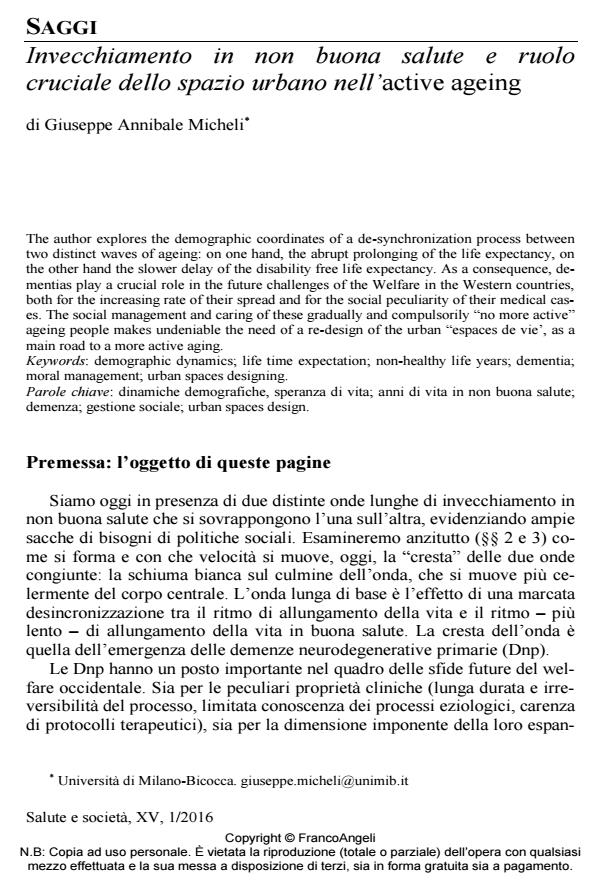
The author explores the demographic coordinates of a de-synchronization process between two distinct waves of ageing: on one hand, the abrupt prolonging of the life expectancy, on the other hand the slower delay of the disability free life expectancy. As a consequence, dementias play a crucial role in the future challenges of the Welfare in the Western countries, both for the increasing rate of their spread and for the social peculiarity of their medical cases. The social management and caring of these gradually and compulsorily "no more active" ageing people makes undeniable the need of a re-design of the urban "espaces de vie’, as a main road to a more active aging.

Parole chiave:Dinamiche demografiche, speranza di vita; anni di vita in non buona salute; demenza; gestione sociale; urban spaces design.

  1. Micheli G.A. (2002). Lo spazio incubatrice. In: Micheli G.A. (a cura di), La nave di Teseo. Anziani: l’identità nel cambiamento, Milano: FrancoAngeli, 91-112
  2. Micheli G.A. (2006). Autonomia strumentale e quadro clinico per età. In FNP-CISL Lombardia, Fuori dall’ombra. Indagine sui servizi di assistenza per anziani in Lombardia. Roma: Edizioni Lavoro, 57-84
  3. Micheli G.A. (2008). Controllare lo spazio interno, radicarsi nello spazio esterno. Come disegnare lo spazio del confinamento. Meridiana, 62: 91-113
  4. Micheli G.A. (2009). Sempregiovani & maivecchi. Le nuove stagioni della dipendenza e le trasformazioni demografiche in corso. Milano: FrancoAngeli
  5. Micheli G.A. (2010). Logiche affettive. Il potere di interferenza degli stati d’animo nella formazione delle scelte demografiche. Torino: Utet
  6. Micheli G.A., Micheli G.B. (2007a). Disegnare sistemi e spazi di cura per Alzheimer. Giornale di Gerontologia, LX, 4: 206-217
  7. Micheli G.A., Micheli G.B. (2007b). La compenetrazione di esterni ed interni per fronteggiare situazioni di confinamento. Territorio, 43: 121-128
  8. Mori F., Valla P. (1995). Il Giardino Alzheimer. Manuale teorico-tecnico per la progettazione e realizzazione di spazi verdi per anziani affetti da demenza. Provincia di Milano Norberg-Schulz C. (1983). Intenzioni in architettura. Roma: Officina
  9. Paci M. (2005). Nuovi lavori, nuovo welfare. Sicurezza e libertà nella società attiva. Bologna: Il Mulino Plas J.M., Lewis S. (1996). Environmental Factors and Sense of Community in a Planned Town. American Journal of Community Psychology, 24, 1: 11-21. DOI: 10.1007/BF0251188
  10. Proshansky H.M., Fabian A., Kaminoff R. (1983). Place Identity: Physical World and Socialization of the Self. Journal of Environmental Psychology, 3. DOI: 10.1016/S0272-4944(83)80021-
  11. Rau R., Rosoko E., Jasilionis D., Vaupel J.W. (2006). Ten Years After Kannisto: Further Evidence for Mortality Decline at Advanced Ages in Developed Countries. Max Planck Institute for Demographic Research, WP 33
  12. Ravaglia G. et al. (1999). Prevalence and severity of dementia among northern Italian centenarians, Neurology, 53: 416. DOI: 10.1212/WNL.53.2.41
  13. Riesman D. (1953). The Lonely Crowd. A Study of the Changing American Character. New York: Doubleday
  14. Skyaeveland O., Garling T. (1997). Effects of Interactional Space on Neighbouring, Journal of Environmental Psychology, 17
  15. Valla P. (2002). Casa Gradmann: un progetto avanzato a Stoccarda-Kaltental, in Valla P. (a cura di). Alzheimer. Architetture e giardini come strumento terapeutico. Milano: Guerini, 60-63
  16. Van Someren E., Hagebeuk E. et al. (1996). Circadian Rest-Activity Rhythm Disturbances in Alzheimer’s Disease. Biological Psychiatry, 40: 259-270. DOI: 10.1016/0006-3223(95)00370-
  17. Vercelloni V. (1990). Atlante storico dell’idea di giardino europeo. Milano: Jaca Book Ward C. (2000). Il bambino e la città. Napoli: L’ancora del Mediterraneo
  18. Altman I., Low S.M. (1992). Place Attachment New York: Plenum. DOI: 10.1007/978-1-4684-8753-
  19. Benasayag M., Schmidt G. (2003). Les passions tristes. Souffrance psychique et crise sociale. Paris:, La Découverte
  20. Binswanger L. (1955). Per un’antropologia fenomenologica. Saggi e conferenze. Milano: Feltrinelli
  21. Bliwise D. (1993). Sleep in Normal Aging and Dementia. Sleep, 16, 1: 40.81 Borroni A. et al. (2011). Prevalence and Demographic Features of Early-Onset Neurodegenerative Dementia in Brescia County. Alzheimer Disease & Associated Disorders, 25, 4: 341-344. DOI: 10.1097/WAD.0b013e3182147f8
  22. Bowlby J. (1969). Attachment and Loss: Attachment. New York: Basic Books
  23. Brawley E.C. (1997). Designing for Alzheimer’s Disease. Strategies for creating better care environments. New York-Chichester: John Wiley & Sons
  24. Brawley E.C. (2006). Design innovations for Aging and Alzheimer’s. Creating caring environments. New York-Chichester: John Wiley & Sons
  25. Brown G.W., T. Harris (1978). Social Origins of Depression. A Study of Psychiatric Disorder in Women. London: Tavistock Publ
  26. Consonni G. (1989). L’internità dell’esterno. Scritti su l’abitare e il costruire. Milano: Clup.
  27. De Masi G., Marcetti C., Solimano N. (1991). La città come disagio e come risorsa. In: AA.VV., Michelucci per la città, la città per Michelucci. Firenze: Artificio: 51-59
  28. Dörner K. (1975). Il borghese e il folle. Storia sociale della psichiatria. Bari: Laterza
  29. Fries J.F. (1982). Aging, Natural Death and the Compression of Morbidity. New England Journal of Medicine. 303: 130-135. DOI: 10.1056/NEJM19800717303030
  30. Gitlin L., Liebman J. et al.. (2003). Are environmental Interventions Effective in the Management of Alzheimer’s Disease and Related Disorders? Alzheimer’s Care Quarterly, 4, 2: 85-107
  31. Guaita A., Jones M. (2011). A “Prosthetic” Approach for Individuals with Dementia? JAMA, 305, 4: 402-3. DOI: 10.1001/jama.2011.2
  32. Jacobs J. (1961). The Death and Life of Great American Cities. New York: Ransom House Jacobzone S. et al. (1999). The Health of Older Persons in OECD Countries: is it improving fast enough to Compensate for Population Ageing? OECD Labour Market and Social Policy Occasional Papers, 37
  33. Jones M. (1999). GentleCare: Changing the Experience of Alzheimer’s Disease in positive way. Vancouver: Hurtley & Marks
  34. Jones M. (1970). Ideologia e pratica della psichiatria sociale. Milano: Etas Kompass Lynch K. (1960). The Image of the City. Cambridge, MA, MIT Press

Giuseppe Annibale MIcheli, Invecchiamento in non buona salute e ruolo cruciale dello spazio urbano nell’active ageing in "SALUTE E SOCIETÀ" 1/2016, pp 21-38, DOI: 10.3280/SES2016-001003